

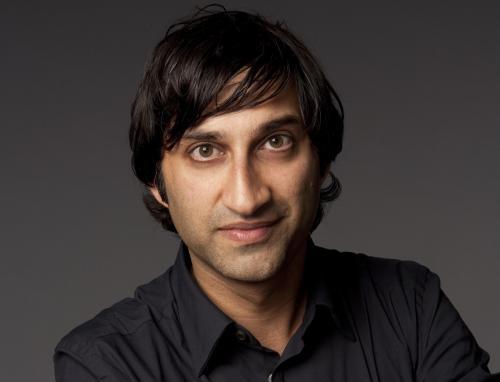
On March 20 CPH:DOX hosted a 90-minute conversation between Academy Award, BAFTA and Grammy winning British director Asif Kapadia and Thom Powers, programmer at the Toronto International Film Festival, co-founder of DOC NYC and host of the Pure Non Fiction podcast. The event was part of the Morning with Filmmakers initiative organised by the festival.
Powers first touched upon Kapadia’s body of work, which includes fiction, documentary and VR projects. The moderator reminded the audience that he had hosted a previous talk with Kapadia in Copenhagen four years ago, during which their dialogue focused on the doc trilogy made up of Senna, Amy and Maradona.
After being invited on stage, Kapadia spoke about his family background. He grew up as the youngest of five kids in East London and, despite his parents being “pretty relaxed about parenting” one of his desires was “to escape from his house” and “to look for a space of his own.” His family is Muslim and of Indian descent, he said.
He further explained how he never felt particularly safe outside of London, until he realised that being part of a crew could also mean being part of a community. “I was just making teas and carrying boxes, but then someone asked me to work on their graduation film in Cornwall, on the other side of the country. […] That was the first moment someone said ‘you’re useful, come to work on my film.’”
Speaking about the lockdown period, he described it as “a profound moment” during which he could reconnect with his family and watch many films with his kids, but also an essential in allowing him conceive his latest effort, Creature.
“Creature came along and it only existed because of Covid. Akram Khan [lead dancer and choreographer] created a show, and they couldn’t perform it because of Covid. Someone contacted me and said, ‘Would you be interested in doing something?’” Khan and Kapadia had met first at a panel discussion 20 years ago, when they were both at the early stages of their careers. “It took us 20 years to meet again,” Kapadia said, explaining that the whole feature was shot over a 10-day period and focuses on the rehearsals of the ensemble, which he described as “pretty mad and intense.”
The director highlighted how it has been creatively stimulating to work with restrictions in place (ironically comparing his effort to that of Dogma auteurs) and how the project was driven by passion at all levels.
Powers later asked Kapadia to talk through the challenges of framing such a dynamic, two-hour show over such a short time frame. The helmer said that he closely worked with his “brilliant AD” [Christiaan Faberij de Jonge] and only had a few cameras available, with no other crew members on site. Some cameras, moreover, “weren’t operative” as they were stuck in their positions. There were even times when Kapadia’s mobile phone was involved in the shooting.
“Essentially, we [were] starting from some ‘wides’ on Monday, and then on Tuesday we shot the first 15 minutes with coverage, on Wednesday the next 15 minutes, Thursday the same, and on Friday some special shots. On the second week, we moved on to Act II,” he revealed.
He pointed out how the music was always on and loud, so that dancers could “go with the flow” during their rehearsals and how the shots couldn’t be “broken up too much,” so his directing vision would never focus on single shots.
The project is the result of a strong co-operation between the English National Ballet, Khan and the filmmakers. Overall, Kapadia defined the experience as “a very small budget indie film but with great fun.”
One of Kapadia’s main references while working on this doc was Wim Wenders’ Pina, which he considers “his favourite 3D film.” Creature was cut by Sylvie Landra (best known for being Luc Besson’s editor) and places great importance on blackness and empty spaces.
Ultimately, Kapadia realised how dancers never thought about the camera, so his goal was mainly “to let them be” and “not mess with them.” Moreover, not too many words were spoken. For example, Kapadia confessed he’s never spent any time talking to the lead dancer, Jeffrey Cirio. Working on a drama, he would spend “ages” talking to his lead actor.
He hopes his next endeavour will be “a mix” of what he has learnt from fiction, documentary, archive and VFX, “everything, all at once.”
In the last part of the conversation, Kapadia disclosed that he might have never directed a documentary had it not been for Harvey Weinstein “killing” his first fiction feature, The Warrior. The film’s popularity remain limited to the UK as Miramax bought worldwide rights – excluding the UK – in 2001. The acquisition, he argued, was part of Weinstein’s strategy based on acquiring as many promising foreign films as he could so that the Oscar for Best International Feature was more likely to come his way. “Even now, that film can’t be shown around the world,” he underscored.
Kapadia didn’t trust Weinstein and didn’t feel good about the deal from the very beginning. Weinstein offered him a contract so that his next three features “had to be with him,” but the director refused to sign it, which determined the producer to “kill his film.”
He expressed strong criticism towards the way showbiz used to work (and still works), arguing this industry has been too much forgiving over the years. “Where are all this people who were happy to work with this guy [Weinstein]?” he asked the audience.
Kapadia also expressed his concerns over the viability of theatrical distribution for documentaries and the growing role of streaming platforms. “I don’t want cinema docs to only exist at film festivals or during award season. […] Award season is great, but it’s not everything. It shouldn’t be everything. There should be room for other stuff. What we have to watch out for as we have this rise of authoritarianism in politics is also a rise of a certain few people who make the decision about what we are about to see – everywhere in the world. Is that good? I don’t know.”





