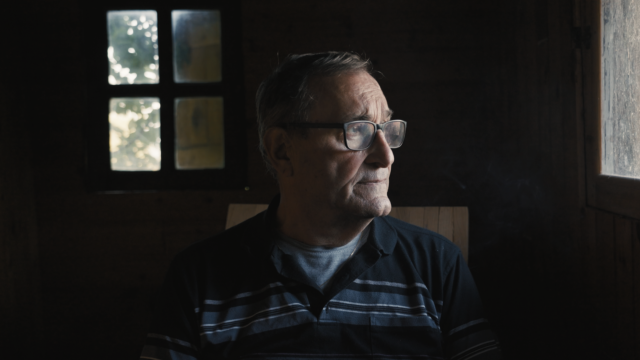
A powerful and desperately moving story of terrible abuse at a Catholic children’s school, Clémence Davigo’s The Lost Boys of Mercury (Les Oubliés de la Belle Étoile) is both revealing and cathartic as it goes about offering three men the opportunity to reveal what happened to them and discuss how they still feel unseen and unacknowledged by the Church.
Sitting just above Albertville in the beautiful Savoie region is the Catholic “correctional” facility of La Belle Étoile. Once wards of the nation as orphans and children of the DDASS (the former French social services), the trio of Dédé, Michel and Daniel lived there as kids in the 1960s and ‘70s. While there they were beaten, humiliated, shamed, sexually abused and perhaps ultimately broken.
Almost 60 years later, the three gather in a house overlooking the distant peak on which the Belle Étoile sits – it remains a nightmarish vision for the former boarders – as they finally reunite to break their silence and further attempt to break the still-powerful law of silence of the Catholic Church. They are just a few of the many who bear the indelible scars of their time in this place of terror, which was ruled by the iron fist of the man who still haunts them, Abbé Garin.
As they sit and watch old film of them going to church from June 1970, they dwell on footage of Garin, his face red “with blood and wine” as Dédé pithily comments. He adds grimly: ”I’d hang him…I’d snap his neck…he’s not a man.” Recounting their humiliations as children he adds that they don’t know why they were beaten. “Why starve us?,” he says. “Why the constant beatings? What was in their hearts to beat us all day long?”
In the house and garden the three men share food and drink, and talk about their pasts and what happened to them – Dédé became a career criminal and was jailed for 35 years; Michel tearfully talks about his fear of police and of being shut in a darkened room, while Daniel talks about the marathons he ran and the medals he received. At times they almost become children (even stiff-jointedly climbing into a tree-house) but always aware that a short distance away is Belle Etoile.
Their stories and comments are powerful. “Instead of learning at school I was wondering where I could find food,” says one, while another adds that he doesn’t blame his church or religion, just the people who abused him.
They sit and leave a message at the church’s support unit and eventually, alongside a handful of other survivors, meet with Jean-Claude Creps and Marie-Josephe Creps, the
family counsellors for the Archbishop at the Diocesan Centre for Savoie. The pair claim to have never heard stories about Belle Etoile, so the men recount the horrors they experienced, from one child whose eye was gouged out by a stick thrown at him by staff, to children who tried to escape but were returned and had heads shaved and were made to run naked in snow. There is also talk about incidents of sexual abuse. They ask how they can get recognition when all of the archives have disappeared. When the counsellors say that their testimonies will be communicated in full to the Bishop, the men ask to meet with him.
They eventually do get to sit down with the Bishop, but while he tries to assure them that he does recognise what happened to them there is no formal admission of guilt or recognition from the Church. It is plainly frustrating for the men, but while there is clear pain in terms of what they have revealed there is also a strong sense of comradeship that has helped given them much-needed strength and understanding. The last surviving “bastards” have bravely spoken of their ordeal, but breaking the still-powerful law of silence of the Catholic Church is clearly another matter.
France, 2023, 106mins
Dir: Clémence Davigo
Production/sales: Alter Ego Production, Lyon Capitale TV, in association with Tënk and Mediapart / Int Sales: Andana Films
Producers: Elise Hug, Cécile Lestrade
Screenplay: Clémence Davigo, Anne Paschetta
Cinematography: François Chambe assisted by Cyril Pedrazzini
Editor: Lou Vercelletto
Music: Benjamin Gilbert
With: André Boiron, Michel Guibourt, Daniel Rabiah, André Bovagnet, Jean-Claude Creps, Marie-Josephe Creps