

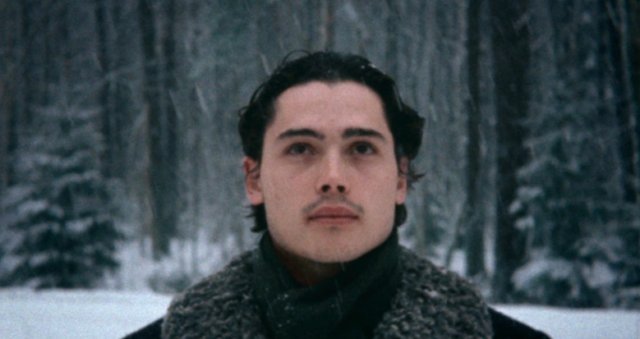
Catarina Mourão’s new documentary Astrakan 79 (a world premiere in Burning Lights competition) looks at an extraordinary, long concealed chapter in the life of its protagonist, Martim Santa Rita Masasri. Martim is now in his late 50s but when he was 15, he went to live and study in the Soviet Union, in Astrakan.
His parents were die-hard communists and he shared their political convictions. Once he arrived in Russia, the Portuguese teenager lied about his age (he said he was 18). He discovered sex and alcohol – and he fell deeply in love. Matters, though, did not pan out as he had hoped. He came home to Portugal earlier than he should have done, bearing psychological scars which didn’t heal easily.
Mourão knew Martim through her family. “He is the brother of the husband of my sister,” the director explains the connections. She had heard vague accounts of Martim’s time in the USSR but didn’t have the full story.
The director had made an earlier documentary, 2015’s The Wolf’s Lair, which looked closely at secrets she had discovered within her own family. “It’s a story very much in the context of the Portuguese political dictatorship. During the process of making this earlier film which is about the dictatorship and family taboos, I realised after the revolution that there were other taboos connected with [the] revolutionary process.”
Mourão had then been planning to make a film about her communist uncle’s experiences as a political prisoner. Covid intervened making this project too difficult to pursue. She therefore switched her attention to Martim.
“I decided to ask if wanted to tell me more about it [the time in Russia] because I knew that within his family, his brother, his parents, it was something people spoke vaguely about but not up front about. It was also a taboo.”
Martim agreed to share his memories on camera. He was willing to be interviewed but wanted to speak in a place “that wasn’t home…he felt more comfortable to open up in a kind of abstract place.” That’s why the film opens in a near empty house with a strange, ghostly feel about it.
On one level, Astrakan 79 is a coming of age story – a poignant and sometimes funny account of the adventures of a European adolescent in the land of the Soviets at a formative moment in his life. At one stage, director Mourão contemplated going to Russia, but with the war in Ukraine, that wasn’t going to be possible. “And I thought it was much more interesting to keep this kind of fantasy of this time.”
Martim is shown on camera talking about his Astrakhan experiences with his son (also called Martim). “It is the first time his father is really telling him the whole story,” the director notes. There’s an extra layer of mystery in that the son “also has a secret to share.” That secret is revealed toward the end of the documentary.
“The film is really about coming to terms with your identity, your past, your life and also challenging these taboos,” Mourão explains why the documentary includes such personal material about the son. “Father and son meet in this strange world created by the film.”
Mourão was able to draw on a treasure trove of archive photos, postcards and letters to depict Martim’s time in late 70s Russia. She also uses reconstructions in which Martim as a teenager is played by his own nephew. “It was all in the family,” the director says of this footage, mainly shot on 16mm.
Martim now works as a potter and ceramic artist. “I think there’s a level of restlessness [about him]. I wouldn’t say he is a tortured person but I think there is still something of a trauma that is still revisiting him…I could feel while he was telling us his story, he became very emotional at times. There was a kind of ambiguity of leaving this woman behind [in Russia] and, at the same time, blaming his parents for letting him go [there] so young.”
The director believes he chose to “lead this quiet life doing his ceramics” as a way of dealing with the complexities in his private life. His wife features briefly in the film, holding the ladder as he prunes a tree. That image is “quite symbolic…she is sustaining and grounding him in a way.”
Mourão’s previous films have generally had women protagonists. She sees Astrakan 79 as dealing with changing ideas about masculinity. “Martim the son has this female side but also Martim the father is talking about his emotions and how it is still not welcome for a man to cry.” She regards the documentary partly as a love story. “It’s about choices you make and the encounters you have in your life that form you.”
There is an interesting coda to the project. Making the film emboldened Martim to track down the woman he had fallen in love with in Russia all those years before. “Life is full of ironies. He found her and she was living in France. They spoke [on a video call] and in the background, she had a poster of Marie Le Pen [the nationalist and right wing French politician]. He was appalled. He was, like, oh my god, history is so weird!”
Astrakan 79 is supported through Portugal Film – the Portuguese Film Agency who will oversee its release in local cinemas along with the film’s production company Terratreme Filmes.
Mourão is now turning her attention toward fiction. Her next project Ivy, which she pitched recently in the Berlinale Coproduction Market, is about a woman in her 40s in Lisbon trying to start a new life.
“It’s a personal story,” she explains. “It’s also a coming of age story but more of a coming of middle-age film…”





