

It’s a horrible kind of limbo. You’ve lived your entire life in a country; you’ve studied there, paid taxes and maybe even bought a house and started a family. All the time, though, you know you can be deported. This is the plight that faces the ‘dreamers,’ the estimated 2.5 million undocumented immigrants brought to the US as kids.
Dreamers, the new documentary by Swiss filmmakers Stephanie Barbey and Luc Peter (which world-premieres in Burning Lights Competition in Nyon) focuses on the experiences of Carlos, now in his late 30s and who came to the US from Mexico when he was a kid. He is a proud and resourceful man who had a successful career as a professional footballer and now works as a building superintendent. However, he still feels the constant creeping dread that everything will be taken away from him. Meanwhile, his family are still struggling to cope with the emotional devastation they experienced after Carlos’ brother was sent back across the border.
Barbey and Peter first met Carlos around a decade ago when they were in Chicago, scouting for their earlier film Broken Land (2014), about Americans living close to a huge fence put up to stop Mexican immigrants entering the country. Carlos told them his story. He was both intimate and intense.
“The way he speaks is made for cinema in a way,” Barbey says of Carlos. They didn’t use him in the previous documentary (which ended up entirely set in Arizona) but after the virulently anti-immigrant Donald Trump was elected President, they decided to revisit him.
“He [Carlos] never left us in our heads and when Trump came to power, we said we have to go back to immigration and tell this story,” Barbey says.
“We thought this story is strong we have to tell it,” Peter adds. “For us, it is very important to get the confidence of the people [in the documentaries] and so we see them many times before filming. We need to get in touch very deeply with them. That’s why it took time.”
The project was pitched at Vision Du Réel in 2019 and has been made over the last four years.
Carlos was keen to participate in the film. He felt that talking about the plight of the ‘Dreamers” would help audiences understand their nightmarish situation. His eloquent and haunting voice-over runs throughout the documentary.
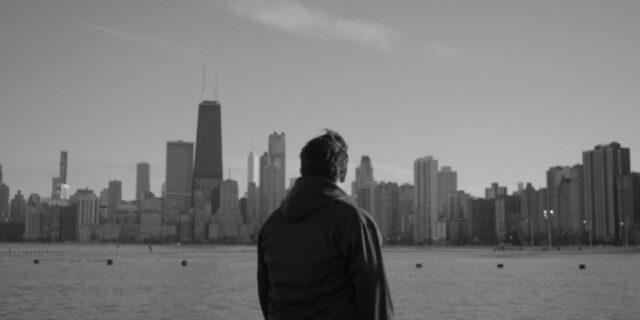
The film is made in black and white. “All these lives are in the shadow, people without a real life. They work, they pax taxes but they always have to hide in a way and to be very low key,” Peter explains why the filmmakers didn’t use colour.
Perhaps surprisingly, his lack of documentation didn’t get in the way of Carlos’s college football. His sporting career ended because of injury and because he had to make a living. He now works very successfully in construction. He is heavily in demand, with different companies vying to employ him. Other ‘Dreamers’ have had equally successful careers. One was a journalist at the New York Times.
“You’d be very surprised, There are ‘dreamers’ in top positions [in American society],” Barbey says. These people, though, still have to “live under the radar” in the knowledge that if they get into the slightest bit of trouble, they’ll be deported to a country they barely remember.
“What we really love about him [Carlos] is that he is not complaining. It is a terrible story but he is very strong…but inside you feel he is really hurt,” Peter observes.
The filmmakers don’t show the brother who has been deported. His voice is heard but he is never seen. This makes it easier for the audience to understand the huge sense of loss experienced by Carlos and the rest of his family. It’s impossible for them to visit him.
Can the documentary be used as a tool to raise support for its subjects?
“Why we did the film was for the dreamers. This is the drive. If the film can help, this would be the perfect situation. My dream is that this film would be useful to their cause,” says Barbey.
Peter, meanwhile, talks of giving a voice to people who are too often treated just as “numbers, just statistics.”
“America was built on immigration,” Barbey reflects on how strange it is that the country now behaves so cruelly to the dreamers. “These people are American…for these 2.5 million, I don’t understand why there is no legal regularisation of their status. It’s absurd, really absurd.”
Dreamers was made through Intermezzo Films. The Swiss release will be handled by Zurich-based Xenix Filmdistribution. International sales are handled by Lightdox.
Barbey’s next film will be made closer to home – and will look in a very personal way at the legacy of European colonialism. The working title is Totemic. Peter will be producer.
“It’s about totem poles which were actually bought by my great-grandfather,” she explains. These poles were taken from a tiny island in Alaska to Switzerland. They’re huge objects, around eight metres high. Now, Barbey wants to give them back – and make a documentary about their return. She has some very strong archive material shot on 16mmm by her great-grandfather which will be included in the film.
“I grew up in his house with all the objects. When he died, everything went to the museum. Now, I’ve decided it’s a heavy heritage and a big responsibility. I’ve lost everything but I went to the museum and started asking about the poles. Now, we are working on it, to send them back…it’s in the pipeline. It’s not done yet.”





