

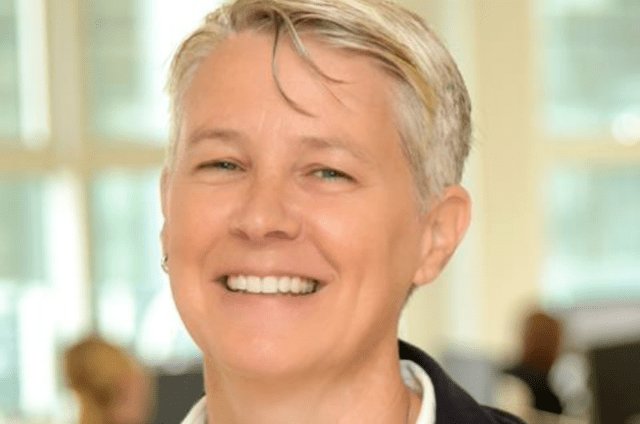
“It was fairly unexpected shall we say,” Emma Hindley reflects to Business Doc Europe on the unusual circumstances which led to her being appointed as Lead Commissioning Editor at BBC Storyville (the strand that showcases the best in international documentary).
Hindley is a seasoned doc exec and a former Creative Director at Zinc Media Group. Her production credits include Suffragettes with Lucy Worsley, David Harewood: Psychosis and Me and Tom Daley: Illegal To Be Me. She had been freelancing at the BBC last summer when she was suddenly asked to look after Storyville following the departure of the previous Head, Philippa Kowarsky.
When the Storyville call came, Hindley’s response was: “yes, of course, I’d love to do it.” She already knew Storyville commissioner Lucie Kon with whom she had worked on Deborah James: Bowelbabe In Her Own Words, a documentary covering the last five years of the eponymous cancer campaigner. Hindley exec-produced the doc.
From August 2022 until the end of the year, Hindley did the job on an “interim” basis. Then, when the Storyville position was advertised, she applied and was delighted to be appointed on a permanent basis. The announcement was made in January 2023. After all her years as a successful producer, this meant she was a “poacher turned gamekeeper,” as she puts it.
“I really love it. It’s the best job in the world. It’s amazing,” the exec enthuses. “You get to co-commission. You get to co-fund with all sorts of different people. You work with hugely talented filmmakers and editors…As soon as I started doing the job, I thought wow, this is amazing. I had always viewed Storyville from afar and thought it was a real jewel in the crown at the BBC.”
Not that BBC Storyville is a big operation. “It’s a very small team. It is just Lucy [Kon] and me and a shared team assistant and an amazing person who works in delivery.” Storyville is now part of BBC “Unscripted” (led by Kate Phillips), having previously been under the umbrella of BBC Film.
To outsiders, the internal politics of the BBC can sometimes seem daunting but Hindley has dealt easily enough with the bureaucratic side of the job.
“I am incredibly enthusiastic about working for the BBC because I have been on the outside for a long time,” she says. “The bit I am working in is incredibly well managed. Yes, there are various hoops that projects have to jump through and certain types of paperwork [to do with] compliance and editorial policy – but actually I am really pleased about that. We check our films in a way I don’t think any other broadcaster does.”
Storyville looks to broadcast between 20 and 24 feature documentaries each year. Most go out on BBC4 but some (for example Bowelbabe) are shown on BBC2 while others, primarily those angling for a younger audience, turn up on BBC3 (for instance, Lizzo Live In Concert and Love, Lizzo). “I just want to get the Storyville branding on to all sorts of different ages and eyeballs really. I am trying to grow the audience in every different direction,” Hindley says of how the documentaries are increasingly popping up on different channels.
Storyville has around £2 million a year to invest across all its activities. Ever since Nick Fraser launched the stand in 1997, its emphasis has been on co-production. (It’s rarely in the position to fully finance projects).
“We tend not to come in on things until they have got 50% of their budget confirmed. We certainly don’t sign any paperwork until they’ve got 50% confirmed, but we also pre-buy and we acquire,” Hindley explains. “At the moment, the slate is a big mix of mainly co-commissions and acquisitions.”
The Storyville team will agree a “hold-back window” early on with filmmakers who are looking to launch their films at festivals and get them into theatrical distribution.
“Obviously, I am going to support all filmmakers to get their films into as many festivals as they can, get them on awards lists and all of that,” Hindley states. She and Kon will also talk to distributors and sales agents about “trying to have as narrow a window as possible between the release in the cinema and on TV…the problem is that with the few papers that do review feature docs, they tend to review the cinema premiere and they don’t bother with the TV one because they’ve already done it. We are trying to get around that by closing the window as much as possible.”
Hindley tries to make sure that Storyville isn’t too UK-centric. “We need to hear brilliant international stories beautifully told. That is what Storyville has always done. I am talking to UK filmmakers about UK subjects but I think we will show less of those. There are always going to be some but we are not focusing in that direction so much partly because there is a very healthy documentary industry in this country…”
In recent months, the strand has supported, among others, Dutch docs (Three Minutes : A Lengthening), Swedish docs (Nelly And Nadine), US docs (Attica) and Israeli docs (Blue Box).
Since taking the helm at Storyville, Hindley has been travelling almost non-stop. One of her predecessors, Mandy Chang, gave her advice which she has been following.
“She [Chang] said in your first year go to all of the festivals that you are asked to. That’s what I am doing. It has meant it has been quite exhausting and that I haven’t seen much of my kids but that is what I have done,” she says of her recent globetrotting through which she has “tried to put names to faces” and ensure that she is well known within the European industry. Ports of call have included Nordic Panorama, Sundance, Berlin, Hot Docs, CPH:DOX, Docs Ireland and various points beyond. “I’ve got to get my face out there and get to know people. People have to get a feel of the films we are interested in. I’ve got to meet filmmakers, meet broadcasters.”
On a recent trip to Israel for CoPro 25, the BBC exec told the Israeli press that she was looking for “funnier” documentaries.
“I think the tradition of docs can be a little bit earnest,” she elaborates on her call for more humour. “Obviously there is a place for really important, serious documentaries,” she acknowledges, but argues strongly for films which set out to tickle as well as enlighten and provoke their audiences. “Serious, dark stories” are all very well but she also wants Storyville viewers to be entertained.
Another of her passions is for observational documentary. “From my own experience, they’re the hardest film to make. There is nothing like being in the room when something is happening rather than being told what is happening.”
Storyville had several projects at the recent Sheffield Doc Fest among them Dalton’s Dream, directed by Kim Longinotto and Franky Murray Brown, about young pansexual Jamaican singer Dalton Harris won UK TV talent show The X-Factor in 2018.
Does the Storyville boss have any tips for filmmakers pitching to the strand?
“I’ve always been a very out lesbian in this industry and I think it has done me some favours and a lot of…not favours. I am very much for promoting diverse teams making stories about diverse subjects. Diverse is a very broad term but anybody who is from one of those minority groups understands exactly what I mean by that,” Hindley says. She also flags up the Storyville “portal.” Don’t email her directly because she doesn’t always have time to read her messages but submit your material into this portal. That’s where it will be looked at and considered, she says.
“Brilliant stories brilliantly told…the subject can be anything,” Hindley sums up the never changing Storyville ethos. “In a way that is the beauty of Storyville, how eclectic the range is. There is something for everybody.”





