

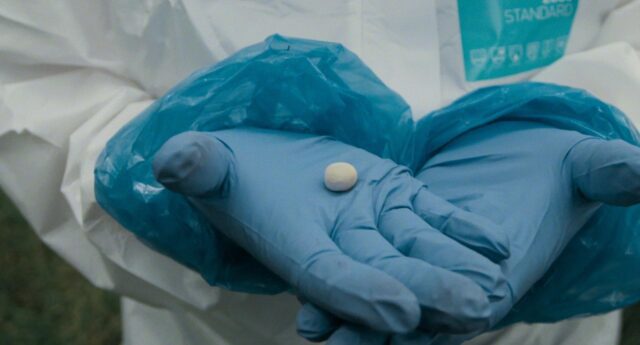
No, it’s not the director’s own kidney stone. The narrator in Sofie Benoot’s new hybrid documentary Apple Cider Vinegar (which screened this week in CONNEXT) is a famous TV naturalist who also has just had the stone removed. They can be very painful and come in all sizes. Some can be as big as tennis balls. This one looks like an old ball of chewing gum.
“But I wanted to do something about stone in general. The subjects that interest me are more ecological topics and I feel that stone is left out of all the stories about the natural world. They are always about the green part and never about the stone part. I was interested how we as humans relate to this matter that we call dead. We always say that stone is silent, it is dead. I wanted to do something opposite and bring it very much to life. The kidney stone is a metaphor for that.”
Detective Lorna Dawson is assigned to investigate the kidney stone. She is a real-life figure, known as the “mineral” detective, who has cracked some very high-profile cases involving killers and rapists. Dawson discovers that the stone contains trace elements of Weddelite only found in the Weddel sea close to Antarctica. The idea here is that in something very small (in this case a tiny stone) there might reside a huge mystery.
The TV naturalist has a soothing, quizzical and somewhat ironic voice. It belongs to Dame Siân Phillips (star of such classic TV dramas as I Claudius and films like Dune and Clash Of The Titans).
“I wanted a British voice,” Benoot explains the choice of Philips who is now in her 90s. The naturalist is like a female equivalent to David Attenborough, the patrician BBC presenter who seems to some fans like the voice of god. “I just googled all the ‘Dames’ and I loved her voice. And she loves doing voice-overs,” the director says of Phillips.
The narrator wants to unravel the secrets behind the stone. What starts as a story about someone with a commonplace affliction turns into an essay on ecology, loss and the mystery of things.
At certain points, the voice-over interacts with characters in the film. That’s a break from usual narrative convention but again lends a gently ironic note.
This is an eco-documentary but it isn’t one of those earnest affairs like An Inconvenient Truth which lectures viewers on the dangers of climate change. Instead, Benoot is trying to provoke audiences to look at environmental issues from a new perspective. “Humour is always a great connector to make people think about things they haven’t thought about before.”
The TV naturalist in the documentary is retired. She no longer travels the world in search of rare gorillas or near extinct reptiles. Instead, thanks to the wonders of digital technology, she can watch the animals from her home in fuzzy footage on webcams. “I find it very interesting how people sit for hours and hours behind a screen sometimes, waiting for an animal to appear…it’s like holding a wake for this planet.”
The film was shot in Palestine, Cape Verde, the UK and the US. It has VAF support and was made through Inti Films. Peter Kruger is the producer. Among the co-producers is Dutch outfit Pieter van Huijstee Film.
This has been a very long gestating project, first conceived almost a decade ago. The title itself is tongue in cheek. “Mostly titles compromise the film…I wanted something that had nothing to do with the film,” the director explains but qualifies her remark. Apples, cider and vinegar are indeed considered a useful cure for kidney stones. “I like to have something [as a title] out of the blue. My producer says it is an unsellable title! We will see about that…”
Benoot combines her filmmaking with working as a tutor and mentor to aspiring local and international documentary makers at Masters level at Sint-Lukas film school. “I guide them along, help them reflect on their work and [we] find solutions together.” Those she had advised include Sarah Lederman, a young documentary and fiction director chosen at this year’s CONNEXT as one of the Lukas Dhont’s “Future Five” fast emerging Flemish talents to watch.
How easy is it to combine the film school work with her own filmmaking? Benoot sighs at the question. “Hard…but we have to. But it is so rewarding actually to get into contact with all these young voices. I learn as much from them as they from me – and so it is an exchange.”
Ecological concerns and questions about how humans relate to landscape have increasingly slipped into Benoot’s films.
“This film is quite personal because I had quite a lot of anxiety around the subject [of climate change]. It enters my dreams. I feel that we need a new way of storytelling to relate to these times,” the director says of Apple, Cider, Vinegar. She is intrigued by the Japanese belief in animism and the idea that objects like stones have their own spirits.
“There was a time when I was going to shoot in Japan as well but then Covid happened and Japan was locked for three years and so I couldn’t [go there], but there is indeed this whole idea of animism that is present in the film as well…I hope that when people see it [the film] that after they exit, they don’t look at stone in the same way for a while.”





