

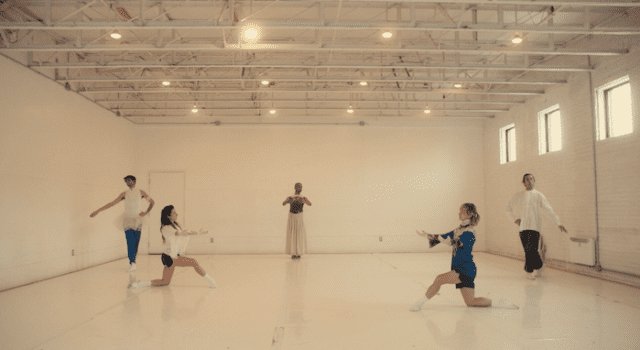
Suite Canadienne is a ballet originally created in 1957 by Ludmilla Chiriaeff, founder of Les Grands Ballets Canadiens, and broadcast on Canadian TV the following year. Visual artist and choreographer Adam Kinner was commissioned to create a new performance based on the work. Prolific Canadian filmmaker Olivier Godin’s documentary Suite Canadienne (screening in the International competition at Doclisboa) shows Kinner and his dancers at work.
“That piece [the Chiriaeff version of Suite Canadienne) is not well known to anybody. I knew of it because I know of Adam’s work. He has been working on that for years. [But] because of the pandemic, he learned he wouldn’t be able to make a show out of all the work he had done,” Godin explained how he became involved. Kinner had grants for the production he would no longer be able to stage. He therefore proposed that Godin use the money to “document” on film the work that he and the dancers had been doing.
“I had the time, the timing was perfect and a few days later I was shooting with him,” the filmmaker recalls how quickly the project came together. He knew Kinner as a saxophone player, and had used him to do music on a couple of his earlier movies. “We have this friendship. I knew he was a bit of a dancer…he’s very lanky with a long, interesting body for being a contemporary dancer. I was more interested in his music to be honest, but I was fascinated by the project when he showed me the Chiriaeff piece and talked to me about it.”
Godin is an experienced director who has made several dramatic features and shorts, among them Irlande cahier bleuand The Art of Speech. There have already been retrospectives of his works. However the collaboration with Kinner marked his first steps into non-fiction.
“I had never done a documentary before. I thought, OK, let’s try things,” Godin says of his freewheeling approach to the task. It helped that Kinner gave the director ‘carte blanche’ to approach the film in any way he saw fit.
Godin filmed the dancers rehearsing over a period of several weeks. These performers come from a variety of backgrounds. Some have stepped away from classical ballet but still like to perform. He relished the speed at which he was able to work. There were none of the delays he was used to with his fictional work. He had “inherited” a budget from Kinner and was able simply to get on with it, without having to make grant submissions or pitches to funders.
It wasn’t as if there were huge resources. Godin had enough financing to rent the equipment and pay for time. But he had full creative freedom.
“At first, we almost did not film them [the dancers] full frame. At first what I wanted was small moments and to work on movement and the dynamics of the movement. But what helped was that the piece Adam was working on was 20 to 25 minutes. During a rehearsal that would last a couple of hours, they would do it [perform the piece] four or five times.”
The repetitions meant that Godin quickly came to know the work inside out. He was doing the sound and sometimes the camerawork as well. “We knew what we wanted to get…we were using mostly available light from the windows.”
When they realised they weren’t going to be able to perform to the public, the dancers organised to stage their show in front of 15 people (the maximum number then allowed under Covid rules). “That is what I filmed. Adam invited some people from the dance community [to attend].”
In the film, audiences are given hints about the complexities behind Chiriaeff and the sometimes problematic nature of her legacy. “There are lots of things like the representation she did of Quebecois identity, that are quite insulting today. But if you put it in context, it kind of works and kind of makes senses,” the director reflects on the history behind the original Suite Canadienne.
Chiriaeff was very positive about Quebecois identity and “positioned herself in quite an interesting way” (as the director puts it) in the debate about Quebec’s relationship with Canada. What was controversial, though, was the way she recruited young dancers from orphanages because she couldn’t find male performers elsewhere.
In the documentary, contemporary choreographer and dancer Marie Claire Forté talks about how Chiriaeff is regarded today. “She (Forté) asks the question – what was she (Chiriaeff) thinking about? Was she trying to make something that would please the audience? How personal was it for her to think about something (Quebecois identity) like that? These are unanswered questions…the actress we hired to play Ludmilla, the things we make her say are things she [the real character] actually said. She views Quebec identity in a very positive light.”
The film is a world premiere in Doclisboa. The next step is to show the film in Canada and is expected to premiere in Montreal next month. Members of Quebec’s dance community are very keen to see the documentary and Godin is intrigued to see their response. “And for the Portuguese audience, I am hoping that the playfulness – there is a lot of humour in it – will carry the film [for them] even if they don’t get the historical context,” the director says.
Meanwhile, having made his first documentary, Godin is open to continue working in the form.
“I just released a fiction film that is still playing in Montreal…but I really enjoyed making the documentary,” the director observes. “Yeah, of course, I would like to make another documentary if the subject is right!”





