

Thaxted is a small, sleepy town in Essex but it is a place also deeply steeped in history and intrigue. It has a magnetic pull on filmmakers.
This is where Italian auteur Pier Paolo Pasolini shot part of his raunchy 1972 Chaucer adaptation, The Canterbury Talesand where the legendary Boulting brothers made their documentary Ripe Earth just before the war. British Carry On star Sid James was seen pulling pints as the pub landlord in 1952 comedy, Time Gentlemen, Please!, shot in Thaxted.
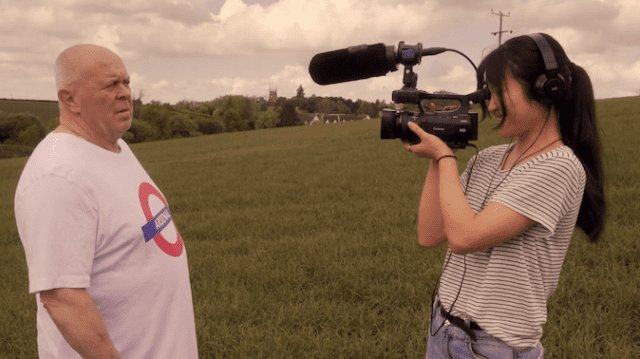
Marc Isaacs’ playful new documentary This Blessed Plot (a world premiere in Doclisboa’s International Competition) mixes fact and fiction, and even introduces a ghost or two, as it looks into the community’s rich and surprising past, its Morris dancing and its tradition of Christian socialism. In the film, a Chinese filmmaker, Lori, turns up in town with her camera. She meets some very colourful characters (played by non-actors) who share some of their secrets and longings.
Isaacs was working from a script by Adam Ganz (who also collaborated with him on The Filmmaker’s House, a 2020 project again straddling documentary and fiction and which the director made in his own home with a cast full of characters connected to his real life).
“We used to teach together at Royal Holloway University (London) and so that is how I met him originally,” the director says of his collaborator.
Isaacs continues to teach and recently launched a “documentary fiction” course at UCL. Over the years, he has taught several Chinese students. He has always been intrigued by how they regarded the UK. “I got really interested in how they were thinking about English life from a very different perspective.”
Yingge Lori Yang was one of his former students. She hadn’t acted before. “She came to do a presentation to my students of her graduation film and I really liked the film she had made. I helped her to finish it, got to know her a bit and thought she would be good for this role.”
The burly Arsenal FC-loving Keith Martin, who appeared as a builder in The Filmmaker’s House, had moved to Thaxted. Isaacs and Ganz went to visit him. While there, they discovered facts about the town that startled them. For example, they hadn’t realised that composer Gustav Holst had spent a lot of time there and was close friends with Conrad Noel, the very progressive vicar of Thaxted. Holst wrote some of his best-known works in the town and is said to have regarded his masterwork, The Planets, as a musical portrait of Thaxted.
“I was already thinking about Englishness, mythology and the way that the country over the last few years has desperately been trying to solidify some sense of itself,” Isaacs reflects on why he wanted to make This Blessed Plot. “We were also thinking about ghosts. One idea we had early on was that Keith’s character would be grieving the loss of his wife.”
Keith hasn’t lost his wife in reality. He’s a macho, self-confident man but Isaacs felt it would be intriguing to portray him in a more vulnerable state, as someone grieving. Susan Mallendine, who plays his wife appearing from beyond the grave to Lori, had also featured in the director’s 2007 documentary, It’s All White In Barking. She had suffered bereavement herself.
“We started to think a lot about ghosts in films but also film itself as a ghost,” the director explains.
Keith’s ‘uncle’ character is played by one of his close friends who had indeed been in prison for real for money laundering – and had also once left a bag of cash at Keith’s house.
There is a sense of boxes within boxes about parts of This Blessed Plot. Isaacs is filming Yingge Lori who herself has a camera and is filming people and events in Thaxted. Much of her material features in the film. She spent three days in Thaxted on her own. “She was really intrigued by the place, a small English village, and got really immersed in it. She had independent relationships with some of the people there…I think her view of the town changed over time from one that was slightly one-dimensional at the beginning but that deepened over filming.”
Isaacs talks about “trying to avoid the obvious” and of uncovering the hidden folk history of the town.
“The film was made for very little money, a little bit from here and a little bit from there. Some was money I made [from] my previous films…our total budget was something like £30,000,” the director says of budget. It was hardly a king’s ransom but it gave Isaacs a creative freedom that might not have been available if commissioners and broadcasters were breathing down his neck.
As for the blurring of lines between documentary and fiction in his work, Isaacs insists that he simply sees himself as making ‘films.’
“I think the boundaries aren’t so important to me in one sense. But in another sense, I really enjoy working with non-actors, ‘real’ people, and finding ways to draw on their sometimes ‘real’ stories…and some of it is very pragmatic. I like my conversation with reality to unfold as I am making the film and I can introduce things that I might have missed or have thought of if I was sat at home writing. The whole method keeps it, for me, very fresh. The process of discovery can go for a year sometimes.”
This Blessed Plot will go on to IDFA after its Doclisboa premiere. Verve is handling the UK release while Andana is in charge of world sales.





