

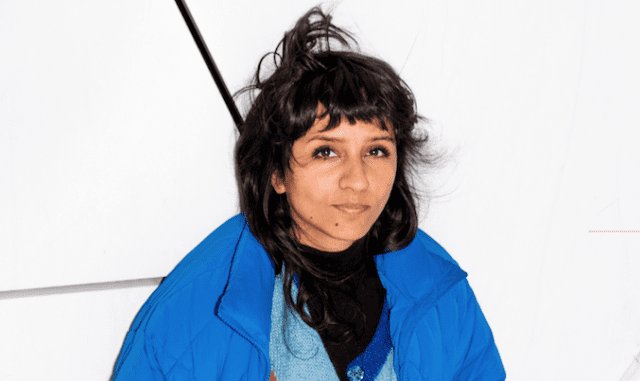
Last year, Niki Padidar’s film All You See, a playful and provocative look at the experiences of immigrants in the Netherlands, was the opening film at IDFA. This year, Padidar is back at the festival in a new guise, as curator of the Youth Competition selection.
Padidar, who was born in Iran and came to Holland as a seven-year-old kid, has always had an interest in younger audiences. She graduated from the University of Amsterdam after specialising in “youth and media.” Her 2015 short Ninnoc won Best Youth documentary at IDFA. Early in her career, she worked on kids’ programmes for the public broadcasters, covering everything from news to human interest. She is therefore very well qualified to be a “fresh pair of eyes” on IDFA’s youth programming.
“I think I watched about 250 films,” Padidar says of the many hours of viewing that went into choosing the 15 or so titles in the competition. One set of films is aimed at 9 to 12-year-olds, while the other targets older kids, aged over 13. “They [IDFA] gave me a little more freedom. I was allowed to watch adult films and to consider those too,” she adds.
The one requirement was that any title in the Youth Competition had to be a Dutch premiere. “That gave me more room to look around,” Padidar says, citing documentaries like Medhin Tewolde Serrano’s Nyanga, an animated story about a young man kidnapped and forced to work in the Mexican plantations; the French doc The Sketch, about a young transgender filmmaker who moves from Brazil to Paris, and Polish director Katarzyna Miechowicz’s surrealistic Headprickles.
Some films aimed at the teenagers deal with tough subjects. For example, the Polish doc Sister Of Mine is about teenage drug addiction. “This film is intriguing because it’s very layered. There is no victim or perpetrator. No oversimplified reality like in most youth films. But a raw family portrait in which you get to experience the subject through different points of view,” says Padidar
Dutch films are well represented in Padidar’s selection. One title bound to intrigue viewers is Sebastian Mulder’s And A Happy New Year which looks at the New Year’s Eve firework celebrations from the point of view of a small army of often terrified dogs, equipped with GoPros.
“It’s a simple concept. They put cameras around the necks a lot of pets. But somehow, it really makes an impact,” Padidar reflects on as film which goes far beyond the simple novelty of having canines do the camera work. “It’s a festive day we all know, but it is seen from a totally new angle. Just by the way of the dogs looking up to us instead of us looking down on them and you can really get a sense of what they are looking at, what they are reacting to. The sounds of the fireworks get worse and worse and the dogs get more and more scared…I thought it was a smart, critical way of looking at us humans and how we affect the planet.”
Padidar hopes that another of the Dutch selections, Jonas Sars’ Figure, will inspire a new generation of young filmmakers. Sars made this stop-motion animated short on his own in his bedroom. His brother Justin helped with the music.
“I really wanted the selection to be diverse in terms of types of documentary and types of storytelling,” the curator reflects. Sars was 19 when he made Figure. Padidar describes the film, which features a wooden mannequin trying to move and escape the static world in which it has always been caught, as being about “identity and broadening your horizons…I thought what an interesting way to look at that subject instead of putting somebody on a chair and having an interview. I hope it will be inspiring for children. If they see it, they will [think] ‘oh, I can make a film and it can end up at IDFA!’”
Some of the films in the selection come from big name directors. For example, Girl Away From Home, about a young Ukrainian gymnast who moves abroad after the war breaks out, is directed by Simon Lereng Wilmont and Alisa Kovalenko. Last year, Wilmont received an Oscar nomination for A House Made Of Splinters.
However, Padidar points out that when she was making her selection, she deliberately ignored the credits. “Actually, I tried to watch the films without watching the titles and knowing who [the directors] were. I like to watch things without prior knowledge so I won’t be influenced by that sort of information. This ended up on the shortlist because I thought it was really well told…It’s a captivating short story about a girl leaving Ukraine and then actually feeling homesick, wanting to go back although there is a war.”
Padidar adds that she was always looking for authenticity in the films she chose. She sees double standards when it comes to the financing of youth documentary. Everyone says how important it is to make films for younger viewers. “But I don’t see that reflected in the industry enough. If you work for children’s TV, you get paid less than if you work for adult TV for instance. There are opportunities to get funded for youth documentaries but they are less than for regular documentaries.”
Padidar also calls for youth docs to be better distributed and shown in more prominent slots at festivals.
Overseeing the Youth Competition has meant that the director has had to take a step back from her own projects. Nonetheless, she has enjoyed the experience and relishes making work for younger viewers.
“I would love to do something for youth again. I have never seen it as a stepping stone. I really like the audience, because they are brutally honest. With adults, you can get away with using big words and metaphors that nobody understands and won’t admit they don’t. But with children, they will never put up with that! They challenge you to be really good at what you do – and when you reach them, it is really rewarding,” Padidar ends.
This article was previously published in See NL, a collaboration between Eye Filmmuseum and The Netherlands Film Fund.





