

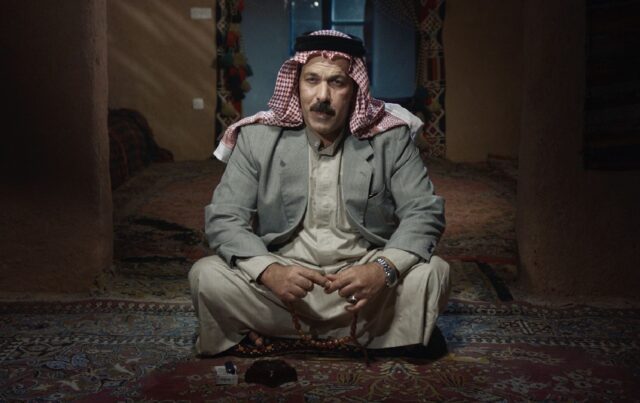
It’s now almost exactly 20 years since Saddam Hussein, the toppled President of Iraq, was discovered in December 2003 by US troops, hiding in a hole in remote farmland. The story of Alaa Namiq, the farmer who harboured the world’s most wanted man for more than 200 days, is told in Hiding Saddam Hussein, the new feature documentary from Norwegian-Kurdish filmmaker, Halkawt Mustafa. The film receives its world premiere in IDFA’s Frontlight section.
“I was always curious about the story behind the hole, to be honest with you,” Mustafa says of his 14-year quest to make the movie. He started searching for Alaa in 2011 but it took two years to find him. “And it took me four years to make him feel sure he wanted to tell his story!”
At his first encounter with the farmer, Mustafa wasn’t even sure he had the right man. He had been talking with Alaa’s uncle who agreed to broker a meeting. He was sceptical about Alaa – and he could tell that Alaa had doubts about him. “At the meeting, I got nothing, just the confirmation that this was the real guy.”
The director and his subject spent the next three years talking by phone before meeting again in Istanbul in 2016. “And then he opened his heart…”
Mustafa was born in 1985 during the Iran-Iraq war. He ended up fleeing Iraq because of Saddam Hussein. “All of my family was fighting Saddam Hussein,” the director remembers. He therefore has every reason to loathe the dictator, but insists he wanted to tell the “human story” of what happened when Saddam was in hiding. He was approaching the project from the perspective of a filmmaker. He didn’t want his political beliefs or personal feelings to overshadow the human story.
Nor was he keen to be sidetracked by the US invasion or the political in-fighting. He was determined to allow Alaa Namiq to recount what happened “in the way he wanted to tell it…I gave him all the time he needed. I didn’t push him to tell the story.”
The Saddam shown here is neither a hero nor monster, just a desperate human in fear of his life.
One of the fascinations of the relationship between the humble farmer and the former President was the shift in their status. For most of his adult life, Saddam was an all-powerful figure but when he was hiding out in a hole on Alaa’s land, he was in a position of complete weakness and dependence. The farmer was the one making the decisions, not him.
“I was really surprised by how weak [he had become] when he lost his power. When he has lost everything, what can he do?” asks Mustafa. And as he dealt with the farmer, Mustafa realised that it is “so difficult for an Iraqi man to show feeling.”
Isis terrorists later took over many of the places where he was hoping to shoot. This meant the project was delayed by four years.
Mustafa is the producer as well as the director of the documentary. He received support from the Norwegian Film Institute. “I was shooting in Iraq many times. I think I went there 23 times, 24 times.”
Hiding Saddam Hussein has different levels. Part is about what happened between Alaa and Saddam, but the film also uses archive and reconstruction to bring the era back to life.
Now the film is completed, Alaa is “really happy” that he decided to participate. He told the director that “everything Saddam Hussein told me was going to happen has happened.” The war, the chaos and the rise of organisations like Isis were all predicted by the former President.
It is yet to be decided what will happen to the documentary in Iraq itself. The director hopes the film will give hope to viewers and will show them how important it is to cherish their personal freedom.
“I lived in Iraq and I lived in Norway. I saw the contrast,” Mustafa says of the differences between existence under a repressive dictator and the liberties citizens enjoy in Scandinavia.
Sales agents and distributors have been clamouring around the project. The director plans to take matters slowly and not to be rushed into decisions about how its global release will be handled.
As for the actual hole in which Saddam lived like an animal, that is now hard to find. “The place is [on] his farm. It is still his farm but Isis was blowing [it] up when they took over the place.”
Mustafa sighs as he contemplates the immense struggle it took to complete his documentary. He spent months scouring the archives to get material he needed to complete the film. The logistics were daunting at every step of the way. Even finding a safe place where he could interview the farmer was a struggle.
“From my perspective, everything was difficult about this story. But I really wanted to tell the story. It is something like love. When you love someone or you love something, you just hope it is going to be fine…but this is not only Alaa’s story. It is the story of my past too.”





