

Just as the pandemic was subsiding, Simon Lereng Wilmont, Oscar-nominated for A House Made Of Splinters, was asked to direct a short doc as part of the Silk Road, sold by Autlook, a groundbreaking doc series for kids for which a separate film was being made in every country along the Silk Road. The Danish director was very keen to work with Alisa Kovalenko, director of the highly lauded We Will Not Fade Away, and to make his film in Ukraine.
“She [Kovalenko] is one of the most talented documentary directors I have met for quite a while,” Wilmont observes. “I reached out to her and asked if she wanted to be part of the project.” By working with her, he knew that even if “Covid flared up again,” they would have a good chance of completing the project.
They decided to collaborate. This was how Girl Away from Home (a world premiere this week in IDFA Competition for Youth Documentary) began.
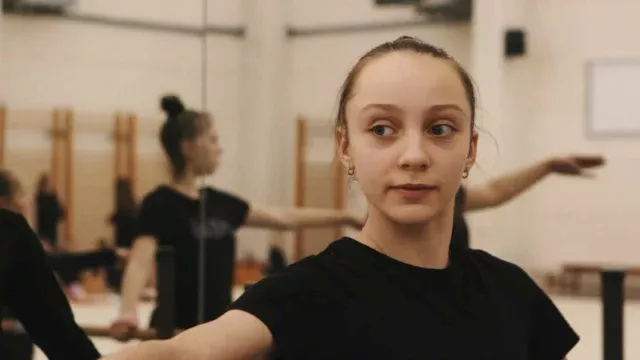
In the beginning, before the full-scale Russian invasion began last year, director Kovalenko had begun to film five girls at one of the best gymnastic schools in Ukraine. She likes to spend time with her subjects. The girls were training very hard, up to five hours every day. Kovalenko was there so often, “sitting in the cold, big sports hall” in the dead of winter and listening to the coaches shouting, that they soon grew to trust and like her. “They don’t see you as a foreign element in their world.”
Kovalenko accompanied the gymnasts to a prestigious competition. The idea was that the girls, who were a team, would split up after the competition and start to compete against each other. The documentary makers would then follow Nastia, one of the girls.
“That actually was the story we were working on before the full-scale war happened. When that happened, for me it was like: ‘ok, there goes that film!’” Wilmont admits he briefly feared the project would need to be abandoned.
Almost a year later, the filmmakers discovered that Nastia and her mother were interested in continuing with the project – but that the girl and her grandma had been sent to Germany for their safety.
“I think we both could see [the opportunity to make] a film about a young kid having her life uprooted and placed in a completely different country – missing your parents. What does it mean for a kid to be driven out of their own country. That’s why we decided to follow up in Germany,” the Danish director explains.
Kovalenko’s We Will Not Fade Away is also selected for IDFA as a Dutch premiere in Best Of Fests. This is about the idealistic young people in Donbas who have effectively been living with war in one form or another since 2014.
The Ukrainian director acknowledges she is inspired by younger people. “I really wanted to support this generation,” she says. “What I saw is that it doesn’t matter which town you grew up in. If you have light inside, you can change this world and you can fight for your dreams. That is what motivated me to follow them.”
Both filmmakers agree that they enjoyed a very smooth collaboration.
“Alisa was for most of the time much closer to the protagonists. She also did a lot more recording than I did,” Wilmont acknowledges. “I think we really owe it to her, a lot of the really good moments in the film.” He was easily able to “put his ego aside” and accept the excellence of the work that Kovalenko was doing. “For me, it’s also being curious about other directors’ ways of doing stuff. I think that is super fascinating. I really enjoyed watching Alisa shoot,” Wilmont adds.
Kovalenko chimes in that she relished working with her Danish colleagues and is now keen to do more co-directing.
During editing, Kovalenko wasn’t always present. “We tried to communicate as well as possible but it was a little bit difficult so far between us,” the Dane explains why he took as pragmatic approach as possible.
The film ends on an upbeat note. The homesick Nastia is summoned by her parents to return to Ukraine.
“Her heart was in Ukraine with her parents,” Kovalenko says of her subject who had struggled to adjust to her new life in Germany. She had continued with the gymnastics but was too distracted to do full justice to her gifts. Wilmont remembers that the documentary was already very close to being completed when the news broke that Nastia would be able to go back home.
Girl Away from Home is a doc aimed at younger viewers. “You want to leave the young audience in a film like this with a protagonist who has some type of power, some type of hope, and not to make it dark,” says Wilmont.
Both directors talk of their passion for reaching the youth audience. “I think it is super important. We have to make more effort to make more documentaries for children,” Kovalenko says. She has a four-year-old son and is already watching documentaries with him. One was about migrants from Mali. He was fascinated and moved by it – and easily followed its story.
Wilmont also has children. “They understand much more than we give them credit for…” He also talks of making documentaries which take the younger audience seriously.
Girl Away From Home went through so many changes that the directors eventually decided the best way to tie its narrative strands together was with a voice-over from Nastia.
Kovalenko wrote the voice-over, basing it on interviews the filmmakers did with Nastia in Germany. “She wrote this really beautiful monologue and recorded it with her. It’s true and based on her own words. That’s why she could put all those emotions into the monologue,” Wilmont observes. Kovalenko adds that she is usually reluctant to use narration, but in this case, “I felt very, very fine with it.”
Now Nastia is back in Ukraine and has resumed her gymnastics career. “She is very successful and has won competitions…she is very talented!” ends Kovalenko.





