

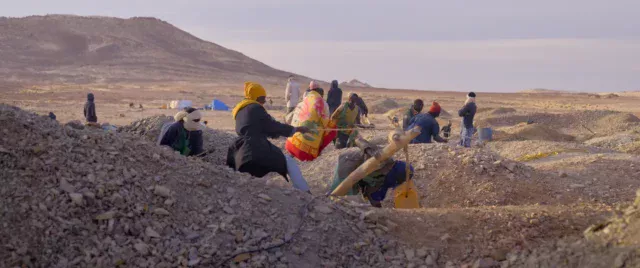
At the beginning of Karim Sayad’s 2G, onscreen captions explain the dilemma that faces four men trying to eke out a living in Agadez in Niger. These are people smugglers, or rather former people smugglers, whose trade was curtailed by the ban on ‘migrant transportation’ in 2016, imposed by the Niger government following significant pressure from Europe.
So the quartet of Ibrahim, Abdelsalam, Daouda and El Bak must find alternative ways to earn a living, the most obvious being gold mining in the desert, which can be dangerous and rarely profitable. The 2G of the title actually refers to a hard-won two-gram nugget of gold, valued at 80 euros but which must pay the salaries of a long line of personnel involved in its mining. But as we see in the film, illegal people smuggling continues unabated as the number of folk desperate to take the journey to Europe never seems to diminish.
The men are hardy Saharans who “can walk for three or four days without food or drink.” They are people who “fear nothing but God.” The towns people laugh at them, we are told, but they laugh in turn at the townspeople.
Director Karim Sayad refuses to pass judgement on the four subjects of his documentary, some of whom have served time for their past actions. Now they are assessing a different life away from smuggling, although they are all too aware how easy a return to it would be. Libya cannot be patrolled, one says, as it is “a desert,” before chillingly articulating the onward journey of the migrants. “Tripoli…from there Malta, Lampedusa…” Even the initial journey across the Sahara presents the threat of bandits, and therefore director Sayad and his crew were protected by Niger military during the shoot.
The director underlines that he was determined to imbue his film with a ‘western’ aesthetic. The film is shot in widescreen to emphasise the horizontal vastness of the sands. What’s more, his characters “are modern cowboys. They hustle in the desert and instead of riding horses they drive a Toyota Hilux or ride motor bikes,” he stresses. “I tried to look at them through this lens.” Sayad also ends the film with a nod to Ennio Morricone’s spaghetti westerns on the soundtrack.
The film is sold by Prague-based Filmotor (who also sold Sayad’s My English Cousin, 2019) and is produced by Joëlle Bertossa of Swiss production outfit Close Up Films.
Sayad is half Swiss and half Algerian and feels a desire to explore his North African roots in his films. “My name is Karim, I look like a Karim. So people define me as an Arab more than as a Swiss, even though my mother is a pure Swiss. So there is something from the outside,” he says, adding that as an Arab speaker he has unique access to the stories he wants to tell.
He is also grateful to the production support he receives in Switzerland.
“You have younger people that are born in this country [from immigrant parents] and that reflects the reality of this country today. And yes, we are lucky that they [the Federal Office of Culture] help us, and they go with us.” He also cites the examples of other first-generation fiction makers Fisnik Maxville and Basil Da Cunha who have benefited greatly from Swiss funding. “So you have a new generation coming with topics that are more from the immigration in Switzerland. I think it’s good and in the interest of the funders to accompany that, because that’s how Switzerland and Europe looks now.”





