

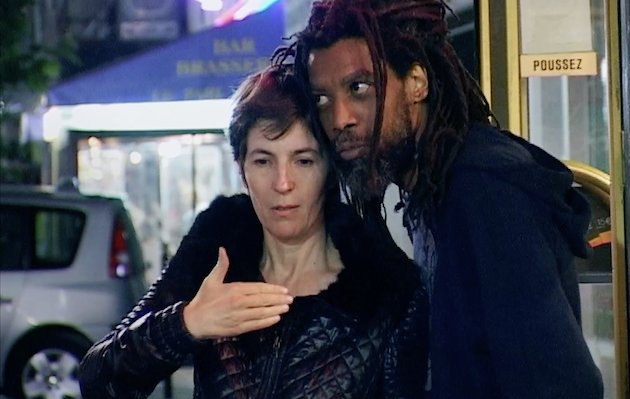
Christine Angot is a distinguished French novelist who has won many literary prizes over the last 20 years and who turns filmmaker with the new feature documentary A Family (a world premiere in Encounters this week at the Berlinale).
The film is sold by Le Bureau, and produced by the company’s BAFTA-winning founder Bertrand Faivre (working alongside Alice Girard). His other credits in the UK and France include everything from Lynne Ramsay’s Ratcatcher and Asif Kapadia’s The Warrior to Jessica Hausner’s Little Joe and Yannick Kergoat’s doc Tax Me If You Can.
Faivre came on board A Family during editing after Angot had split from her original producer. When he saw Angot’s footage for the first time, he felt an astonishment that many viewers will share.
In the film, the novelist turned director deals in remarkably frank and courageous fashion with the sexual abuse she suffered as a young teenager. Her own father had preyed on her.
“I got involved for a number of reasons. I didn’t know Christine personally and I knew very little about her work but I had a chance to see a few images of the film – and I was ready to take the risk to put up the money to finish it and to face whatever would happen…”
Asked about his initial reaction to Angot’s footage, Faivre says: “Wow, was my first response.”
He watched the material twice. At first he worried that it was “too bold, too harsh;” that the film would struggle to find an audience and that it might also face legal problems.
“But I cooled down…yes, it’s a challenging film but it is also very, very important.”
The project had started in unlikely fashion. Angot was off on a business trip that by chance took her to Strasbourg – where her father had lived and died. She was being accompanied by one of France’s leading cinematographers, Caroline Champetier. She decided on the spur of the moment to visit her father’s house and to speak to his wife. Their encounter turned out to be a fraught one – and it was captured on camera by Champetier.
“I think Christine is very instinctive. She has been living with what happened to her when she was a child. She has been living it and writing about it for 40 years – and she had never had the chance simply to talk to this woman.”
Faivre adds that he was “amazed” at “how deeply Angot had thought about the medium she was using.” She may have been a documentary debutant but she already had a very strong identity as a director.
Angot is a strong and spiky personality who refuses to be typecast as a victim. “She tries to be true, she tries to be honest,” Faivre observes of her flinty attitude. “She is instinctive but at the same time she has a very intelligent way about how she speaks and moves…she is intense. It is good to work with people at this level. I learned a lot…and I recognised in her something I have in me. I hate moaning. It is very French [to moan] but I hate this side of French culture. I prefer to take care of things rather than moaning about them – which is probably why I am still in this business.”
Like Faivre, Angot prefers to fight. Nevertheless, he acknowledges that it’s understandable why people prefer to turn their back on something this disturbing – either to pretend it hasn’t happened or to ignore it.
“Is incest a personal issue, a familial issue or a society issue?” the producer asks rhetorically. “This film helps understand how I could be better if I was confronted with such a situation. Honestly, I can’t say that incest is something that has been in my life in any shape or form but I don’t know how I would react to it. I don’t know what kind of denial I would have put in place if it had happened close to me.”
As a producer, Faivre isn’t scared to tackle sensitive subjects. He exposed the scale of global tax evasion in Tax Me If You Can and confronted the festering problem of police violence in France in his 2020 doc Un pays qui se tient sage (The Monopoly of Violence).
“I have a side of my brain that is able to cope with the issues that come along, making films that do not please everybody,” the producer says.
The Bureau boss has enjoyed huge success with dramatic features over the last 25 years – but is now increasingly active in the documentary sphere.
Tax Me If You Can, which Faivre produced with Wild Bunch, looked at everything from the Mossack Fonseca tax evasion scandal to the strategies Google uses to keep its tax bills down. The doc wasn’t a big box office hit but the producer is sanguine about the response it received.
“It’s not disheartening. You offer things for the audience. If the audience is not interested, you can wonder why – but it is not their fault,” Faivre reflects. He adds that one reason Tax Me If You Can failed to perform well is that the big French movie chains are owned by companies well versed in tax evasion. “And most of the newspapers in France belong to billionaires. It’s not conspiracy, just the normal interests of people who use tax evasion. They won’t promote films that say we can do better.”
Regardless of its performance in cinemas, the documentary has screened very widely on the festival circuit and is now available to stream. “You can’t expect to swim against the tide and be at the centre,” Faivre suggests of the resistance it has encountered.
As for documentary in general, Faivre jokes that “it is hardly a business. It’s a labour of love. At my age, I think that cinema is too important a medium just to be used for entertainment. In documentary, you meet people who are fascinating. The star system is somewhere else. You’re not dealing with limousines and red carpets so much. You’re dealing with real issues. And the audience is craving for it [documentary] because the world that we live in is losing its mind…”





