Five years ago, Finnish documentary director Karoliina Gröndahl gave birth for the first time. “The experience was overwhelming. It was great but it was terrible. It was all these things at the same time, a huge paradox for me,” Gröndahl recalls.
She was in Belgium at the time where she was studying as part of the Doc Nomads programme. She prepared as well as she could for the birth, doing yoga and enrolling in pre-natal classes. Nonetheless, she felt under-prepared and still suffered what she refers to as “obstetric violence.” The hospital was French-speaking but that wasn’t a language she knew. It was “a very lovely” place but she wasn’t happy with some of the medical procedures she endured.
“I believe that if this was something people with testicles would experience, not with wombs, there would be more resources put into this, but it’s [seen as] a woman’s issue and so is [considered] not so important,” she muses on the gender politics behind birth. “I knew this was a topic I wanted to discuss and explore in a film.”
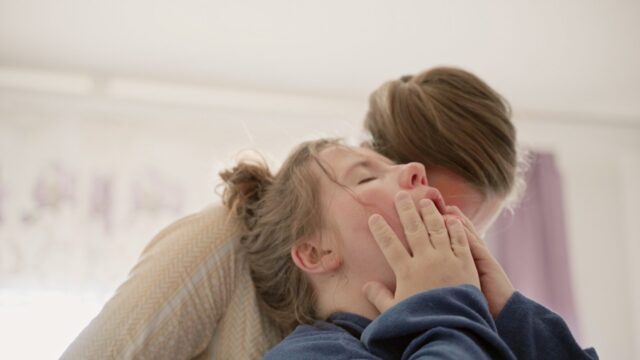
Gröndahl’s feature documentary The Labour of Power and Joy (a world premiere at CPH:DOX) follows Finnish birth experts – midwife Kirsi and ‘doula’ Anna-Riitta – who want to put an end to the obstetric violence and enable people to give birth on their own terms. (A ‘doula’ is a person who supports women through labour and birth, and/or after she has her baby.)
The documentary was made through Icebreaker Productions in association with YLE, the Finnish Film Foundation and AVEK. Syndicado is handling world sales.
As she researched her subject, the director decided she was most interested in the perspective of the professionals who “work with this miracle of life, this life-changing event.”
Gröndahl began to meet and interview midwives and doulas. She quickly realised how passionate they were about their work. For many, it wasn’t just a profession but had become a way of life. “They had a very deep and sensitive approach to work and to life itself.” But she also discovered how hostile hospital staff often were to the midwives assisting at home births, and to the doulas.
The film features three home births and two hospital births. Kirsi and Anna-Ritta had asked their clients if Gröndahl could film them. Several quickly agreed.
Home births remain relatively rare in Finland. “In 2022, there were 45,186 children born in Finland. Of them, 109 were born through planned home births,” is one piece of data the filmmakers share. This reflects the rigid and prescriptive thinking about how births are handled.
“I was very much surprised how many stereotypes there still are according to home births,” the director says of the still prevalent idea that people who give birth at home are consciously risking the life of their baby, or are hippies and eccentrics. In fact, she points out, the majority of people who decide to give birth at home “have done a lot of profound research on the physiology of childbirth and usually they are average middle-class people.”
Even so, the knowledge gap remains. “We really are not taught at school the basic things about childbirth nor at the maternity clinic. Such as the role hormones actually have in that process and how to create the best circumstances to allow your body and mind to relax.”
Producer Kirsi Mattila had herself made a film about childbirth several years before. “I immediately understood her idea when she talked about this subject,” Mattila remembers Gröndahl pitching her the project (which was originally conceived as a series).
“Maybe things have changed for the better but some things are still happening in a very cruel way,” Mattila adds of how giving birth in Finland today compares to the period when she made her film in the 1990s. “The small hospitals are being closed. The situation for the health workers is becoming more difficult.”
Gröndahl herself shot the film. “She is a very sensitive cinematographer,” the producer says of her director.
“I think it was a beautiful collaboration,” Gröndahl responds of working with Mattila. “I was looking for a producer. We talked. She told me about the film she made 30 years ago. I got the link and watched it. I was like, ok to go on board with her.”
As she embarked on the documentary, Gröndahl was continually surprised by what she discovered. “One thing I want to highlight is that not all people who give birth are women and not all women can give birth. Of course, I have been aware for a long time about the diversity of gender,” she notes. Doula Anna-Riitta was a strong advocate for minority rights and introduced her to several people who had given birth, but who didn’t identify as women. The director made sure she used ‘inclusive language” in the documentary and that she respected her subjects’ chosen pronouns. (For example, Anna-Riitta uses ‘they’).
“This was a theme that came close to me. I learned about it by listening to people who are not women but are still in the birth industry, or they have given birth. That really made me open my eyes.”
An early scene shows Kirsi the midwife sunbathing and swimming in the forest as we hear her reminiscing on the soundtrack about her difficult experiences when she herself gave birth for the first time.
“Portraying her in a relaxed atmosphere…I had it in my script that at some point we would see Kirsi in nature. I am very happy it ended up as I was already imagining it at the beginning of the process. Maybe for Finnish people, it [nature] is such a natural part of our lives because almost all of us go to the forests every now and then. It is also symbolic – Mother Nature, holding and supporting Kirsi. It was very important for me [to show it] and also the water because we are all in the water at the beginning of our life.”
Contemplating the world premiere in Copenhagen, the director admits she is nervous, “I don’t know why….”
“I just hope the film will reach many audiences,” Gröndahl states. And, yes, an Impact campaign is being planned. “We are still in the early stages of that. There are so many options.” She is lobbying for the Finnish government to invest as much resources in childbirth as in, say, sports.
“Giving birth can either break or empower you,” is one of the slogans on the posters for the documentary. Gröndahl points out that it’s physically gruelling and can be traumatic.
“Most of all, I think this is a film about the importance that the people giving birth can have freedom to choose the best option for them. Also, that giving birth is always a risk. You can prepare for it, but in order to prepare well you need support from society.”
Reflecting again on her own experiences of childbirth, she tries to put the event into words. “It feels like thunder has hit you. It’s a feeling that somebody else is taking over your body. You can’t control it and you should not control it. You should just go with it. I wanted to portray the power of that, what it is to just surrender to the thunder that hits you!”