

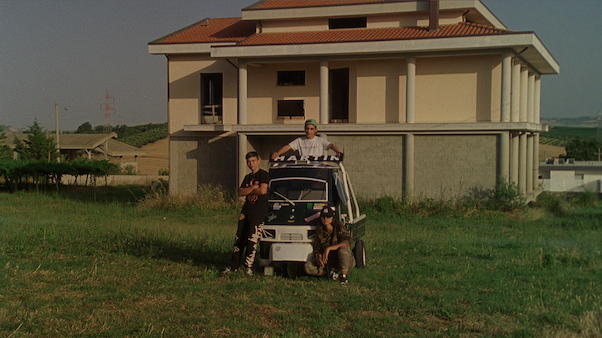
Before the international premiere of his debut feature Sting Like A Bee at CPH:DOX 2024, Business Doc Europe spoke with Italian director LEONE. In this hybrid feature, reality and fiction fuse, the main goal being to give voice to a group of teens growing up and spending their endless days in the small Southern Italian towns of San Salvo, Vasto and Montenero di Bisaccia. The kids want to tell their stories, and share a great passion for their Api Piaggio, the picturesque three-wheeled trucks which evolved out of the more popular Vespa scooter.
LEONE tells how the project started first as a “visual research” for a piece of branded content commissioned by Nowness and sponsored by Piaggio. “Coming from this photography background – and in particular fashion photography – I was interested in following this group of kids living in [and around] San Salvo, nearby Chieti. It’s my birthplace.” The first deliverable of this “visual research project” was a three-minute short, published by Nowness as part of its series “The Young Ones.”
“After that [experience] and wishing to go beyond the aesthetical aspect of it, [there] emerged something deeper about these people, which made me curious. From that moment on, I decided to take a more mature path, and I began casting some of them. And the casting phase is also the beginning of the film.”
“What started as an editorial project for Piaggio turned into a research on the lives of these kids and, quite spontaneously, all the topics of the documentary – including sex, AIDS and homosexuality – emerged. These [topics] originated together [with the kids]. To some extent, it’s been like a social experiment,” LEONE continues.
The director tells us that the idea of “going hybrid” came about while casting the kids. “Soon, we realised that we could ask for more from them, in terms of both narrative and acting. So we decided to stage some sequences, trying not to make too clear the differences between the true and staged ones.”
This “open doors” creative process, which took almost three years, helped Balduzzi to gain the protagonists’ trust right away. “What’s interesting, however, is that from the start of the project some kids grew mature more quickly, so the ones we involved at first worked very well – they were the ones we were looking for.”
Commenting on the premiere screening at CPH:DOX, LEONE smiles and reveals that one of the festival programmers billed it as “a mix between Pier Paolo Pasolini’s Love Meetings and Pimp My Ride.”
The main segments were shot in four weeks spread over the course of six months, between spring and autumn 2023. Post-production hasn’t been challenging at all, says LEONE. “I made my life easier, to some extent. as I’ve shot it fully on analogue film. So I saved much footage, since I had to be very careful about what to film. I entered the editing room with not so much footage. I wouldn’t say I’ve used it all, but almost [all of it].”
LEONE is satisfied about his choice: “I’m much happier [this way.] The [shooting] process has been more lengthy and expensive, but in terms of post-production things went smoother. I think we’ve prepared two cuts only.”
Zooming in on his relationship with the protagonists’ parents, he says that they “immediately realised the social and educational potential of the experiment.” “Besides, they saw it as something that for some weeks would have kept their sons and daughters away from the streets and uncertainty. [..] And, of course, we’ve created a super-comfortable environment, and the kids took their job very seriously. Their parents appreciated [all of] this very much.”
In the film one of the kids, Giuliano, comes out to his parents as gay. “We’ve managed to do that in a very funny, playful way. The approach was the same one we followed throughout the film. What you see in the film is made out of improvisation, it’s never staged. That’s what makes this [documentary] authentic and difficult to label. It is what it is.”
“It’s been a beautiful moment of sharing for a family that is usually very much focused on their own business, and have little time to sit together and think through themselves. We’ve helped them to get closer, and be more open towards each other.”
In one of the doc’s most bizarre – and funniest – scenes, some of the kids try to hide the body of a man they find in the nearby forest, as they’re afraid they might have accidentally killed him. Balduzzi admits that this small acting task was loosely inspired by Alfred Hitchcock’s The Trouble with Harry, the 1955 feature starring Shirley MacLaine.
Speaking about his future endeavours, LEONE discloses he is already working on his second feature, “which leans more towards fiction but still keeps a documentary standpoint.” “I see it as a social experiment which involves a specific place able to tell a story that may look ordinary at first glance, but whose scope is actually wider,” he ends.





