

When Oscar-shortlisted filmmaker (and former pop star) Nick Kelly was asked to perform at an 8,000-seater gig in Dublin in 2021, he realised that his carbon footprint would far exceed that which should be deemed acceptable.
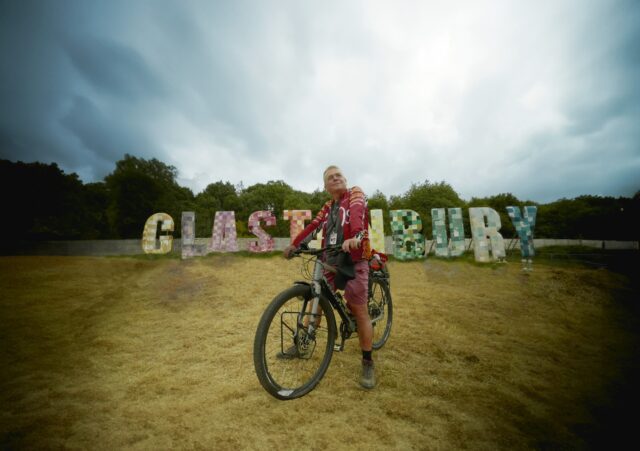
So he eschewed the tour bus and turned up on his bike instead. At which point the seed for a greater undertaking was planted. Why not, the following year, cycle from his home in Ireland to Glastonbury, the most influential musical festival in the world, with a DOP in tow, once more to underline the need for sustainability across both the music and film industries?
“As a not particularly fit, skilled or youthful cyclist, I reckoned that if I could manage to transport myself and my gear to a major musical event solely by pedal power, so could many, many others,” he explains.
In the feature doc The Song Cycle, world-premiering July 12 at Galway Film Fleadh, Kelly chronicles his saddle-bound odyssey as he and fellow performer Sean Millar (who for health reasons had to travel via public transport) play nightly gigs across Wales en route, eventually playing giving two performances at the world’s most iconic music festival.
In the film, we are on the road with Kelly all the way, but we also hear from climate activists, from fellow muso Sean and from other musicians with whom Kelly has played over the years.
Core to the film is an interview with Kelly conducted by multi award-winning Dublin-based documentary film-maker Alan Gilsenan. “I did a five-hour interview with Alan and it was like a therapy session,” says Kelly, who discusses at length his upbringing in an affluent district of Dublin, his hesitancy to pursue a career in law, opting instead for a [successful] career as a recording artist in London with the indie combo The Fat Lady Sings, a band that, in great rock and roll tradition, breaks up during a doomed US tour.
The film does not dwell on Kelly’s subsequent successful filmmaking career – his third short film Shoe was Oscar-shortlisted in 2011 while his debut feature The Drummer And The Keeper (2017) won 18 awards on the international festival circuit. Instead much time is allocated to his relationship with his father, the revered Irish politician, lawyer and academic John Kelly.
“I played Glastonbury on my 60th birthday and my dad died at 59,” the director tells BDE of the film’s very personal undertow. John Kelly was loving but distant, and from an altogether different generation, and it is Kelly’s regret that father John never fully understood the extent of his son’s success as a recording artist, let alone as a filmmaker. (That said, when, as an Oxford don, John let it slip to an undergraduate that he had a son who was working in the music world, he was surprised to be told that he was the father of the Nick Kelly.)
“I know you can’t generalize, and I think there’s a lot of things we can criticize about our generation. But I think, one of the [good] things is that we have traded respect for intimacy, and I think it’s a good trade,” says Kelly of the shifting sands of parenthood over the past half century, citing his relationship with his own kids. “I know them much, much better than I think probably my father knew me, really. And they share much more with me. I share much more with them. And I think we’re very lucky.”
Nevertheless his love for his dad is palpable, as evidenced by the line he quotes to BDE from his song My Republic which serves as a paean to the complexities of the son/father relationship. “These borders that I define link us together in a chain that winds out far beyond us.”
Kelly argues that the transition from musician to director can be organic, and he further compares both his approach to, and structure of, the respective artistic forms.
“Literally I think music and film are almost the same thing. I’ve thought about this quite a lot. I do show sometimes how rock and roll teaches you how to make movies because, I mean, I never went to film school, but almost all of the ways in which you can screw up in film are the same ways you can screw up in rock and roll, and you sort of learn by doing them.”
“Structure, that’s a huge thing,” Kelly adds. “Verse chorus, verse chorus, mid late chorus to fade, all of that stuff is really natural. Whereas for novelists to go into movies, they’re horrified at the idea of inciting incidents and midpoints [but] we love all that as songwriter.”
“I think that there’s a sort of a chaos because they’re collaborative forms, they’re not perfectionist forms,” he adds. “And you learn, I think, that perfectionists should never try and make records or films because everybody who works on your record or on your film changes your record or your film and you’ve got to be excited about that – or at least not appalled by that. That sort of embracing of the chaos of other humans I think comes very naturally to me.”
The film is low-budget, but far from no-budget given how a Kickstarter campaign raised approximately €30,000 from 240 donors to fund post-production. Prior to that, Kelly himself funded the pre-production and shoot. “So this film is kind of a miracle because we did do it all ourselves together with incredible levels of generous support from people who got into the project and wanted to help. It’s not really just me, it’s all of that energy and those skills which they lent me and gave me,” he adds of his crew and collaborators.
Kelly points out how a very recent Irish survey suggests that 70% of the country’s population are concerned about the climate crisis but that very few seem willing, or indeed know how, to do anything tangible about it. This is an attitude he addresses full-on in the film.
“I feel that terror and scolding tend not to produce results, whereas just trying a thing, maybe a very humble thing…” he says, explaining how he understands well the burden of sacrifice. “I’m not a saint at all by the way. I do drive a car, I do take flights. I mean, I try not to take too many, but I became very conscious actually with the last film because I spent about two years flying to festivals all over the world with it. So I’m not perfect, but I sort of thought, okay, this is a thing [the cycle odyssey] I can try and do. And it’s maybe the smallness of it and the silliness of it…It disarms people and maybe it gets a hearing and makes people feel like there’s something useful they can do.”
For The Song Cycle, Kelly has put in motion the “meta idea” to cycle to all screenings and associated gigs, starting with the July 12 world premiere. “I’ve hooked up with the Galway Cycling Campaign and brilliantly they have their AGM by total coincidence earlier that evening. So they’re going to organize a critical mass cycle on the streets of Galway. And I’ve got the council to put some temporary cycle parking units up outside the screening.”
And while it is all a bit late for Glastonbury 2024, is Kelly hopeful of a screening at the esteemed festival in 2025? “They do have a cinema there, the Pilton Palais, and it’s a lovely cinema [the festival is actually held beside the village of Pilton in Somerset, not the nearby town of Glastonbury]. So next year, my great hope is that we will have a fantastic festival run and then there’ll be a sort of a moment where the gates of the Pilton Palais will yawn open and we’ll get to do there. And that would be very, very harmonious, wouldn’t it?”





