

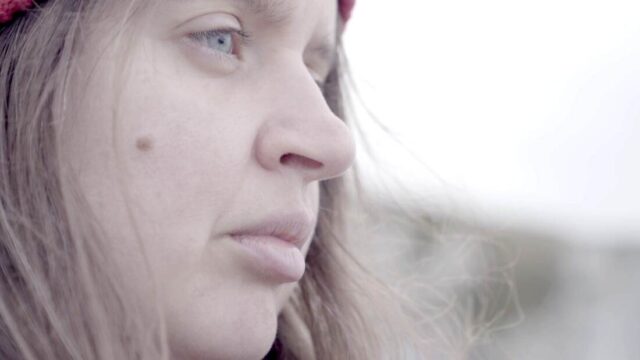
Stefania, called Nia as a child, emerges from a 15-year-long self-induced amnesia. She reveals the overwhelming memories of her childhood spent in Romanian hospitals due to a misdiagnosis. Today, she undertakes an inner exploration through dance and by taking refuge in her own imagination. Dance becomes a new language that helps her reconnect with her past, with others, and especially with her mother.
Still Nia is directed by transdisciplinary artist and filmmaker Paula Onet, whose As You Like It premiered at the Karlovy Vary Film Festival in 2013 before screening at more than 40 festivals around the world (DOK Leipzig, TIFF, ZagrebDox, etc), picking up awards for Best Picture, Best Documentary, Best Short Film, and the Audience Prizes en route.
It is produced by Romanian Ada Solomon of Microfilm, who outlines the project’s vital characteristics and appeal to investors and audiences alike. “I will put it very simply. I genuinely believe that art cures, art is therapeutic, art is healing,” she tells Business Doc Europe. “And this is the vital element of this project – to engage the audience into a beautiful, almost magical journey of healing with the help of dance and collective movement.”
At certain times during the film, we are taken into an imaginary universe, the project synopsis reads, where her childhood reality begets surreal dimensions. There is the space for a hypnosis session but there is also an abandoned space full of long corridors and various rooms. This space accompanies us as the story unfolds, haunting her mind. In this fantasmatic universe, she fulfils her childhood fantasies when she writes poems on the walls, during the night, with phosphorescent paint.
Stefania is also a visual and sound artist, which is a source of inspiration in creating the film aesthetics.
Solomon further describes Still Nia as a portrait of a woman who doesn’t look for culprits, who searches for answers in her own body and who seeks to understand her past. “The film focuses on bearing present consequences of a traumatic childhood (like hypochondria, loneliness, having an alienated body) and on opening up to the possibility of reinvention through dance, a new language that helps Stefania reconnect with her past, with others, and especially with her mother,” she adds.
“Paula is an amazing artist. She is a contemporary artist, she is a DoP, she is a filmmaker. Her sensitivity and yet her clear vision of what she wants and what is to be told about her subject are fascinating,” the producer stresses. “I have rarely worked with someone as creative and yet as grounded and clear-minded. These are the qualities that made me not only embrace this project, but helped me to decide that we will continue for her next project, Unbalanced. And on top, even if we are dealing with a documentary, the way the film is shaped is more like a cinematic dreaming experience than a pure doc.”
At Sarajevo FF Cinelink, Solomon is looking to gain buzz around the project, as well as grab the attention of festival programmers, sales agents, broadcasters and streamers. “We aim to start the international life of the film in the first part of 2025 but life is so unpredictable… we embrace what is given, without forcing the reality,” Solomon signs off.





