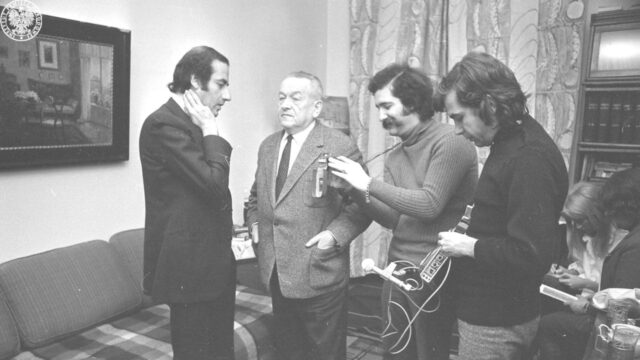
In the 1960s and 1970s Polish Leopold Trepper was caught in a Kafkaesque struggle to leave the only country he had ever known. A legendary figure in the annals of espionage, Trepper had masterminded the most significant anti-Nazi spy network of the World War II, the Red Orchestra. But then, his once-celebrated status became a millstone around his neck, rendering him a pariah in his home country of Poland.
For years he fought to clear his name in the face of increasing and baseless accusations of treachery, until he was forced to undergo a hunger strike to change the minds of the Polish authorities and finally allow him to emigrate to Israel.
In his new archive-based feature doc, Polish Tomasz Wolski sets out to retell Trepper’s remarkable story.
“In our communication, we will position The Big Chief as a documentary espionage thriller, cinema’s response to the novels of John le Carré,” says producer Anna Gawlita of the Polish Kijora Film. “Another key marketing aspect of The Big Chief is that the film gives a unique perspective on 20th-century history. It presents a narrative from the point of view of a real spy, the person who, because of the specific nature of his work, usually appears as a fictional character, not a documentary one in the context of historical events. The film covers the history from before the outbreak of World War II to the early 1970s.”
“The spy’s fate reflects key historical moments: the Holocaust, post-war Stalinist oppression, responsibility for the acts committed during the war, the Cold War, and many others. The film’s plot is full of twists and turns, making this project stand out from the documentary genre,” she adds.
Gawlita points out that The Big Chief is the result of 7 years of “meticulous work”, involving exhaustive searches through archives across different corners of the globe. In addition to Polish sources, the film draws upon archives from France, Great Britain, the Netherlands, Belgium, Germany, Israel, and Russia.
The film eschews voice-over narration, and looks to “create the most cinematic, dramatically charged narrative possible,” with dynamic found footage of Hitler filmed by Eva Braun, and what Gawlita describes as “extremely rare” scenes of Stalin’s funeral in Moscow, as well as symbolic scenes of the destruction of both tyrants’ statues.
“Scenes of historical events are edited with [their] own tension and emotional drama. They aim to convey the atmosphere and reality of those profoundly turbulent times and occasionally remind us of the literal brutality, as in the scenes of hanging Jewish prisoners or the execution of German spies. All of this is to show the stark reality and dangers that Leopold Trepper faced head-on,” says Gawlita. “The footage described above originally lacked sound or had propagandistic voice-over narration, which we chose to eliminate. Instead, we added realistic sounds to each of these scenes, aiming to immerse the viewer in the story and enhance its authenticity.”
In Sarajevo, Gawlita and her colleagues will be looking for sales representation, TV broadcasters, and festival interest. The film is at rough-cut stage and right now the producer is clearing rights, closing the financing and securing pre-sale deals in order to release the film in the first half of 2025.
“The Big Chief will serve as a compelling narrative delving into the tumultuous and intricate era through which our fathers and grandparents navigated,” she underlines. “It will paint a vivid portrait of a man thrust into the midst of adversity, compelled to make choices that, through the lens of contemporary understanding, defy easy judgement. Audiences will bear witness to a figure who defies the conventional notion of a straightforward hero (if such a figure even truly exists), a man shrouded in enigma, harbouring his own secrets, and perhaps even actively crafting the mysteries surrounding his persona.”