Elizabeth Lo received rapturous reviews for her debut documentary feature Stray (2020), about stray dogs in Istanbul. Michael Moore called it “a simple work of genius” and it won several awards on the festival circuit. Now, the Hong Kong and LA-based director is back with a project in a very different groove. It’s also about straying – but this time the protagonists are humans cheating on their spouses.
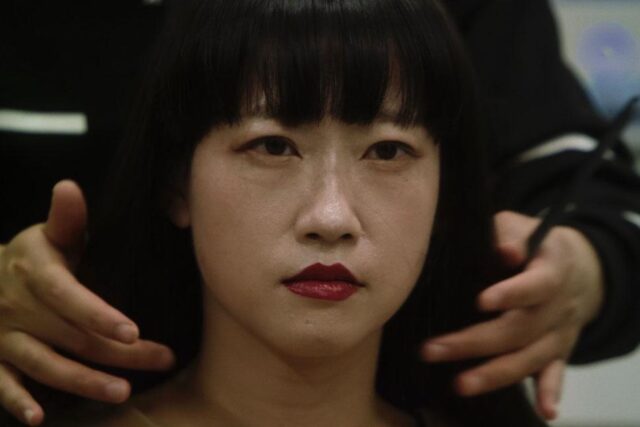
A “mistress dispeller” is someone whom husbands and wives in China can hire to break up an affair. One of these professional marital firefighters, the female Wang Zhenxi, is a central character in Lo’s new feature doc Mistress Dispeller (screening in Orizzonti in Venice and at the Toronto International Film Festival, and sold by The Party Film Sales).
Wang is hired by a middle-aged woman whose husband is seeing another, younger woman on the sly. The wife wants to save her marriage and Wang uses all her powers of subterfuge, empathy and psychology to get the husband back from the mistress.
Lo admits she’s a romantic. “I knew that I wanted to set a film in China and as a filmmaker I have loved love stories for as long as I can remember. I love romantic movies and I love romantic comedies and I wanted to find a love story in China that I could challenge myself to tell. I wanted to show the type of love that I was familiar with, which is a kind of love bound up with duty and sacrifice and where so many things are unsaid.”
“I was also interested in how women navigate Chinese society,” Lo adds. “I though the marginalised perspective of a mistress would be a very interesting way to reveal societal dynamics in the same way I thought a stray dog could reveal societal dynamics.”
During the research period, Lo and producer Maggie Li interviewed dozens of “mistress dispellers” before alighting on Wang. They then worked with her for over a year looking for “people who would be willing to share their life on camera.” Unlike many of her competitors, Wang never resorts to intimidation to scare the mistress away. Her tactics are more subtle and more sensitive, akin to “pragmatic therapy” as Lo puts it.
The wife who hired Wang “was fully on board and understood what the film was going to be,” but the husband and the mistress were left in the dark.
“We knew that a level of deception was inherent in Teacher Wang’s dispeller work but as filmmakers we knew we had to be responsible and transparent to the participants of the film by the end of the process without jeopardising Wang’s work,” Lo explains how she dealt with the ethical challenges inherent in unpicking an extramarital affair on screen.
Wang’s business partner approached the husband and his mistress and asked them if they would be willing to participate in a film about modern love in China – but didn’t reveal what Wang was really doing.
“By the end of the process, we knew we would allow them [the husband and the mistress] to watch the film again so that they could fully grasp Teacher Wang’s identity and role in their life and what she had been hired to do.”
After shooting was over the husband and his lover were given the opportunity to “re-consent” to being in the film. “Thankfully, they did. That’s partially a testament I think to Teacher Wang’s work and her methodology in really positioning herself as a figure in these people’s lives, helping them out of the turmoil and confusion they find themselves in being part of a love triangle.”
Lo had a contingency plan in place. If the husband and lover had dropped out, the film would have been made instead as “a more diffuse” study of several couples in similar situations.
The three protagonists were remarkably unselfconscious in front of the camera. “Our crew was very minimal, four or five people, but mostly everybody would be out of the room. The protagonists were always aware when they were being filmed and the camera was there.”
Lo chose a “still fixed-frame approach” to tell her story, partly because it appealed to her aesthetically and partly to be unobtrusive. “I was inspired by Chantal Akerman’s [1975 film] Jeanne Dielman, 23 quai du Commerce, 1080 Bruxelles where you have these really long takes in domestic spaces – and you’re really elevating these domestic dramas, giving them space and time.”
The wife, the husband and his lover were on good behaviour. They were always aware they were being filmed and, as Wang told Lo, were therefore determined to present the “best versions of themselves.” They may have been feeling raw and often dark emotions but they remain scrupulously polite too one another.
As a documentary maker, Lo is used to filming in tight spaces and making her subjects “feel comfortable.” Her 2104 short Hotel 22 was set on a public bus in Silicon Valley that becomes an unofficial shelter for the homeless every night. Mother’s Day (2017) was about children visiting their incarcerated parents in California prisons.
Mistress Dispeller isn’t judgemental. Instead, the director tries to work out what is behind the behaviour of her three main characters. She talks of her film as a “Rashomon-inspired love triangle” in which the perspectives on the same events are always shifting.
Western audiences may find the subjects a little coy. Sex isn’t much mentioned – but it’s always there in the background.
“I think sex is definitely a part of the equation but it wouldn’t have been something these particular protagonists would have felt comfortable bringing to the surface,” the director says. “The most you see it crack through is when the husband is in the car with the mistress and he comments about her body type. I think that is the extent to which they would allow these feelings to be on the surface.”
Lo remembers filming other couples who don’t feature in the documentary and sometimes being startled by the way the men would disregard the camera’s presence. “They would try to make physical moves on the mistress in front of me. That was shocking to me. I really liked it that everything was simmering under the surface in the protagonists we chose to focus on.”
Wang’s services don’t come cheap. She charges by the hour and asks for travelling expenses too. If a wife wants to get her husband back, she is going to have to pay for it. “One case that takes two to three months to solve, it can easily rack up a bill of tens of thousands of US dollars,” the director acknowledges.
Wang’s clients therefore tend to be very well-heeled.
Lo is full of praise for the wife, the husband and the mistress. “I was completely in awe of how generous and brave these protagonists were. I think in most Chinese families and probably around the world, domestic shame and family shame is not meant to be made public…but these three people were able to override that. They believed that they are going to help other people who are struggling in the dark.”
The documentary has some intriguing backers. Davis Guggenheim (An Inconvenient Truth) is one of the exec producers through the Concordia Fellowship. Leading US production company Anonymous Content is involved, as are Marcona Media, After Argos Films, Impact Partners and CMP. The project was pitched at CPH:DOX and funding came together relatively fast.
“I think maybe the premise of the film is so sensational and unordinary that it helped us. But despite how sensational and potentially salacious that premise is, the aesthetic approach I took was to counter that – to be patient and to seduce viewers through how cinematic our approach is – to really dig into these people’s experiences…” Lo observes of the emotional depth she was determined to bring to the documentary.