Kyiv-based producer Darya Bassel has become used to spending time on the road. Whenever she attends a festival or film market in western Europe, it will take 36 hours or longer getting there. Since the Russian full-scale invasion of Ukraine in February 2022, travel has become very complicated.
“What can you do? It’s not the worst situation. The worst situation would be if you could not travel at all. Of course, it is not very convenient. Of course, you always complain about that but on the other side, when you think about people who are defending our country and who are at the front line, this is nothing.”
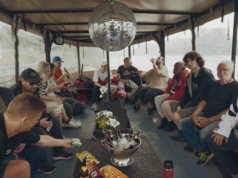
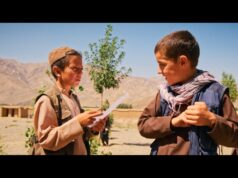
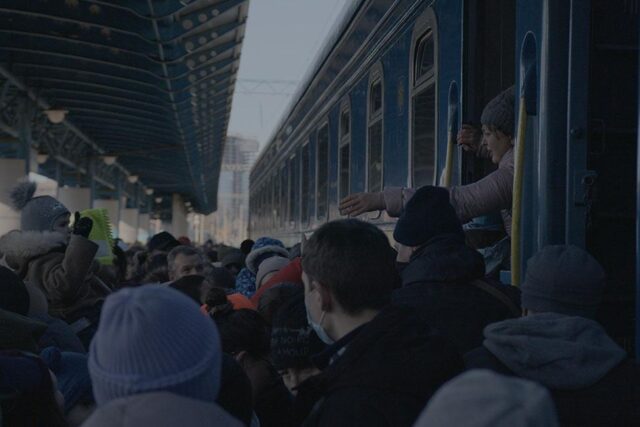
Songs of Slow Burning Earth, the new feature produced by Bassel’s company Moon Man (and sold by Filmmotor), explores just how the war has upended normal life in Ukraine. Everything is different – and one strange aspect is how used to the continual upheaval the Ukrainian people are now becoming.
The film, directed by Olha Zhurba, is described as “a visual diary of the war from the very first days.” A world premiere Out of Competition at the Venice Festival, it marks the second collaboration between Bassel and Zhurba following the 2022 doc Outside, about a street kid who became one of the “poster boys” of the Maidan revolution in 2014, and whom the filmmaker ended up following for several years.
Zhurba recently changed the title of the new doc which was previously known as Displaced. “She had this idea for quite some time but we didn’t want to confuse the industry people and change it [the name] somewhere in the middle of the production process. We decided we would change it when we announced the world premiere,” says Bassel.
Zhurba conceived the documentary only a few weeks after the full-scale invasion. At that time, it looked as if it would focus predominantly on the experiences of Ukrainians displaced by the war. Since then, though, the canvas has broadened considerably.
“Slowly, step by step, we realised the film was much more than that…Also, Olha always wanted this film to be very artistic…At some point she came up with the title Songs of Burning Earth. I thought it was a great title, very poetic.”
Poetic it may have been but the documentary was still gruelling to make. “One of the main challenges was that we were filming during the war and very often our crew advanced to places very close to the front line. It was quite dangerous for them. For us, it was quite challenging to organise the shoot in a way that would prevent any dangerous situations.”
The producer adds that the project was also “very complicated emotionally.”
“Just psychologically, when you are in the war and you are making a film about the war, it’s quite complicated just to survive. On the other side, this job, this work, this film helped us to keep…sane!”
The filmmakers were working with top Danish editor Michael Aaglund, whose other credits include The Distant Barking Of Dogs (2017) and A House Made Of Splinters (2022). “He [Aaglund] has never been to Ukraine but he made those two films about Ukraine. So he was already a little bit familiar with what is going on here. On one side, he was immersed in Ukraine but on the other side, he is still the person from the outside world. For us, it was very important to have his perspective.”
The renowned Niels Pagh Andersen (whose credits include such classics as Act of Killing and The Three Rooms Of Melancholia) was also involved as editing consultant.
Leading Danish doc outfit Final Cut For Real is a co-production partner on the film (just as it had been on the director’s earlier feature, Outside, through company co-founder Anne Köhncke). Other co-production partners are Sweden (We Have A Plan, Film i Skåne) and France (Arte France).
Bassel first met Zhurba in 2019 at Docudays UA, the festival at which she still works as head of industry. “I didn’t know Olha at all. She was a young emerging filmmaker but my colleague knew her and connected us.”
At the time, Bassel was looking for rough cut documentaries. She saw Zhurba’s footage from Outside and was immediately impressed. Zhurba was on the hunt for a producer. The collaboration made immediate sense for both of them. “That’s how we started working together.”
Songs Of Slow Burning Earth has already spawned a spin-off, Ukrainian Factory, a short backed by the Guardian about Vitalii Velychurov, a key worker in the main bread factory of Mykolaiv. Vitali was originally going to be part of the main documentary but, instead, his story was made available on the Guardian website earlier this year.
Bassel had met with Lindsay Poulton, the Guardian’s Head of Documentaries, at IDFA in 2022 when Songs (then still known as Displaced) was in the Forum. Poulton “really liked” the project but the Guardian only commissions shorts. When Zhurba realised that Vitali wasn’t going to make the final cut of the feature, she came up with the idea of featuring him in his own short instead – and the Guardian was keen to take it.
The prolific Bassel has various other projects in development. Her company Moon Man makes both fiction as well as docs. Its drama The Editorial Office, directed by Roman Bonardchuk, which was shot just before the full-scale invasion, premiered in the Berlinale Forum last February.
For obvious reasons, though, fiction films have struggled since the full-scale invasion.
“It is really a big problem for Ukrainian fictional films and for those people who are working in this area…the [fictional] films being released right now or last year, the production started four or five years ago,” Bassel reflects. “It is extremely complicated right now to make a fictional film in Ukraine because there is no local financing.”
Bassel and her team are at work on a new documentary about the reconstruction of Ukraine (Recovery), and her colleague Vika Khomenko is developing Antonivka, a new fiction project with director Kateryna Gornostai. Moon Man is also continuing to develop the animated doc Red Zone, an autobiographical project being directed by poet and filmmaker Iryna Tsilyk and which has Cinephil as sales agent. This is currently participating in the CEE Animation Workshop.
For now, though, the focus is on taking Songs Of The Slow Burning Earth to Venice. The film, Bassel suggests, will show international viewers just “how the war gets into every small aspect of the life of society and how the war gets normalised…it’s not like we don’t want the war to be over. Of course, this is our biggest wish. But the longer you live with it…it’s a very strange feeling,” she pauses. “I don’t know how to describe it, but it is something that becomes an ordinary part of your life but at the same time it is extremely extraordinary. This is the paradox we are all trying to live with.”