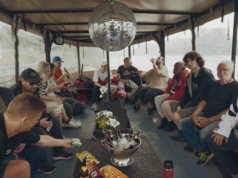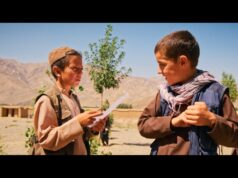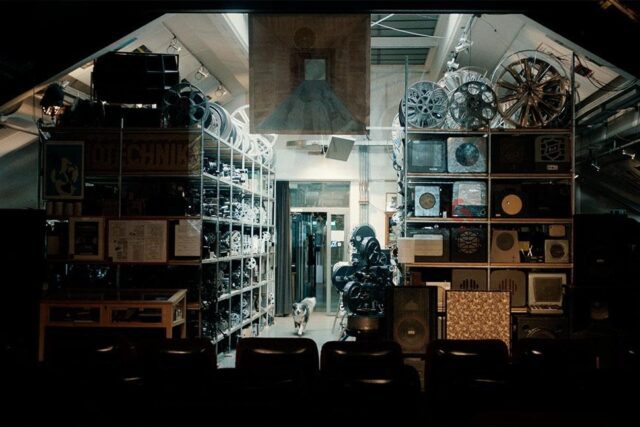
With a duration of 208 minutes, and divided into three acts, Massimo d’Anolfi and Martina Parenti’s Bestiari Erbari Lapideri deals with three fundamental subjects – animals, plants and stones – “which we [as humans] too often take for granted but with which we should actually be in constant dialogue since it constitutes the essential part of our existence on planet Earth,” the filmmakers say.
“It is first and foremost a reflection on the relationship between humans and nature that exists beyond our impact on it,” they add. “We build real and imaginary cages to contain it, but nature always evades our attempt to tame it.”
The opening segment (Bestiari) assesses the cinematic representation of animals, and how the medium of film was, in part, conceived to analyse animal movement. In the early part of the 20th Century, scientific and colonial expeditions were accompanied by photographers and filmmakers to document and explain the science, as well as to convince stakeholders to support these expeditions, we are told. The film also draws a firm analogy between the respective powerplays of shooting an animal with a gun and shooting an animal with a camera. Even the incarceration of an animal in a zoo cage represents its framing within a cinematic sense.
“The very first images, what we can describe as proto cinema, were images of animals,” co-director Massimo D’Anolfi confirms to BDE.
The film’s first section also points to a “co-evolution” that derived from filmed observation of animals in captivity that was used to predict and control human behaviour. “Animals were acting like model organisms for human social planning. Also, these films can be seen as model films, model organisms for planning of the new modern society within big cities, within institutions of education and governance.”
During the film’s second part (Erbari) the makers underline the relative insignificance of the human species in terms of its existence on Earth, and offer a sobering sense of perspective. 99.7% of the planet’s biomass is made of plants, we are told. “The remainder is only 0.3%. We [as humans] are in this remainder. We see a reality that is our own, but we don’t see it from an objective point of view. The data says something completely different. The data tells us we are irrelevant from all perspectives.”
The filmmakers describe the third part (Lapideri) as “an industrial and emotional film on the transformation of stone into collective memory.” In this section we are presented the names, photographs and paper records of revolutionaries, partisans and anarchists who were executed in Italy, but who are now being memorialised in the form of brass-plated stones, bearing their names and inserted into city streets. In parallel, we see the process of concrete construction, with stones taken from quarries that resemble the devastated rubble-strewn cities destroyed by WW2 bombing raids.
“We want to overturn the superficiality, repetitiveness and assertiveness of much of today’s communication,” the filmmakers say in their notes. “We want to compose a [film] that connects the past and the present, causes and effects, and the relentless activity of the human community in its relationship with nature.”
The human species is never fore-fronted within the film, its relative insignificance reflected in how human individuals are represented within the frame. “Our movie is dedicated to wildlife, is dedicated to animals, dedicated to plants, dedicated to minerals. And within the animal world, we do also have human beings. We are a part of it…but when we see humans, we almost never see the whole figure of the human being. We see parts of it,” says co-director d’Anolfi.
“In constructing the film from the drama or dramaturgical point of view, what we aimed at [in the first part, was to] have the human presence with two scholars who are talking, having a dialogue,” he clarifies. “Then in the second act, you have a barrier where the human presence is very limited…where you have people like gardeners or other people taking care of the plant world, of the wildlife, but basically not speaking. And then the third part of the movie, the human presence basically fades away completely. We get into this cement factory where stone is being processed and there is almost no human presence, if any. You see only hands working the stone, working the material. And there is a complete disappearance of the human voice.”
Bestiari Erbari Lapideri is sold by Fandango Sales, with Italian distribution handled by Luce Cinecittà. The filmmakers sourced their archive material from a wide range of European institutions, namely Istituto Luce, Eye Filmmuseum in Amsterdam, Cineteca di Bologna and Cineteca Italiana, Cinématèque Francaise, the Cinématèque Suisse, the Imperial War Museum, the Bern/Lichtspiel Archive, Cinetemaca Portuguesa, Narodni Filmovy Archiv and the Norwegian Library. The film world premieres September 3 in Venice.
“We certainly hope it will travel not only to European countries, but that it will reach America,” Parenti says of her wishes for the film, adding that the central segment (Erbari) will play as an installation in the Padua Botanical Garden where much of it was filmed. The film will also screen on Mubi, which has presented many of the filmmakers’ other films.
Parenti offers further clarification of the film’s final chapter, where the human dimension is defined both by silence and absence.
“There is no human voice being heard. But behind that there are thousands of words, thousands of stories which are being told, which are present, and which you see also in those stones which carry the names of the people who were deported and were killed,” she says. “The silence is filled with stories and words, the stories and words of these people. This being said, we are humans and we know human beings are capable of very terrible monstrous things. But at the same time, they’re also very capable of extraordinary things. And the movie always tries to strike the balance between these two elements.”
Parenti further likens the placing of the memorial stones into the earth to the creation of fossils. “They [the stones] go back to the earth and they will become memories for a future, a future which we don’t know yet.”