

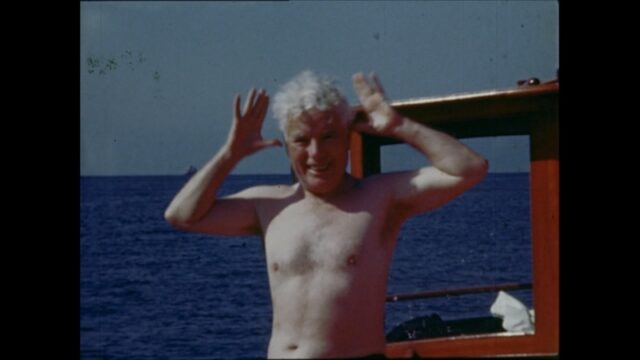
Chaplin, Spirit of the Tramp (screening at Festival Lumière in Lyon following its world premiere last month in San Sebastián where it won the Irizar Basque Film Award) is a deceptive affair. The documentary offers startling new insights into the family background of arguably the most famous movie star of the 20th Century.
Chaplin has always been regarded as the quintessential Londoner but the film (directed by Chaplin’s granddaughter, Carmen Chaplin and sold by Film Constellation) makes a very compelling case that he may have been born into a Romani community in the Black Patch in Birmingham. (That would make him from the same stock as Steven Knight’s Brummie gangsters, the Peaky Blinders).
Chaplin’s origins, though, are only one part of the story Carmen is telling.
The film is also closely focused on her father, Michael Chaplin. Chaplin fans will know Michael as the brilliant young child actor who co-starred in Chaplin’s 1957 comedy A King in New York. Michael has had a colourful life since then. As a teenager, he briefly became estranged from his father after running away from home to be with his girlfriend. Although they were reconciled and Michael revered his father, he also regarded Chaplin’s celebrity as a huge burden.
“His success was rammed down my throat,” Michael told the Guardian earlier this year.
In the 1960s, Michael became a drifter and a hippy, acting and getting involved in the pop world. He recently published his first novel. He has also exhaustively researched Chaplin’s family background and Gypsy links. His investigations provide the film with one of its main narrative strands.
Carmen can’t provide definitive proof of Chaplin’s Birmingham roots – the comedian’s birth certificate is lost.
“Because this film had several subjects in it, you needed one through-line. My father is very shy. He was in love with the idea of celebrating Gypsy culture but he wasn’t in love with the idea of being the protagonist of the film,” Carmen says of Michael. “I had to drag things out of him.”
The director adds that she was determined not to be “sensational” or to trick Michael into revealing anything uncomfortably personal. “I wanted to do it with a lot of respect.”
Spirit of the Tramp was originally conceived several years ago, by Carmen’s sister, Dolores. At the time, Carmen herself was busy bringing up her daughter. “I wasn’t going to make a movie. I was just in motherland.”
But then Michael became ill and almost died.
“All of a sudden, I really wanted to make the film. I wanted to go on that journey with my father…I wanted to explore Charlie. I became fascinated with the whole subject.”
Carmen herself had an idyllic childhood. She grew up “in the middle of nowhere” in a farmhouse in the south of France with her brothers and sisters “and lots of goats and chickens.” The free and easy life here was very different from the luxurious but more formal world she experienced during occasional visits to the ‘Manoir,’ her grandfather’s home on the banks of Lake Geneva in Switzerland.
Chaplin died in 1977, when Carmen was five, but she remembers spending Christmases with him. “I was a toddler, a little child, and he was a very old man…in his older years, he was more drawn into himself, introspective. We would have dinner in this other room with the nanny and then we would go into the sitting room with the grown-ups.”
A huge extended family would be present at such gatherings. The children and teenagers would play around in the gardens, often being filmed by Chaplin’s wife Oona. (The home movie footage features prominently in the film).
Making the documentary entailed delving deep into Chaplin’s past. Carmen explored the sites of the South London workhouses where Chaplin grew up and the asylum where his mother Hannah (a former music hall artist) was incarcerated.
Visiting the south London haunts of Chaplin’s childhood was, Carmen says, like “entering another world.”
“I found it very emotional. Obviously, I knew about the poverty, I had read about it, but when you’re making the film, you do research and you’re in those places. I just found it so mind-boggling that [he] would be so dehumanised, being poor in that way.”
Despite her own grim circumstances, Chaplin’s mother Hannah “managed to instil dreams and artistry” in the young boy. “She still managed to give that to her children. If she hadn’t, I don’t think Charlie would have come out in that way.”
Late in his life, Chaplin received a letter from a man called Jack Hill who told the comedian that he had been born in the “Black Patch” Gypsy Roma camp near Birmingham.
The comedian had been told many different and often contradictory stories by his mother about his birthplace. “There’s no proof of anything,” Carmen says, but as her film makes clear, Chaplin relished the idea of his Romani roots. “He really saw it as something that added to his creativity and his imagination. I know that it is a romantic notion.”
Michael has been to Birmingham to find out more about Chaplin’s links there.
“My father met Jack Hill’s daughter. She said that Jack Hill never told his family that he was a Gypsy. It was something he kept secret.”
Chaplin’s Brummie origins are not “tangibly provable” but he himself took them very seriously. “It remains part of his mystery…he received thousands of letters but that [the one from Jack Hill] was the only one he kept.”
Part of the Gypsy tradition is to travel and not to put down roots. This is one characteristic the family seems to share. Carmen’s aunt, Victoria Chaplin, likens them to mushrooms that can flourish in any environment. Carmen herself has a Trinidadian-Irish mother; she grew up in the south of France; comes from an English family on her father’s side, and has an Indian husband. “I feel like I could live a bit anywhere but I am not from one place,” she reflects.
This is Carmen’s first feature film and also her first documentary. She worked on the screenplay with Ashim Bhalla (her husband), Isaki Lacuesta and Amaya Remírez.
Dutch company Submarine collaborated on the animation. “Thinking about Hannah and her story and that era of the music hall, I thought it is such a cinematic era and so dramatic…I thought how can you bring her to life just to honour her. Animation seemed like the right way.”
The project is a family endeavour. Carmen’s daughter features, as does her aunt, Geraldine Chaplin, and many other distinguished relatives.
Some prominent film industry figures also give interviews, among them double Palme D’Or winning director, Emir Kusturica, and movie star, Johnny Depp.
“With Emir Kusturica, I just so loved Time Of The Gypsies…I had heard him talk about Charlie and I liked his insights. Then Johnny Depp, the same. We had met him and I really liked his spirit. There was something very generous about him and he had worked with [Gypsy band] Taraf de Haïdouks.”
A Romani in Birmingham who read Michael’s palm told him: “Don’t dig up the dirt with Hannah. She doesn’t want it. It is too painful.”
Carmen took this advice to heart.
Not that Spirit Of The Tramp is a sanitised account. It looks in depth at Michael’s complex and sometimes painful relationship with his father. It celebrates Hannah and refuses to treat her as a victim. “I thought to be a young woman in the music hall and to have three children with three different men, she must have had a lot of life and lightness in her – and to also always try to make things right for Charlie…she had to have been quite a luminous character.”
Spirit Of The Tramp was made through Atlántika Films (ES), Basque Films (ES), Constellation Prods (BE), Kwanon Films (UK), Roy Export Company Establishment (UK), Submarine Sublime (NL), and Wave of Humanity (ES). The film won the Irizar Basque Film Award in San Sebastián. Its French premiere is at the Lumière Film Festival (12-20 Oct). Periscoop has taken Dutch rights while BTeam is overseeing the Spanish release.





