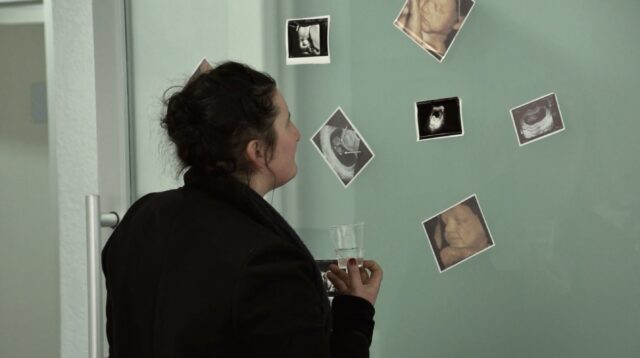
German co-producer Sylvia Nagel of Vincent Productions spoke to Business Doc Europe about Georgian Ketevan Vashagashvili’s intensely moving story of surrogacy in her home country of Georgia.
The synopsis of 9-Month Contract reads how, in the heart of Tbilisi, 25-year-old Zhana decides to become a surrogate. As a homeless single mother, she is driven by a desperate hope to give her teenage daughter, Elene, a safer and brighter future. But her decision leads to a never-ending odyssey that traps mother and daughter, making them confront cultural taboos and navigate the complex world of surrogacy.
“The emotional, ethical, and physical trials they undergo raise questions about the extent of a mother’s sacrifice,” Nagel stresses in her notes for the film, currently at rough cut stage ahead of a mooted March 2025 delivery.
Nagel explains the urgency of the documentary. “Thousands of women choose surrogacy as a solution to their own and their families’ financial hardships. However, the industry remains unregulated. The rights of surrogate mothers are often neglected, leaving them without proper physical or mental care. Many women also hide their pregnancies to avoid judgment from a traditional, often critical society,” she says.
“That’s why we believe that the project is important for audiences. And surrogacy is a topic worldwide. More and more families are not able to have their own child and decide to get a surrogate baby. Couples from various countries such as China, Israel or Scandinavia are coming to Georgia. This year it seems that there are the highest number of surrogacies in Georgia.”
Director Ketevan Vashagashvili has known the protagonist of her film for many years and has been able to build up an intensive relationship with her and her daughter. “This is one of the movie’s strengths. Cinematically, she has also been able to create a great closeness, so that we, as viewers, can experience the protagonist and her daughter and their commitment to a better future at first hand. Ketevan has already shown in her earlier works that she can create this closeness.”
Nagel further indicates how the look of the film and particular details emphasise the emotional dilemma at its heart. “The camera is observational. It immerses the viewer deeper and deeper into Zhana’s unexpected life. In addition to the close observation of her and Elene, there are details in close-ups to observe the things happening around them and to experience Zhana and her daughter in their emotions. These close-ups convey Zhana’s situation in which she is trapped and unable to break free. This close angle also hints at her naivety and fragile view of the world. The tight framing can evoke a sense of claustrophobia in the viewer, which dissolves into long rhythmic shots of hospitals and the city – the conveyor belt of indifference. This visual approach captures Zhana’s loneliness and the feeling of being an outsider in this society.”
Director Vashagashvili adds: “In contrast, Zhana’s home is her safe place. Her relief from claustrophobia. The house is the dream she tries to hold on to. In this home, a calm, observant camera captures the tender mother-daughter relationship. The movements are gentle, sometimes dialogues with Jana arise. She naturally turns to the camera – or the camerawoman, because she trusts me. These dialogues create another layer in the film, in which Zhana and I see the world from different perspectives, even though we live in the same society. And as we both go through the filming process, the audience can observe the changes in perspective through these dialogues.
In Leipzig, the team is looking to secure sales representation, buyers across traditional and digital platforms and partners for an Impact campaign. “The Impact campaign will aim to bring attention to the urgent need for stronger regulations in the surrogacy industry, both in Georgia and in the countries where intended parents come from,” Nagel ends.