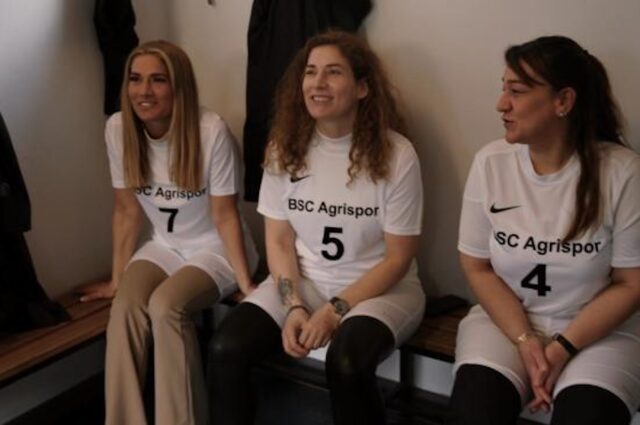
It’s now almost 30 years since German-Turkish filmmaker Aysun Bademsoy was told by a friend about a Turkish women’s football team in Berlin and decided to make a film about them. That was Mädchen am Ball (1995). Arzu and her teammates were both highly skilled players and charismatic, fascinating and glamorous characters.
Michael Apted-like, the director has stayed in touch with the players ever since, periodically detailing their lives in new documentaries. The latest feature, Game Changers (world-premiering this week in DOK Leipzig’s German competition), catches up with the same characters as they live their lives today.
The women are now mothers with grown up kids of their own. Several, though, still seem caught between two cultures. They’ve prospered in Germany but some also feel a deep nostalgia for Turkey.
“Nazan and Nala don’t think about going back to Turkey,” the director reflects on some of her replies. Arzu has considered returning but, as Bademsoy points out, Turkey has changed dramatically over the last 20 years. “It is really hard to go back and live there. It is such a different world.”
There is now a strong bond between director Bademsoy and the players. Occasionally, there have been periods when they haven’t seen each other for a year or two, but they’ve continued to talk on the phone, and to send holiday greetings – and eventually to make new documentaries together.
“I like the people I make films about,” the director observes of how the women in the football team have long since become her friends as well as her subjects. She adds that almost all of her work deals with the experiences of migrant communities. “My focus is mostly on the women – how they’ve stayed here [in Germany] and planned their lives…sometimes I feel like an ethnologist!”
The football players had strict parents who sometimes frowned on their sporting endeavours. They’d often have to sneak out of their apartments to join in games. Now, they have had to decide what freedoms to give to their own children.
Not that this is in any way a dark film. The women themselves are (as the director describes them) “so nice, so warm, so open…I see they are really, really intelligent people. They understand so much. We are so close and they opened their world to me…they understand that it [the film] is not only about them. It is about a generation of Turkish women. And I think that I opened a door for German or European people to see a world they don’t know.”
There is a very telling moment in the documentary when Selin, the daughter of one of the players, observes: “If others don’t accept that we are Germans, how are we supposed to accept that?”
The director herself came to Germany when she was nine years old. Her father was very strict about making sure she quickly learned how to speak the language. He also pushed her to study hard. “I had fights with my parents too,” she acknowledges but she grew up in a far more open environment than many other German-Turkish women of her generation. “I was lucky because my older brother helped take me with him to concerts, bars and parties. He opened a door for me. I saw worlds other than the Turkish life.”
Bademsoy had boyfriends. Even more startling to some of the more conservative members of the Turkish community, she also had male friends who weren’t her boyfriends. And it helped that her mother was a huge movie fan. Every weekend, they’d go to the cinema.
Filmmaking now runs in the family. She is married to the renowned German director Christian Petzold, whose films have won Silver Bears at the Berlinale.
“I met Christian at the university…after six or seven years, I married my husband. They [her Turkish friends] would say ‘what? So long!” She laughs when she remembers the surprise that their wedding didn’t come sooner.
Their children are “more German than Turkish. I don’t like to press on them the Turkish religion or culture…[but] since they were small, we always went to Turkey in the summer. They know Turkey, they know the place where I grew up. They like to be there, like me.”
And, yes, she always reads the treatments for her husband’s films. “And he always reads my treatments, for my documentary stuff. We talk so much about films. Always, if we have time, we watch so many films, in the cinema or on TV…both of us, we are cineastes!”
Petzold recently finished his new feature – and immediately asked her opinion about it. “It’s looking…from the point of view of a woman. It’s important for him to know that…we help each other.”
Bademsoy talks about her own life with the same openness as her protagonists in Game Changers. Her documentary, which was produced by Pong Film, was supported by BKM and Medienboard Berlin Brandenburg. It doesn’t yet have a sales agent. The director is not sure what will happen to it now although some festivals (including the Boston Turkish Festival) are keen to show it.
“I don’t know what is going on now,” she says. However, she is committed to making further films about the women – and to continue chronicling the Turkish migrant experience in Germany in all its colours and contradictions.