

After the full-scale invasion of Ukraine by Russia in February 2022, many Ukrainian refugees arrived in Amsterdam. Some of their stories are told in All is Well, the heart-rending new feature doc from Petra Lataster-Czisch and Peter Lataster, receiving its world premiere in IDFA’s ‘Signed’ section.
“The city made a big effort to find places for them. We wanted to do something in regards of what it means to be a displaced person,” Peter remembers how the project, filmed in the municipality of Weesp, began. “How does that affect all the things in your life – your personal relationships, your ambitions for the future of your relations with your children?”
They decided to explore the situation of the refugees primarily from the point of view of elderly Ukrainian women. “We know that in Ukrainian society, the ‘babushkas,” the grandmothers, have a very high status…we wanted to find out what it did to them to lose their family, their normal habitat, and how they feel about it,” Petra says.
The documentary includes moments of raw grief, for example when one of the grandmas visits the grave of a beloved son or when she returns to her abandoned home in Ukraine (accompanied by the filmmakers).
“Oh, life goes on,” Zoia sighs, between tears. She had told the filmmakers, to whom she had grown close, that she was planning on going back. “We said ‘if it is OK, we will accompany you.’ She was very surprised…[but] she loved the idea,” Peter recalls.
“We like each other very much and she simply allowed us to film what I am convinced a lot of women have to go through now,” Petra notes.
And, yes, it was emotionally wrenching for the filmmakers too. There were moments when they wanted to lay down their camera equipment and to console her.
“It was very difficult but, at the same time, you could see she was totally in her own world at that moment…the whole thing took maybe 10 minutes and she needed that time to settle down in the house. There is this big outburst of emotion and then she finally calms down a bit and realises she is home and there is nobody there. That was also the moment when she said she wanted to stop filming…it was getting too much,” Peter remembers.
“She told us that she always had these outbursts when she comes back [to her home].”
On the same visit, they record her reunion with her husband who is in his early 60s and has finally decided to quit the army (which at his age he is entitled to do).
When they’re in the Netherlands, a very long way from their country, one of the main ways the refugees stay in touch with their own culture is through food.
“It was so moving. When we were filming, all of the women came again and again with food for us. It was impossible to refuse for two reasons – you are not kind if you refuse but also it was impossible to refuse because the food is so well done!” Petra observes.
“We put on a bit of weight and so now we have to lose it again,” Peter chimes in as he remembers the borscht, the bread, the cakes and the elaborate Christmas feasts.
In their 2022 feature doc Journey Through Our World, which also played at IDFA, the Latasters turned their camera on themselves during the pandemic. As the outside world ground to a halt, they looked for drama and humour in their everyday life.
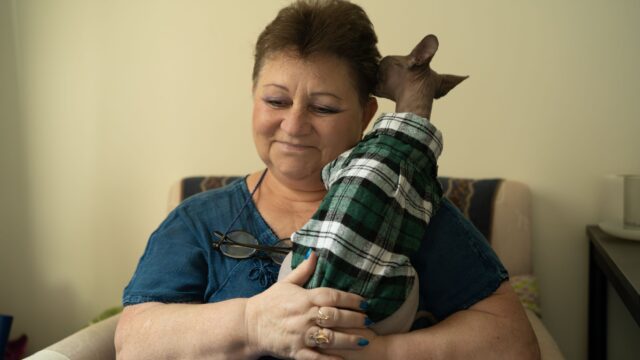
Some of that intense focus on the minutest details of domestic existence is also present in the new film. We see characters with their pets or cleaning their rooms.
“The Ukrainians love their cats and dogs. A lot of people brought their animals,” Peter observes. “That was part of life in the shelter. It was really lovely…”
At the same time, as they look at their cellphones and TV screens, the refugees are hearing distressing details about the war. Meanwhile, Dutch politics is swinging to the right. Populist ministers are calling for the Ukrainians to be sent back home despite the war.
“We thought we should have a few of those moments in the film but, at the same time, it should be seen from the Ukrainians’ view. That’s why there are Ukrainian news clips…a lot of people are aware about the politics [in the Netherlands] and they are worried about the change of mood in western Europe,” Peter says.
“They [the refugees] are worried they will be forced to go back,” Petra says of the anxiety caused by the Dutch right-wing politicians.
The filmmakers would visit the hostel “a few days a week at different times – and we made appointments with the women when we could film them.”
The subjects clearly trusted the two Dutch directors and raised no objections to their presence. “The people that we film know and feel that we deeply respect them and that we like them,” Petra remarks on the strong bonds they developed with their protagonists.
Some of the women have jobs. They say, “thank god for my work. If I didn’t, I would be thinking of the war all the time.” For others, time weighs heavily. They’re homesick and anxious about their loved ones. They are resourceful, though. Working or preparing food is one way of keeping misery at bay.
The shelter is “very basic.” None of the residents have private kitchens or bathrooms, “none of that.” They will often live two or three to a room. “Often I am amazed by the fact that they can do it. A lot of those people have been living there for two years or more,” Peter notes. They make the best of it, though. The Latasters were able to take part in the enormous Christmas feast that the Ukrainians put on, finding joy in adversity.
As usual, the two filmmakers produced and directed the film together. Dutch distribution will be handled by Mokum (the cinema release is straight after the IDFA screenings). The documentary was commissioned by HUMAN TV Channel. Supporters included the Netherlands Film Fund, The Dutch Foundation for Public Broadcasting (NPO) and the Veterans’ Fund.
Veteran sales agent Jan Rofekamp (founder of Films Transit) is consulting on sales.
“We got the money in a very pleasant way, I must say,” Petra reflects on a documentary that proved very straightforward to fund, partly because of the reputation of the filmmakers and partly because the subject matter was so compelling.





