

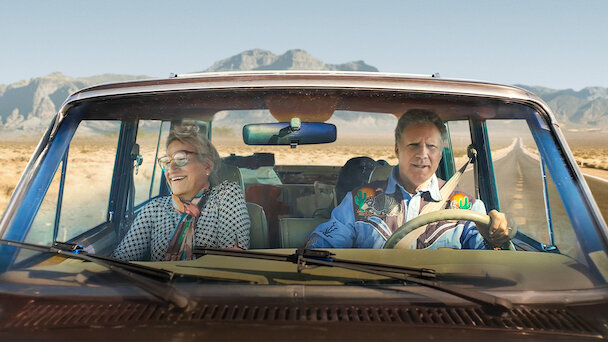
Will & Harper is one of the front runners for major awards this year. The Netflix-backed film following comedian Will Ferrell and his friend Harper Steele on a 17-day road trip across the US has already won Critics’ Choice and National Board of Review accolades while being nominated for a host of other prizes since its Sundance premiere last January.
Harper (formerly Andrew) Steele used to be head writer at Saturday Night Live (SNL). She started working there three decades ago, at exactly the same time Ferrell began to perform on the show. They’ve been close friends ever since. Steele was – as Ferrell describes him – “Iowa born and raised, 501 jeans, shitty beer, a hitchhiking type of guy.” After the pandemic, she transitioned to live as a woman.
Director Josh Greenbaum came on board to chronicle what turned out to be an emotional and revealing journey shared by the two old pals.
“My first goal in making the film was to keep the crew as small as possible and to maintain a very intimate, safe space for both of them to open up and be vulnerable,” Greenbaum explains his approach.
As Will and Harper drove, Greenbaum was in a van in front of them with a camera operator and a sound technician. “But occasionally I was in the back seat and sometimes we were filming from behind them.”
They were also accompanied by a large RV that was carrying their luggage, and where the “data wrangler” was based, downloading the footage as it was shot.
“We were like a three-car caravan crossing America,” Greenbaum describes the makeshift team. He tried to keep the documentary “as unplanned as possible” so that it was very open and spontaneous. “Really, we were just following Harper and Will on their journey. On a given day, they might spot something on the side of the road like a small bar or the hotel they were going to stay in. We just had to follow along, all in the name of keeping things as natural and organic as possible.”
The trip starts in New York City, which was where Harper and Will first met through SNL all those years ago. It ends in LA. The travellers knew that they would stop off at an NBA basketball game during their trip and that they would visit Harper’s home town but, beyond this, the itinerary was completely open-ended.
Greenbaum pays tribute to his producers, among them Samantha Apfel, for keeping the project going. “Every day, you’re figuring out where can we stop for lunch and where are we going to house 12, 13 or 14 people,” he talks of the often daunting logistical challenges.
“I was [also] concerned whether these two very funny comedians would ever really open up with one another,” Greenbaum acknowledges one major potential misgiving early on. “If you’ve spent any time around comedians, being emotionally open and vulnerable is not necessarily one of their strengths. They’ve usually built up coping mechanisms in the name of comedy and making other people laugh.”
In this case, the director realised the trick (“the beauty of documentary” as he puts it) was just to keep filming. Sooner or later, the subjects were bound to loosen up.
There were uncomfortable moments along the way but also times when the filmmakers were expecting a rough reception and found the reverse.
“Every day, there were surprises that I would never have predicted.”
Mid-way through the trip, for instance, Harper decided she wanted to go into a bar in Oklahoma alone. This was very different from being accompanied by Will Ferrell, one of the most popular comedy stars in the US.
When Greenbaum saw the pro-Trump posters, the Confederate flag and the ‘fuck Biden’ signs on the walls of the bar she chose, he feared the worst. “I had to go there first to get the cameras in place. I didn’t tell anybody what we were filming. I said we were filming a couple of people on a road trip and most people stopped paying attention.”
Greenbaum fully expected the locals to give Harper a tough time. After all, she was a trans woman in what seemed to be a very redneck dive, full of pool playing, beer swilling rowdies.
“My prejudices and biases were proved totally untrue and wrong. In fact, she was met with quite a lot of acceptance and love. She was in that space for an hour before she texted Will to come in. That was incredibly surprising and heart-warming – and, I think, affirming of the notion that it is hard to hate up close. That was something we found over and over.”
By contrast, a few nights later, when Harper and Will stopped off at a steakhouse in Amarillo, Texas, they had a far more uncomfortable time – and only partially because Ferrell had gone into the restaurant dressed as Sherlock Holmes. (The comedians have a private joke among themselves of wearing fancy dress at events where such costumes are not required). Harper immediately felt very uncomfortable, the mood in the room changed, and some harsh words were shouted out by the other patrons.
“But really where we found all of the hate throughout our trip was unfortunately online…I think that’s a reminder of this notion that while social media has connected us, it has also dehumanised us in a way.”
The film, though, is already successfully challenging transphobic prejudices. Having it on Netflix, Greenbaum asserts, is the equivalent of a massive impact campaign. “The sheer reach of Netflix is in and of itself an impact campaign. At core, that is our goal – to get this in front of as many people as we can.”
When Greenbaum and his team partnered with advocacy group GLAD, one startling statistic they were given was that 70% of Americans claim they don’t directly know a trans person.
“It becomes this unknown. Unfortunately, for human beings, the unknown is synonymous with scary…for these people who don’t known a trans person, now if you watch this film, you know one – you know Harper. It’s hard to deny her humanity and what she is wanting, which is to exist, live her life, and live her true self. I don’t know why anyone would deny another human that.”
Trump spent a small fortune on anti-trans advertising during the recent US Presidential campaign. “Stories like ours, stories of love and friendship, are how we fight back. It’s that idea that when our leaders don’t set the moral tone, it is time for us to step in.”
Greenbaum has accompanied the film to screenings all around the world, to an overwhelmingly positive response. “She [Harper] is not an athlete and she is not 16. That removes some of those counter arguments that everyone just loves to zero in on.”
The director has known Ferrell for a long time and testifies that, yes, the Anchorman and Elf star is just as affable off screen as he is funny on it. He adds that one of the “joys” of doing the documentary was being able to “share the Will I know…with the rest of the world. He is that genial and he is that kind. That is not manufactured in the editing room.”
When Ferrell’s father saw the doc, he came up to Greenbaum after the screening, saying “that’s my boy up there. That’s the son I know I raised. Thank you!” The father said this was his “favourite thing Will had ever done.”
This was one project on which the protagonists approached the filmmaker rather than vice versa – and Greenbaum was immediately keen to take part. The doc was made independently and then sold to Netflix after Sundance. The filmmakers had ended up shooting 250 hours of footage and then had to work out how to assemble that into a film.
Greenbaum was a psychology major at Cornell and Oxford University. That background comes in handy when he is making films. “Ask the question and then shut up and listen,” he suggests is a psychologist’s technique which applies surprisingly well both to documentaries and to drama. Awkward pauses should be embraced rather than shunned. “That, in our film, proved invaluable. They [Will and Harper] took that to heart. As you see, in the course of the film, they get more and more open and willing to be vulnerable with each other to the point that by the end, you can see there are no walls between them or artifice being put up.”
There is a lot of harrowing and emotional material in the doc but it is always leavened with humour. “I hope that is what welcomed the larger audience to this. People who think they may not want to engage in the conversation around the trans community and trans people might will end up dipping their toe in the pool because it’s Will Ferrell and it’s a much easier ramp into this world,” the director concludes.





