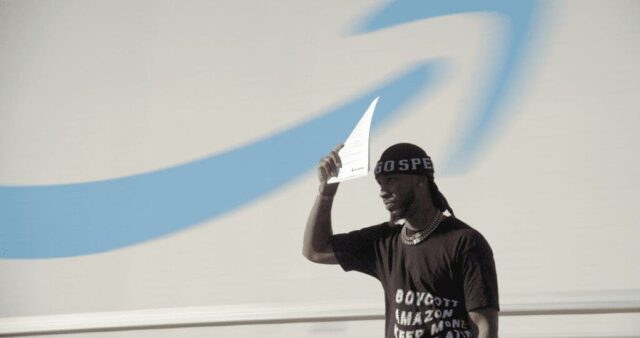
In this year’s Oscar race, Union, directed by Stephen Maing and Brett Story, is very much the underdog. This was a film warmly received at Sundance 2024, where it won the U.S. Documentary Special Jury Award for the Art of Change, but which theatrical distributors and streamers alike ended up shunning. Its subject matter was simply too explosive for them.
The feature doc tells the story of The Amazon Labor Union (ALU) — a group of current and former Amazon workers in Staten Island New York. They’re the David taking on a modern-day Goliath in the shape of Jeff Bezos and his Amazon empire. Bezos doesn’t wasn’t unionised workers.
“We’ve been invited to almost 100 film festivals internationally…but at the same time we had a sense we weren’t going to be able to bank on the likelihood of getting any significant streamer or studio distribution,” Maing explains. Certain major distributors told the directors that, yes, they loved the film, but that they couldn’t acquire it because either they “did too much business with Amazon” or the labour issues that the film broaches were too “discomforting for the people higher up” in their own companies.
That’s why the filmmakers put together their own self-distribution plan and released the movie themselves. This involved worker screening series on which they partnered with trade unions across the US.
“People are really hungry for this film,” Maing insists after the enthusiastic response to Union from Amazon workers themselves.
The film has also had significant play abroad. Festivals from IDFA to CPH:DOX, IDFA and Visions Du Réel all programmed it. It had a theatrical run at Bertha Doc House in the UK.
Union is an immersive experience. It avoids talking heads, interviews and “experts.” The directors shot 600 hours of material over 300 days and worked in the classic tradition of verité cinema.
“The thing about verité filmmaking is that you have to be observant about the things that seem they don’t matter. You have to be there all of the time,” Story suggests. “You can’t plan for dramatic moments. In fact, you have to be a keen observer of the non-dramatic moments.”
Co-director Maing is a cinematographer himself – and had employed Maysles brothers-like observational tactics on his earlier documentary Crime + Punishment, about systemic racism in the New York police department. On Union, he was working alongside DoP Martin DiCicco.
The Amazon workers trusted the filmmakers because they put in so much time. “Showing up was its own form of demonstrating our commitment to their struggle. For us to be there every day when there was no other media signalled to them that we took them seriously – and because they understood we took them seriously, they were very, very open with us,” Story notes.
Being there almost all the time also meant that the filmmakers were available to record such disturbing moments as when the union representatives are arrested by the police simply for being on Amazon property.
“We didn’t know that that arrest was going to happen but we were on the ground with our participants,” Story says.
At the centre of the film is the charismatic union leader Chris Smalls, the ex-Amazon worker who has described the ALU as the “N.W.A. of the organising world.” He had been fired for supposedly “violating Amazon’s COVID-19 protocols” but many viewers will suspect that it’s his union activism that most upset the Amazon bosses.
The film includes some footage shot by workers themselves inside the Amazon warehouse. This was deliberately done on the fly. “We made the decision – it was an aesthetic but also a political decision at the beginning of making the film – not to ask Amazon for permission to get our cameras inside. We knew that would be a compromised situation. We would be taken on a PR tour!”
During the pandemic, for the first time, Amazon workers had been allowed to bring their cell-phones to work. (Previously, they were obliged to leave them in lockers at the start of shifts). That’s why it is rare to see footage from the warehouses. Now, though, workers are beginning to document the conditions on the shop floor.
“This isn’t glossy high production footage of an Amazon workplace that the company heads are allowing us to see. This is footage of workers trying to show the outside world what their conditions are like,” Story says of the grainy material from inside the mausoleum-like Staten Island Amazon facility. It is very different in tone from, say, the Amazon workplace shown in Oscar-winning film Nomadland – a movie that Story describes as being “defanged…the book is much more political than the film.” (She is well qualified to pass judgment. Her earlier short CamperForce, about seasonal workers at Amazon, was adapted from the ‘Nomadland’ book by Jessica Bruder).
There is material in the documentary showing Amazon’s “union busting” meetings where they try to “educate” workers about labour issues – but their real intention is to pressure and manipulate them into voting ‘no’ in any ballot about whether unions should be allowed.
This was a tricky project to structure. At the outset, Story and Maing weren’t sure whether an election about the possible formation of a union would even be allowed. You need 30% of workers to support such a measure. When the vote finally went ahead, there was then no guarantee the union would actually win.
“We as filmmakers needed to understand that there would still be a film, even if the campaign didn’t follow a linear path. We filmed it in such a way that could prepare us for that,” Story says. She argues the documentary is as much a study of “group dynamics” as it is a story about an election. “The film is about a group of ordinary people [who] become politicised by their workplace and then learning in real time how to become organisers. That does not require a linear storytelling trajectory.”
If the ALU had lost the election, the documentary would have started with that loss – and then start to ask probing questions about race, class, companionship and “what it means to think about unions in the 21st Century, in the post-Reagan and post-Thatcher world.”
In the event, the ALU was victorious. It therefore made sense to adopt a chronological approach.
“This wouldn’t have worked as just a campaign film because there was no brilliant strategy that got them there,” Story suggests. This was a film instead built on a foundation of “very small moments.”
There were moments of tedium as well as of rancour and stress along the way. Nonetheless, Story says the mood was also often joyful.
“A lot of these people don’t have anyone that cares about them. They are marginalised in society. They’re the workforce exploited by a company like Amazon…there is tons of precariousness and crisis in these people’s lives,” the director observes of the film’s subjects. Some live in cars. Some are ex-cons. They’re very conscious that society considers them “disposable” and second class. They can be fired in a moment. The union, and the film being made about it, showed that at last someone was paying attention to their problems.
“There was a feeling of real camaraderie…of really showing up for each other and cared for,” Story says of the mood during shooting.
Predictably, Amazon hasn’t welcomed the documentary. “We know they’re aware of the film. In the immediate wake of the election, the company filed a series of objections to try to get the election overturned, and they cited our film crew a couple times in those objections,” Story says. “The objections alleged that the crew was a hired film from Chris Smalls and that we were out there intimidating the workers.”
After the Sundance premiere, Amazon filed another attempt to get the election result overturned, citing the film as containing new evidence.
Now, though, Union is right in the Oscar mix. It has been quite an achievement to get on the short list given the lack of distributor support.
What would an actual nomination mean?
“It would mean a tremendous amount of exposure for the film and hopefully it would mean getting picked up – and getting to millions more people,” Story reflects. “If political work is not getting platformed and not getting awarded, it does harm to our democracy. We are in a situation where we can’t trust the news, we can’t trust the social media websites. We can’t live in a system in which our media is getting filtered by the interests of whoever has got the biggest pockets. Getting our film to nomination would signal to the field that audiences want to see political stories…we feel that we are a little bit mirroring the ALU. It would mean that the little guy still has a chance – and that a film without distribution can still break through despite not spending millions of dollars on a campaign.”