

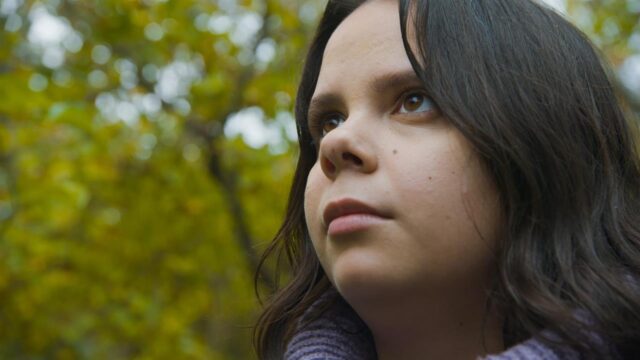
“Five minutes and 32 seconds from first shot to last,” Sam Fuentes states in her haunting voice over at the start of the Oscar short-listed film Death By Numbers (directed by Kim A Snyder and based on Fuentes’s journals). She is referring to the school shooting in Parkland, Florida, in February 2018. Fuentes was one of the shooter’s victims but, unlike many of her classmates, she survived.
The short documentary shows how she came face to face with her assailant in court, looking him in the eye as she read out a harrowing and very powerful victim’s statement.
Fuentes has been in London this week for a special screening of the film. (Director Snyder was due to attend too but stayed behind in the US because of a chest infection.)
Death By Numbers is one of several films that Snyder has made on the subject of gun violence, following on from Lessons from a School Shooting: Notes from Dunblane, which premiered at the 2018 Tribeca Film Festival, and Us Kids, a US Documentary Competition contender at Sundance in 2020.
In Us Kids, Snyder told the story of how some of Fuentes’s classmates launched their own grassroots campaign against gun violence after the horrific events at their school.
“I came to know Sam at that time and… I was just really intrigued by the story that has never been told, about this impending trial and what that was like for her to think about facing her shooter and how she was trying to work through trauma in the midst of that,” the New York based director tells Business Doc Europe via Zoom.
Fuentes is now based in New York herself where she is studying film at Hunter College. “We’ve become much closer as friends. She shared with me very privately [while] writing Death By Numbers,” Snyder says. She and her producer Maria Cuomo Cole immediately saw the journal as a very rich potential source for a film. “We didn’t know if it would be long or short but we decided to make a film that would interweave her own writing and her inner thoughts together with what happened in the trial.”
For Fuentes herself, the film was a way of “talking about the trauma and reckoning that comes along with these sorts of experiences and how it is often a ripple effect, constantly spreading.” She also felt the documentary would show that her “particular shooter wasn’t unique.” He belonged to a grim collective of other murderous psychotics “subscribing to an ideology of bigotry and hate – which is something that is overlooked oftentimes with these mass shooters…oftentimes, people like him are described as if they’re sick or mentally ill – there is something very much wrong with them.” (She deliberately doesn’t mention the name of her assailant).
Her argument, she continues, is that explaining away the atrocities as being a result of mental illness is “an overcorrection.” The killers are really driven by “hate.”
Together with Snyder, Fuentes made a conscious decision not to show the killer’s face until the moment when she is looking directly at him. Snyder talks of the movement in the US called “No Notoriety” which strongly advocates denying murderers the media spotlight that many of them crave.
It took huge courage for Fuentes to confront the shooter in court. “For one thing, to state the obvious, it was certainly frightening,” she says.
“I prepared quite heavily for both the testimony I had made as a victim but also my victim statement at the end. It was a lot of preparation. I knew that even though I had so much rage and so much sadness and frustration, I wanted to approach it with a foundation of dignity and composure because I know that people like these mass shooters, these effectively domestic terrorists, their hope is to know their reign of terror is one that lasts. They seek fear, they seek anger,” she explains why she worked so hard to show calmness and resolution.
Fuentes adds that her determination to expose the killer “for the person he was” helped her overcome any “nerves or fear or rage that I had. It felt like a duty in a way.”
Snyder knew from the outset that she wanted the film to “give Sam’s perspective,” and to show events through her “lens.”
“It was extremely stressful on two levels, both to absorb that pain and that trauma around me…but also we were terrified not to do anything that would compromise the legal process,” the director remembers. “God forbid we do something there’s a mistrial because of our film.”
Snyder was the only independent filmmaker who had access every day to the courtroom camera feed. She knew what it meant for Fuentes to confront the shooter after what she had endured. (The documentary deliberately withholds the “most horrific details”” about the massacre).
“I was just in awe of her ability to stare him down and to really try to reclaim her power. It was an incredibly powerful day to document,” she says.
Since Death By Numbers was launched at the Hamptons and Woodstock festivals in the autumn, Fuentes and Snyder have been travelling widely with the film.
“Doing Q&As and interacting with people is usually a comfortable experience and I learn a lot about the way people are responding to this, especially in the context of their own trauma journeys,” Fuentes says. “That’s what makes the world of difference to me, that I know I am touching people with this story.”
She acknowledges that it can be “exhausting” and sometimes “triggering” to keep revisiting such terrible events. “But the reception we get back from the film makes it all worth it. I know that in many ways, this film is upholding the legacy of the people we lost…and I think that it [accompanying the film] is a good beneficial challenge for me. In the whole journey of healing from my trauma, it is a very practical tool. This whole project was a way of reckoning with a lot of these emotions and grief and guilt and many things I was dealing with. The creative process has been a very therapeutic one for me.”
The screening in London this week was revealing. British viewers were appalled at the extent of gun violence which, shockingly, in the US is sometimes now simply accepted as a grim and gruesome part of everyday life.
“Unfortunately, living within American society, we are so used to these shootings. We are almost inured and desensitised entirely by them,” Fuentes observes.
“But I think it [the film] is about standing up to hate,” Snyder adds. Her earlier documentary, Notes from Dunblane, drew comparisons between the Sandy Hook school massacre in the US in 2012 and the mass shooting in Dunblane in Scotland in 1996. “That was really meaningful to me because we [in the US] have not learnt any lesson where every other country that has had this kind of horrific mass violence has done something corrective – and we have not.”
This was a true collaboration. Fuentes’ journals were, Snyder says, the “root of it all.” Director and writer decided between them which excerpts should form the “spine” of the film. “Sam was very involved. We are both music people. The score was extremely important.”
Snyder believes the documentary is now breaking new ground. “I don’t think there has been a film that has got recognition in this space that has had a gun violence survivor, especially a young person, as one of the creators involved…”





