

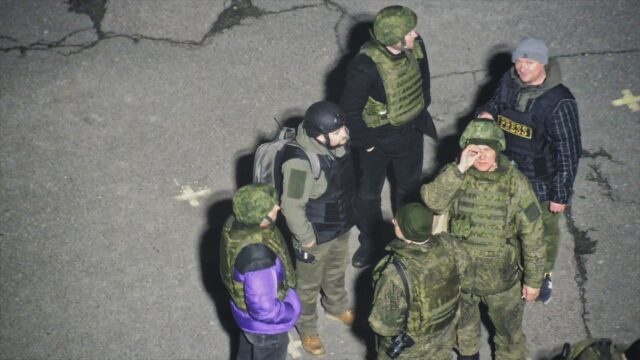
The Russian squaddies shown in Oleksiy Radynski’s feature doc Special Operation (a world premiere in Berlin’s Forum Expanded) don’t look like members of a world-beating army. The soldiers we see wandering around the Chernobyl Nuclear Power Plant a few days after the February 2022 full-scale invasion of Ukraine have a slightly gormless air, as if they are not quite sure what they should be doing, or why they are there, at the site of one of the greatest nuclear disasters of recent times.
“What you see in the film is that the much-feared Russian army that had this image as an unstoppable and ruthless force is actually extremely incompetent and ridiculous, in a way unprofessional – deeply dysfunctional also,” Radynski reflects on his hapless subjects (who were at the plant for around five weeks).
These soldiers could have seemed almost comical were it not for the fact that their unit had already been committing atrocities in cities like Bucha. They were dangerous and desperate men with no respect for human life or dignity.
Radynski’s footage all comes from video cameras at Chernobyl. The Russians realised they were being filmed and tried to tape up the camera lenses and turn off the cameras – but (typically) they failed to do an efficient job.
“They found some of the cameras but they didn’t find most of the cameras – and they didn’t know how to turn them off.”
Proof of this is that the director ended up with almost 1000 hours of material to make his documentary from.
This is the second film Radynski has completed about the Russians in Chernobyl. In his short, Chornobyl 22 (2023), he used footage from an anonymous informant who had filmed the Russians at the nuclear facility.
“I started the documentation of the aftermath of the Russian troops’ presence in the Chernobyl zone almost immediately after it had been ‘de-occupied,’” Radynski remembers what first took him to Chernobyl in the spring of 2022. His short was part of a much larger war crimes documentation project. He was recording the testimonies from the survivors of the occupation. Among his interviewees were the engineers who had been operating the video cameras. “They told me during these interviews that they had been trying to back up some of the footage to preserve as evidence of Russian war crimes and negligence at this nuclear plant.”
At grave personal risk, these engineers had been secretly storing their material on hard discs. Material that would have been deleted otherwise was thereby preserved.
It took the director around a year to trace this footage and get permission to use it. Much of it had ended up at the office of the Ukrainian Persecutor General who “kindly agreed” to share it.
Initial funding for the documentary came from The Reckoning Project, the initiative to collate testimony and evidence of Russian war crimes. There was also support from the European Solidarity Fund for Ukrainian Films. The film had Lithuanian co-producers (Studija Kinema) but was made through Ukrainian collective Kinotron. Producer was Lyuba Knorozok, with Jurga Kaye as co-producer.
All the CCTV material was silent but the filmmakers worked with top Lithuanian-based sound artist Vladimir Golovnitski, well known for his collaborations with Sergei Loznitsa, to create the chilling soundscape.
“I knew his previous work and I was always amazed by how he works, creating sound for archival footage, found footage that has no sound,” the director says of Golovnitski. “Basically, the concept we developed was very straight forward and simple. We just wanted to add the sound that was missing – the sound of things that are happening in the frame and, of course, some of the things happening outside the frame…this was based on a strict notion of realistic sound.”
The director adds that “all the sound elements are based on actual evidence and testimonies from the survivors of the occupation at the plant.”
Explosions are heard in the distance. There are no interviews and no voice-over. The director wanted the footage to “speak for itself.”
Radynski has spent a lot of time around the Chernobyl “zone”. Obviously, this is the location of a terrible nuclear tragedy – and the complex has become a monument to that tragedy. “It’s a disaster site that has to be maintained very carefully…there are lot of objects that commemorate the disaster.”
For the director, though, the zone is also “one of the most beautiful places on earth.” He rhapsodies about the wild life and the way “nature has evolved” in the absence of humans.
“The fact that the humans are gone doesn’t mean that nature goes back to some sort of original balance, because there is no such thing,” Radynski nonetheless dismisses the idea that some new Eden has sprung up in the shadow of the nuclear reactor.
Ukrainian troops there don’t just have to keep the place safe from further nuclear disaster but to stand guard against other potential invasions from across the Belarus border.
Radynski edited Special Operation entirely in Kyiv. As the director explains, documentaries are in his DNA. He grew up at a documentary film studio in the city. His family worked there. “It’s like a small campus. There are houses and apartment buildings for the workers.”
After the collapse of communism in 1991, the studio almost went bankrupt and soon fell into disrepair. It was still an exciting place for the young Radynski and his friends to roam around. And, yes, being there sparked his curiosity about becoming a filmmaker himself.
Now, Radynski is established as a prominent director. “It is a huge privilege to be able to continue making films. Of course, a lot of my colleagues are now in the army. Some of them are able to make films while in the army as well, some are not…but it is just a big privilege,” he repeats of being given the chance to make documentaries like this even after the full-scale invasion.
Special Operation has already been selected for several other festivals after Berlin (it’s too early to reveal details of which ones). For now, Kinotron is handling the sales and distribution duties itself.
The director, meanwhile, is thinking about his next project – and it looks as if it will be on familiar ground. “I should make one more film in Chernobyl. Maybe it is going to be a trilogy. I hope we can go back there again at some point soon…” he says of the force pulling him again to the Zone.





