Lviv in western Ukraine is Vitaly Mansky’s home town. This is where he grew up, eventually leaving when he was a young man to go off to Moscow, where he studied film at VGIK (the All-Union State Institute of Cinematography).
In his new feature documentary, Time to the Target (a world premiere in the Berlinale’s Forum), he once again returns to the city. He has filmed there several times before, for example on Gagarin’s Pioneers/Our Motherland (2006), about his classmates, and in Rodnye (Close Relations) in 2016.
The title of the new documentary refers to how long it takes a Russian missile to reach Lviv. This may be in the west of Ukraine but the city has still been bombed. Daily life, as the film reveals, has been upturned since the full-scale invasion of 2022. The film’s title, therefore, has an obvious metaphorical meaning. He isn’t just referring to the missiles but to how Ukrainians in Lviv and everywhere else “feel they are in constant mortal danger.” Ordinary activities take place under the shadow of constant tragedy.
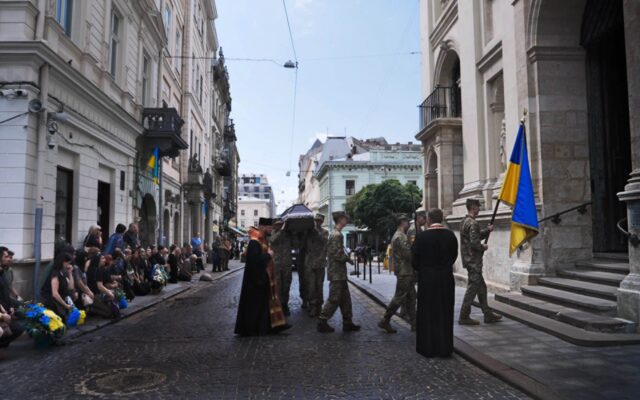
Among the main protagonists in the documentary are members of a military brass band. (A grim footnote to the film is that since the film was completed, these musicians have been sent to the front line where they will now stay until the end of the war). Also featuring prominently are the gravediggers. For obvious reasons, both groups are very busy. The band plays at funerals. The gravediggers bury the dead.
“I thought Lviv was an eternal city and that I know it very well… However, with the start of the first war in 2014, and later on, the full-scale war, when I was passing through Lviv, going somewhere else, I started to notice the gradual changes,” recalls the veteran documentary maker (whose previous credits include films such as Putin’s Witnesses and Gorbachev, Heaven).
Mansky took inspiration from Pieter Bruegel paintings that show humanity in all its colours and at every period from birth to death. While making the documentary, he accompanied the band members to hundreds of funerals.
“When I am shooting, I live with my film protagonists. I am trying to be honest with them. The musicians and gravediggers…we’ve become friends. We share pretty intimate information still. We keep in touch. I spent an enormous amount of time on the bus with the military band as they were waiting for the moment to come out to play at another funeral.”
He talks of the “psychological barrier” he felt in attending funerals or entering the homes of the grieving families. As it turned out, though, the mourners barely seemed even to notice the film crew.
“The level of grief is so high that those people don’t get distracted…during those funerals, no-one takes any pictures. No-one is shooting, even with mobile phones.”
Mansky may now live in Riga but he is a well-known Russian/Ukrainian filmmaker. He was wary how families who had lost their loved ones at the hands of the Russian army might react toward him.
“There were three different times when I found fathers of fallen soldiers looking closely into my eyes. I got really nervous because the most part of my life I have spent in Russia. I was a very famous filmmaker there. Can you imagine, we’re standing there and there is a funeral of a young man killed by the Russian army.”
After a funeral, one of the fathers came up to him. Mansky was frightened about what the man might do, but in the end the father thanked him “for being on our side.”
Time to the Target was made in collaboration between Vertov, Mansky’s company, and Czech outfit, Hypermarket Film, with support from Czech Television and Braha Production Company. When Mansky embarks a new project, he tends not to have financing and co-producers in place. He will start to shoot. Then, when he sees that “there could be a movie out of it,” he’ll begin to bring the relevant partners on board. He likes to work with “friends” and describes Hypermarket’s Filip Remunda as someone he knows well and trusts. “We’ve been together on quite a lot of projects and we think in the same direction.”
Since leaving Lviv as a young man, Mansky has returned there many times, He describes the city as “the place that formed me and a permanent source of strength.”
Over 30 years of filmmaking, he has rarely, if ever, “taken the camera in my own hands.” On this documentary, though, he did so. (He is credited as “additional camera.”)
“With words, with an explanation of what is or should be captured, it is impossible to convey the message correctly. It can only be observed and felt. I wanted the images to reflect my feelings,” he explains his thinking.
Mansky worked both with the film’s DOP Roman Petrusyak and Camera Operator Aleksey Leskov for the first time. Early on Leskov captured some eye-catching images but Mansky made it clear to him that he wasn’t looking for spectacle. He wanted intimacy and human warmth. The film is shot from eye-level so viewers can see events as if they themselves are participants in the everyday life of the city.
The director strikes a despairing note about Russia under Putin. Five years ago, he famously took part in a protest outside a Moscow prison, holding up a pair of underpants to signal his dismay at crude attempts to poison to the opposition leader, Alexei Navalny. Since then, Navalny has died in Russian captivity.
“In 2014, right after the Russian annexation of Crimea, I left Russia and came to Latvia because I didn’t want to stay there any longer. However, still some hope remained – and that hope was connected with what Navalny did. After his death, all hope is gone…”
Mansky used to trust in the Russian nation to do the right thing. He feels now, though, that they betrayed Navalny. “That is catastrophe for the nation, for the Russian state, and also a tragedy for Navalny’s family.”
“And since we are talking about documentary cinema, it is a pity there is no good film made about Navalny.”
He believes that no filmmakers or writers have yet done justice to the “full tragedy” of what happened to Navalny. “I won’t be able to make such a film myself. I just hope that it will be made some day.”
The documentary maker is equally downbeat about what cinema audiences are now prepared to watch. He believes they prefer shallower stories that are “easy to watch” and that films like Time to the Target are “too long and too complicated” to strike a chord.
And, no, Mansky doesn’t see a bright side to the story he is telling despite the endless courage and defiance of the people in Lviv. “I would like to say there is optimism in the film…but that wouldn’t be an honest answer,” he sighs.