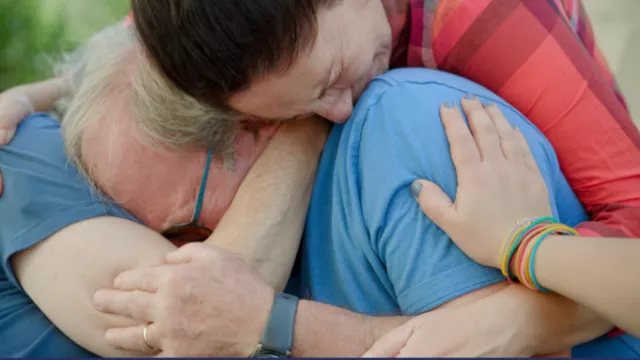
It’s the worst form of mental torture you can imagine – your child held hostage and very little you can do to free her. This was the predicament of the parents of Liat Beinin Atzili, kidnapped by Hamas on October 7 2023 along with her husband, Aviv. The story of how Yehuda and Chaya coped, and how they worked tirelessly to liberate their daughter, is told in Brandon Kramer’s feature documentary Holding Liat, world premiering February 16 in Berlin.
Kramer is a Washington DC based filmmaker. He remembers a few “key moments” which led to him taking on this project. He is a distant relative of Yehuda and Chaya. On a trip to Israel years ago with his brother and filmmaking partner Lance Kramer, he stayed with them on the kibbutz and he also stayed with their daughter Tal, Liat’s younger sister, in Tel Aviv.
“They were our introduction to Israel. We had a relationship with them.”
After Liat and Avid were taken captive, Kramer called Yehuda and Chaya just to offer his support and ask what they could do to help.
“It became clear from that phone call that Yehuda was not getting the responses that he wanted from the Israeli government. He was going to travel to the United States to our home town, Washington DC, to advocate for Liat and Aviv’s release.”
As Yehuda and Chaya were “thrust into the epicentre of this geopolitical crisis,” Kramer realised it would be “important to document what they were going through.”
“We didn’t know that we were making a feature film at all. We just felt a historic obligation to film these early moments.”
It was until Yehuda and Chaya arrived in the States with various other close relatives in tow that the Kramers realised that there was material here for a movie. Each member of the family had their own “unique political view.” They were facing “an unfathomably horrible situation.” The filmmakers decided that telling their story could help others try to make sense of the ongoing tragedy.
This is classic verité filmmaking. Kramer records the meetings between the Israelis and the prominent US politicians in a way that rekindles memories of celebrated direct cinema docs like Robert Drew’s Primary(1960).
“It became very clear to us at the beginning of this film that this was a story about this one family. That frame was such a critical rule for us when telling the story…there are obviously thousands of families suffering in Gaza and elsewhere from this conflict [but] we felt the lens of our film, the story we had to tell, was of this one family,” Kramer states. “That allowed a level of intimacy. When you’re a verité filmmaker, you have only one camera. It allowed us to hone in on each of the relatives and try to reach a level of depth with them.”
As he saw his relatives caught up in the Washington political world, Kramer was fascinated by the “interplay between the public and private…what it looks like when you are dealing with trauma that has global implications.”
One moment Yehuda and Chaya would be discussing their daughter’s plight with leading Senators. The next, they would be alone again in a hotel room.
This isn’t the first feature that Brandon has made following both the public and private lives of their protagonists. Other earlier projects like City of Trees and The First Step (both made with brother Lance) have adopted similar storytelling styles. Often, the moments that were the most revealing weren’t the meetings themselves but the incidents around those meetings. “We have a lot of experience in how to gain access to film very authentic moments,” Kramer says. “You find creative ways to build a level of trust where you be present and document these really important and revealing moments that really happen in the fringes.”
The director pays tribute to his DoP Yoni Brook, also a producer on the project, whom he calls “a masterful verité cinematographer who really knows how to clue into these intimate moments.”
Among the other producers of the documentary is Darren Aronofsky, the filmmaker behind such modern day classics as Requiem for a Dream, The Wrestler, Black Swan and The Whale.
When the Kramers realised how daunting the project was going to become, they reached out to contacts. “We started to mobilise every filmmaker in our network we felt could help us.” Brook had put them in touch with Aronofsky and they shared some of their early footage with him. “He was an incredible supporter…really more than anything he made sure we stayed true to the nuances, the complexities of the story we set out to make,” Kramer says of his illustrious collaborator.
On a human level, this was a challenging movie. Not only was Kramer dealing with deeply emotional and disturbing subject matter but he was very close to his protagonists.
“That balance was the most challenging part of making the film for me,” he says of how he tried to “both show up as a relative, somebody who loves and cares about this family deeply, and also as a documentary filmmaker. I had a lot of conversations with the family with the camera down, explaining to them the importance of documenting what was happening here, the moments of resilience but also the moments where things were really challenging.”
Yehuda, Chaya and the other relatives were going through “unimaginable pain and suffering,” and yet still never lost their sense of a larger perspective. Yehuda would continue to talk about peace and reconciliation despite the terrible predicament of his daughter and son-in-law. He and the rest of the family were prepared to “open up their lives” to the filmmakers in a period in which they were on an emotional rollercoaster.
“There were moments where I pushed too hard and that was really difficult for the family and I had to work through that. Then, there were moments where I put the camera down, just showed up as a relative to give them a hug and realised I had missed a moment and didn’t film. It was a really difficult line to walk.”
“I didn’t want to make this film,” Kramer adds. “This is not a story I wanted to tell but we felt an obligation to tell it. We had no idea how it would end; we had no idea if Liat and Aviv would ever come out. We had no idea what the family would go through.”
The story has some cruel twists. Joy and extreme sadness collide.
“We made it clear, and I hope the film is a testament to this, that we were never looking down the lens of our camera at the protagonists of our film but, by the same token, we were trying to document the story in a balanced way,” Kramer emphasises.
After its premiere in Berlin, the film will be going on the festival circuit. The project was shot in an extreme rush over a period of little more than a year. “You know, making this film was such a uniquely challenging experience in so many way…with thousands of people’s lives currently at stake, I felt my first and foremost job was to make the film. Now, my job is to make sure the film can reach audiences and generate the kinds of conversations that can contribute toward ending these cycles of violence,” the director reflects. “I can’t move on to the next film just yet…”