

Daniela Cölle has been at world sales, festival distribution and production company Pluto Film for almost a decade now. She joined the outfit in 2016 and then, in 2022, became managing director and head of acquisitions after she and partner Benjamin Cölle bought out the company. Benjamin, like colleague Daniel Vadocky (sales manager at Pluto) has a very strong background in documentary. What’s more, one of Pluto’s former owners was Heino Deckert, a big beast in the European documentary jungle.
It’s no surprise, then, that docs feature so prominently on Pluto’s EFM slate.
Cölle [Daniela] tells Business Doc Europe that the company is looking for locally “relevant” docs made by directors with storing personal visions.
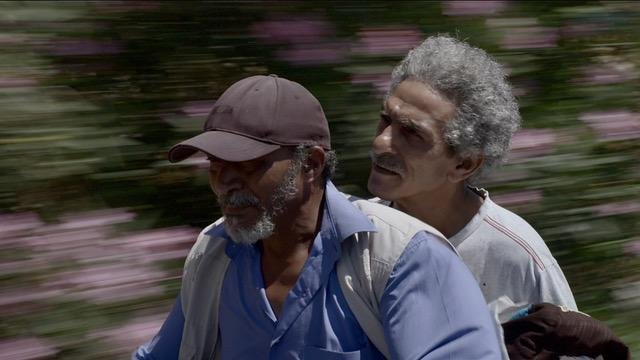
One of the titles the company has been representing in the Gropius Bau this week is Mathijs Poppe’s The Jacket, produced through Elisa Heene’s company Mirage and about an old jacket that stands for Palestinian identity. Cölle describes it as “a classic auteur-driven documentary when you are following your main character; it’s kind of like a road movie in a way.”
Also being sold in the market is Circusboy by Julia Lemke and Anna Koch. This is another road movie of a kind, about the extraordinary life of eleven-year-old Santino, growing up in the world of a travelling circus. The boy never stays in one place for long. He loves to hang out with his great-grandfather, one of Europe’s last great circus directors, who has become the boy’s best pal.
“It is a documentary for kids, a very specific genre that is rising a lot,” the Pluto boss says of the crowd pleasing big top tale. “The boy is travelling all the time, one of the last nomads of Germany.”
Meanwhile, TV production The Underground Railroad, made by friends and fellow filmmakers, Martijn Blekendaal and Finbarr Wilbrink, one black, one white, explores the roots of the huge racial and political divisions in the US.
“They’re travelling through America, following the underground railroad, discovering the history of slavery and modern slavery,” Cölle explains.
In Germany, getting theatrical docs into cinemas remains an uphill task. Nonetheless, Cölle has high hopes for Circusboy with German audiences while she sees The Jacket as the type of strong festival title that may well attract arthouse buyers.
“And with documentary series, of course, it is oriented to the platforms, TV stations and the streamers. There is a very clear definition and different way of selling it.”
Pluto has been moving into production recently with the new fiction feature The Melting Mood of Ecstasy, a gay-themed drama from director Julian Dieterich. And, yes, Cölle is looking to board documentaries as well as dramas at an earlier stage. She talks of “having this possibility to co-produce, to get into the funding [of documentary] and to offer a way to be part of the financial structure of projects.”
Apart from anything else, this allows the company a greater say in how films are shaped and ensures that Cölle and her colleagues get the movies they want.
“Of course, we are not going to do it with every project. We are not primarily a production company, but for the projects we would like to be part of from the beginning, we can offer all our experiences as a team at Pluto Film together with financial support…we are not the only ones doing this but it makes sense to join at the development stage.”
Cölle adds that there are also “opportunities” to board projects at a later stage and that she wants Pluto to be “more flexible and creative” in how it finances, makes and sells films.
Now that Pluto is firmly in the documentary as well as the drama universe, Pluto execs are travelling constantly.
“We started recently last year [in documentary] and so we have been at a few markets and a few festivals,” Cölle says. “I don’t think we will be completely crazy and travel everywhere, to every market. The documentary world is very complex. I think it is more about finding the partners, the other companies who are producing fiction and documentary.”
She confirms, though, that Pluto would be interested in working again both with Mirage, producers of The Jacket, and with Flare Film, the outfit behind Circusboy.
Cölle also points out that Pluto won’t be looking to represent more than “two or three” feature docs at any one time. The market and festival strategy will be driven by the films’ needs. “We don’t want to go everywhere – that would be impossible!”:
Thanks to the hard work of Pluto’s festival manager, Rebecca Hartung, the company has already established good relationships with most of the key documentary events in the calendar. “We are still, of course, working on this.”
On a personal level, Cölle was delighted recently to be able to attend Ji.hlava IDFF, an event of which she has very fond memories. Now that Pluto is selling docs, she can go back there again, both for business reasons and to bask in that event’s unique atmosphere.
One change the Pluto boss has noted is the definition of what constitutes a documentary. In an era when hybrid films, drama docs and archive-heavy fiction films are being made in bigger numbers, this means that the number of festivals embracing documentary has risen too.
Looking forward to the spring and summer, Cölle expects further docs will soon arrive on the slate. “We have documentaries we are following but nothing to announce yet,” she strikes a coy note about future pick-ups. “We are looking for something [in documentary] that will complement our fiction slate.”
This week at the EFM, Pluto has been back searching for uncut new non-fiction gems. “Yes, we are actively scouting documentary projects and attending events at EFM dedicated to documentary,” Colle signs off.





