

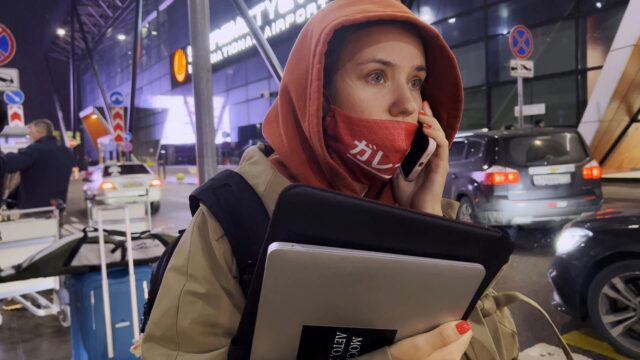
Julia Loktev’s epic verité documentary My Undesirable Friends: Part I — Last Air in Moscow (screening as a Berlinale Special) dives headfirst into the lives of a remarkable group of journalists working for news channel TV Rain in Moscow. The film starts a few months before Putin’s full-scale invasion of Ukraine. This is a time when independent journalists are already being targeted by the regime and being dubbed “foreign agents.”
The director wants her viewers to have the feeling they’ve gone to pre-war Moscow to visit a friend and then been plunged into her professional and social circle.
That’s exactly what happened to Loktev herself. She already knew one of her main protagonists, the charismatic, bob-haired news anchor Anya Nemzer. “And she knew most of the other characters, at least professionally. Most of the time, when you see them, for the first time, I am literally meeting them for the first time.”
Loktev is often told that she is a “friendly and unintimidating presence.” It helped that she had grown up in Russia and spoke the language (although she has lived in the US since she was nine). “We just developed an incredible rapport right away and I was amazed by how open they were.”
The director achieves extraordinary levels of intimacy with her subjects, also partly because she was shooting on an iPhone. There was no cumbersome equipment getting in the way. She’d simply mic up the subjects.
“People are just so used to having a phone around. I think it would have been a different feeling if I had come in with a crew and a large camera.”
Working with a cell phone meant that she had to get up close with the characters. The more she filmed, the more accustomed they became to her physical presence.
“I think it is also important that all the characters in the film are storytellers themselves. They became collaborators as well as friends.”
Loktev had first noticed that something strange and alarming was happening in the Russian media in the summer of 2021. Journalists have long had a hard time in the country. It’s now almost 20 years since the murder of the brilliant investigative reporter Anna Politkovskaya in 2006. Others have died too. What changed in 2021, though, was that press who fell foul of the Putin dictatorship were forced to issue disclaimers stating that they were ‘foreign agents.’
The director had read a story in the New York Times about Sonya Groysman and Olga Churakova, two young women journalists who had embraced their new pariah status and had even started a podcast called ‘Hello, You’re A Foreign Agent.’
At the time Loktev arrived in Moscow, Anya Nemzer was hosting a show on TV Rain, ‘Who’s Got The Power.’ By then, the channel was among Russia’s last remaining independent TV outlets. Nemzer’s show was about activists, civil society leaders and whoever else was then “trying to make a better Russia.”
When Loktev began work on the documentary, she and her subjects both knew there was something deeply sinister happening. No-one guessed that Putin was already planning his full-scale criminal invasion of Ukraine. The documentary offers a portrait of the independent media in the period just before that invasion began, “the last months when it was possible to work and when people were still fighting from the inside.”
Since then, a million people have left Russia, almost all the TV Rain journalists among them. They can no longer work properly in Russia because they would face arrest every time they filed a new report.
Now, the US itself is becoming increasingly authoritarian under its returning President, Donald Trump. To Loktev’s obvious dismay, the Trump regime has been trying to “make friends with Russia.”
The five hours shown in Berlin comprise only the first half of an ongoing project.
“There is a second half…in the film, the first half ends with every one of my characters fleeing Russia. The second half picks up two days later in Istanbul where they are in a hostel, they don’t know where they are going; they have no idea what the rest of their lives looks like.” My Undesirable Friends Part 2: Exile is currently in post-production.
Loktev has been following her characters in the three years since then. Most have moved countries several times. “They have no sense of stability and certainly no opportunity to go home as long as Putin is in power – and quite likely for long after.”
In exile, the characters from the first film have all continued to work as journalists.
Astonishingly, despite being feted at the Lincoln Centre in New York and showcased at the Berlinale, the first film doesn’t yet have distribution or a sales agent. That is likely soon to change.
“I hope somebody will pick it up. Everyone keeps on telling me that it is an absolute nightmare of a landscape for documentaries that have political content. I find that terrifying. The world is on fire and the streamers are focusing on true crime and celebrity documentaries.”
Loktev was utterly dismayed to hear that Amazon is currently making a $40mn movie about Melania Trump…produced by Melania Trump. “With the larger streamers, what we are seeing in a way is what [historian] Timothy Snyder called anticipatory obedience…”
Loktev has made both fiction and documentary in the past. Her 2011 drama The Loneliest Planet premiered in Locarno while her 2006 feature Day Night Day Night was in the Quinzaine. She funded My Undesirable Friends with grants (from the Ford Foundation and the IDA among others), and by not paying herself. At the moment, she doesn’t have enough money to finish the sequel.
Despite the lengthy running time, this is not a daunting movie to watch. It has elements of reality TV (but the “reality” in question is that experienced in Putin’s Russia, pre-invasion). The protagonists are attractive and compelling personalities. They go through break-ups, divorces and new loves. Some have to cope with their partners being in captivity – so there’s plenty of human drama alongside the politics.
“It’s not like a documentary with interviews. You’re with these young, quite beautiful women who are living through this incredible moment. It feels at times like a thriller. They are also very funny – they have real gallows humour…I always think for a film about political repression in a cold place, it is strangely warm and funny. I’ve also been told it’s very binge-able!”
And the story has an increasingly universal resonance. “For me, the story is really not just about Russia. It’s about a larger idea of what it feels like to live with a government doing terrible things you oppose. That’s very familiar to many people right now…”





