

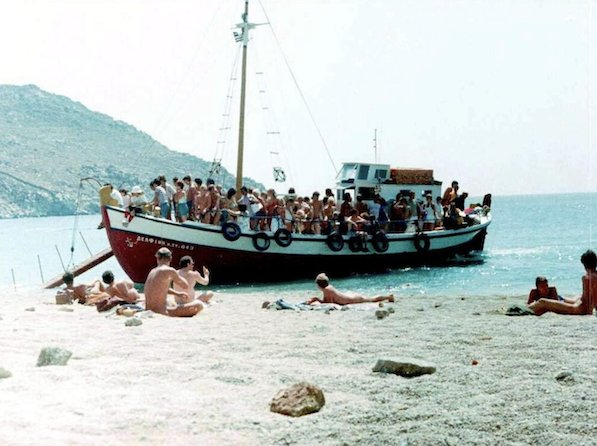
Over the past fifty years, the Greek island Mykonos has undergone radical transformation. Once an affordable, off-the-beaten-track paradise, it has become an exclusive, high-end destination. The island, which was once a beacon of inclusivity, is now a symbol of luxury tourism. How did this small Aegean getaway become a melting pot for such divergent experiences? Was it a paradise? Is it still?
World-premiering in the Newcomers section of this year’s Thessaloniki Documentary Festival, Super Paradise explores these questions. Speaking to Business Doc Europe, director Steve Krikris discussed the project’s origins, the research process, and the challenges of bringing this story to the screen.
Krikris revealed that the idea for Super Paradise had been gestating for many years. “We started working on it five years ago, but the thought of making it goes way back. I first visited Mykonos when I was still in school, probably in 1979. I was very young, and that summer, I went there with my friends without knowing much about the place. It was an incredible experience—such a beautiful island, full of amazing people from around the world. It was free, not expensive, nothing like what it is today. I kept going every summer for the next ten years.”
During his visits, he met two people who profoundly influenced his decision to become a filmmaker. “One of them was a woman from San Francisco who owned a gallery and was deeply involved in the arts. She introduced me to the San Francisco art scene, and that played a role in my decision to study in the US. Later, I enrolled in an art school there and started studying film.”
Many years later, a friend and co-producer of the film, Paul Typaldos, came up with the idea of doing something about Mykonos in the 1970s. “I wrote down some thoughts, and we started drafting a proposal for the Greek Film Centre. We envisioned a film spanning from the 1950s to the 1970s, exploring how Mykonos became so popular. That ignited the idea for Super Paradise five years ago. We slowly began securing funding, visiting Mykonos, interviewing people, and searching for archival footage.” Krikris manage to entice co-producer Titus Kreyenberg of unafilm, who introduced the project to ARTE. “Now, we’re here premiering the film and trying to bring it to the world.”
Speaking about the research process, Krikris explained how they identified interview subjects and sourced archival footage. “Some of them I already knew from my visits to Mykonos. We spoke to them, and they were very open about sharing their stories, introducing us to other people. Each time we went there, we discovered something new. We also collected archival footage, and in some cases, we re-enacted and created our own archival-style footage to blend with the real material. On top of that, we found an archival producer from Canada who helped us secure a substantial amount of footage.”
Reflecting on the challenges of making the documentary, Krikris admits that initial financing was a significant hurdle. “Pitching a project that would take years to complete, requiring multiple trips and considerable funding, wasn’t easy. Funding came slowly, but we eventually got the support of Filmiki, a prominent production outfit based in Athens, which embraced the project and helped us bring it to completion.”
“Finding the archival footage was another challenge. We ended up connecting with private collectors, including a man from San Francisco who had visited Mykonos in the 1960s and shot a 16mm film. He had some amazing footage, and he gave it to us. We were lucky to find people who understood what we were doing,” Krikris adds.
The sheer volume of material also posed difficulties. “It was a very challenging project overall, but we had an amazing editor who helped a lot. We had a hundred hours of footage that had to be condensed into an 80-minute film.”
Discussing the post-production process, Krikris said they edited as they filmed. “We started editing from the very beginning. We were shooting and editing at the same time until about six months ago. The past five months were focused on the score, sound mixing, VFX, and colour grading. We had to deliver it to ARTE by 31 December, and they received a 43-minute cut.”
As for distribution, Krikris confirmed they are in discussions with potential sales agents. “We’re in talks with a couple of companies who have shown great interest. After Thessaloniki, we’ll definitely sign with one of them. It’s really important for us to get the film out there—to broadcasters, platforms, and audiences—so people can see how Mykonos has changed and why, tracing all the transformations that started in the 1950s and 60s.”
Participating in Thessaloniki’s Agora was a crucial step for the project. “We first attended the Pitching Forum and then the Docs in Progress showcase last year. We’re very thankful for these two opportunities; they helped us a lot along the way.”
Looking ahead, Krikris is considering new projects but remains uncertain about revisiting the theme of places in transformation. “We met a German producer at the festival who suggested making a series about locations that have turned into mass tourism destinations. It’s an idea, but I’m not sure yet, as I’m currently working on a fiction feature for which I’ve received development funding. I don’t know how to balance both commitments for now, but it’s definitely a subject that still interests me.”





