

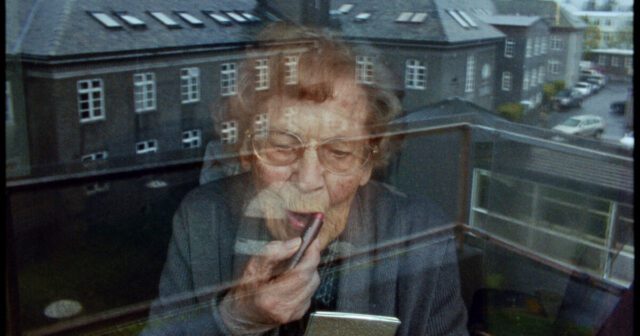
In a warm moment at the start of Yrsa Roca Fannberg’s The Ground Beneath Our Feet, we catch a glimpse of the filmmaker at her day job, caring for an elderly resident at a nursing home in Reykjavik. Fannberg isn’t one of the main protagonists in the film, but when the resident asks her what these cameras are for, Fannberg says simply she’s making “a film about life.”
“More than a portrait of a person, it’s about this time in life, it’s a specific moment in life,” Fannberg says of her film, which follows elderly people in their daily lives at the home. “I wanted to meet the human being at this moment, and you just see humanity.”
The film avoids all the cliches the audience might expect inside a nursing home – there’s not a focus on one or two people looking back across their lives in their final days. Instead we get a very human chorus of different characters going through the daily routines during this phase of their lives. It adds up to a poignant and warm examination of life’s final chapters, but doesn’t slip into easy sentimentality.
“It would be easier to make a film when you follow a person and then they die, and you tell people how to feel at that moment: ‘Now, you should cry.’”
The director continues, “I showed the film to one of the residents, and she said, ‘it’s so clear what the film is about.’ And I said, ‘What do you think that is?’ She said, ‘death.’ But I think it’s about life before death, it’s about life when there’s very little time left…We die because we are alive. So it’s very close.”
The Ground Beneath Our Feet is Fannberg’s third feature documentary, after Salome (2014) and The Last Autumn (which played at DOX in 2020). The producer is again Hanna Björk Valsdóttir of Akkeri Films (with Malgorzata Staron from Poland’s Staron Film co-producing). The film will have its world premiere in CPH:DOX’s NORDIC:DOX section on March 25; no sales company is attached yet.
Fannberg somewhat surprisingly found herself working at the nursing home years ago. “It just happened, I needed a job. I was studying for my Masters, and I was going back and forth to Spain to edit my first film,” she says. “So this meant that I always had a job when I came back to Iceland.”
She eventually got her training as an auxiliary nurse, and she prefers working in the care home when she’s not working on her own films, rather than serving in a crew position on other films or TV shoots in Iceland. “It gives me space to concentrate on my own work, and in the end I also think it’s a very giving job, it’s very easy to make these people happy.”
It was her close observation for years that inspired her to make this film in her very personal observational and poetic style. “Working there, I see death. It’s a natural thing. But there is so much life. And you don’t do the residents any favours by having this story be sentimental, because most of them are prepared for death. It’s not a tragedy to die when you are 95.”
Fannberg sees this cycle of life in floral terms – “It’s like a flower, you can water it and water it and water it, but at some stage the flower is gone and there is nothing you can do about that. It’s the same with life. You can squeeze everything out of life but is has an end.”
Iceland-born (and based) Fannberg, who studied art in London and creative documentary in Barcelona (the filmmaker has Catalan heritage), is also a photographer and teaches documentary filmmaking in Iceland. The Ground Beneath Our Feet is several years in the making – as a project it was selected for Eurodoc 2021 and was pitched at Nordisk Panorama and CPH:DOX.
She first thought of the idea to make a film at the nursing home back in 2015 when she was making The Last Autumn. “I can only concentrate on one film at a time, because they are very close to me, so I had it in the back of my mind since then.” In 2020, during the pandemic, she started to prepare – she and writer co-writer Elin Agla Briem would discuss, “what does it mean to be old? How do we respect that?”
The shoot began in 2021. Helpfully the residents already knew about Fannberg’s work because she’d shown them The Last Autumn and some of her photography. All of the people seen in the film were of sound mind to agree to be filmed. Plus, they trusted Fannberg not just as a filmmaker but as a person in their daily lives. “it was really important to me that I look after them, that I come back the next day and I do whatever they need, whether that’s giving them medicine, or they might ask you to kiss them good night.”
Editor Federico Delperio Bejar came in during the scripting process and they talked through some principles ahead of the shoot, but of course also had to make room for what would be discovered during the years of filming. The director says of an editing process that took about 18 months on and off: “It took some time to find the right tone, both atmosphere-wise and emotionally, to find the right pace, even though I knew I wanted it to be quite faithful to the rhythm of the residents themselves… To find the right balance of what you say and what is left unsaid.”
The score, by Skúli Sverrisson, has a prominent accordion, a reflection on one of the residents who plays the instrument. “The accordion can breathe, it’s like a lung,” Fannberg says. “I don’t like music to accompany emotions but to have a narrative element to it – to bring the film into a different state, or indicate where the film changes. The music is not just observational, it should bring in a different layer of understanding. The music can’t just be decorative.”
The Ground Beneath Our Feet wasn’t of those documentaries that has 500 hours of footage to sift through, because it was important for Fannberg to shoot on 16mm film (the DoP was Wojciech Staron). She says her preference to shoot on film isn’t just an affectation – she’s an analog photographer in her private life, too. The process of bringing in a film camera also signals something about the filmmaking process. If it was digital, “I could have shot it myself and always have a camera with me. Of course, with film, that means you miss some moments, but you get different things. I like to plan the shooting and the process of saying, ‘now we’re here to film.’ And there is a softness to the image, and a certain glow.”





