

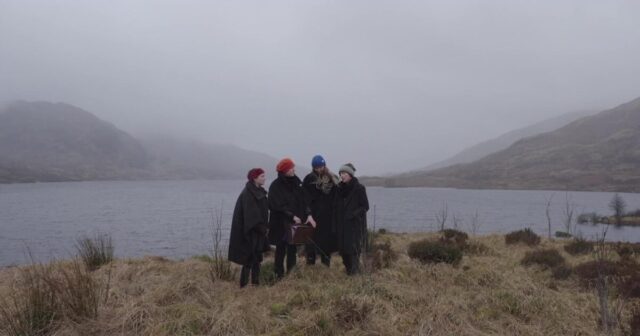
During the Covid lockdowns, French/Australian/North American filmmaker Hannah Papacek Harper become interested in folk music. She started listening to a podcast, Folk On Foot, and around the same time she also read Robert Macfarlane and Jackie Morris’ book, The Lost Words.
This book had been created in response to 50 words all relating to nature being summarily removed from the Oxford Youth Dictionary in 2007. As words like ‘raven’, ‘magpie’ and ‘otter’ were taken out of the dictionary, they were replaced with other more functional and technological words and phrases like ‘block graph’, ‘biodegradable’ and ‘chat room.’
“I realised how subversive it was,” Hannah reflects on the book. Her film Lost For Words (a European premiere in CPH:DOX this week) is inspired by the book. It looks at the consequences of the disappearance of nature’s names from the everyday language of a younger generation. Without these words at their disposal, it becomes harder for this generation to develop empathy and connection with the non-human world.
The film takes the form of an epic nature journey across the UK, exploring and celebrating humans’ increasingly fragile relationship with nature. Its protagonists range from academics to school kids, from musicians to artists, from playwrights to biologists, from linguists to geologists.
“The project for me was based around my own sense of curiosity and the fact that we can only breed curiosity in others by admitting our own need to know.”
Harper herself grew up in the countryside in Normandy and says her own relationship with nature “feels very much like a given…I was left to my own devices and it was something that completely shaped my vision of the world without me realising it.”
She has always felt “uncomfortable” in cities. She now lives in Edinburgh, “quite an exceptional place because it feels quite small and has nature in the middle of it.”
Harper has a colourful background for a filmmaker. She studied at the Sorbonne and then “finalised” her degree in Audiovisual Communication at the University Of Lima. She was drawn to Peru by a cinema sector that seemed “full of potential.” It was also a chance to get away from “the hybridised intellectual approach to film I had suffered from in Paris and that felt very, very limiting.”
One irony is that she has been working so hard on her film about nature that, during its production, she hasn’t been able to spend nearly as much time in nature as she would have liked.
Lost For Words is less an adaptation of the Macfarlane and Morris book than an exploration of the themes it raises. The writer-director talks of “trying to connect the more philosophical and artful ideas with concrete science.”
This is a beautifully shot documentary with a very particular visual language. “I definitely wanted it to be a character driven film but where the main character is nature itself. We didn’t want it to be focused on the humans even if their voices do take a lot of space.”
A lot of work went into recording sound “underwater and against rock, or of objects reacting against natural elements.” The intention was to “create a really rich soundscape that is a portrait of the landscape through the seasons.”
Harper talks of trying to create “an organic film” whose different elements are all woven together.
Making the film took her all over Scotland. She started shooting at the start of January 2022 and filming continued with breaks until May 2024. “We tried to return throughout the seasons so we had a really rich selection of images.”
There are striking visual flourishes. For example, we will see a siren-looking figure on a beach. This is Greek artist Dora Zoi. The idea here is to show a human being scrutinised in the same detached way humans scrutinise nature. “It is trying to put into perspective the way that we categorise, put under glass, think of extinction,’ the director explains.
One of the biggest challenges that she faced in making the film was preparing the edit. There was a huge amount of imagery and many, many interviews to sift through and then to cut together in a way that made the material “digestible to the public.” Harper was trying to make the science “accessible” but not to “dumb it down.” She also wanted the film to have an emotional connection for viewers.
The Lost Words authors Jackie Morris and Robert Macfarlane were behind the project from the outset. “Obviously, authors are wary of how things can go but then were very open very fast to the approach we had because, to a certain extent, it was a more discreet and grassroots approach to documentary than they might have expected. I think they were curious about that…until the ending, they were still quite mystified as to how everything was going to join up, but they’ve been really supportive.”
A wide range of children became involved in the film. “We were looking for a variety of different types of schools and children from different backgrounds,” the director explains how kids from the Edinburgh Montessori Arts School, and Burnside, Calderwood and Burgh Primary Schools all become involved.
Other partners included the Royal Botanic Gardens in Edinburgh, National Museum of Scotland and the Warburg Institute in London. The filmmakers even worked with a choir, the Heartwood Community Choir.
Lost For Words was produced by Rétroviseur Productions, a French outfit based in Normandy (which is where Harper grew up). She had worked with them before, for instance on a project called An Instance Of Non-Existence, about her attempts to reconnect with her Slovak roots.
“We have been working closely and we obviously knew we wanted to do a co-production with the UK. Hopscotch seemed like the most important partner we could get,” the director explains how she also ended up working with John Archer’s Hopscotch Films, the Glasgow-based outfit which has produced many of Mark Cousins’ award winning films.





