“Crossing the Mountains is a necessary and urgent film, telling the story of one of Europe’s most symbolic borders through an intimate and political lens,” producer Céline Loiseau (TS Productions, Paris) tells BDE of her ParisDOC 2025 Work-in-Progress project. “At a time when fascism and migration repression are intensifying, this film offers a powerful narrative of resistance and solidarity. It is not just a documentary about the migration crisis, but a broader reflection on our times, on the struggles of those who challenge borders, and on the fragility of our idea of freedom.”
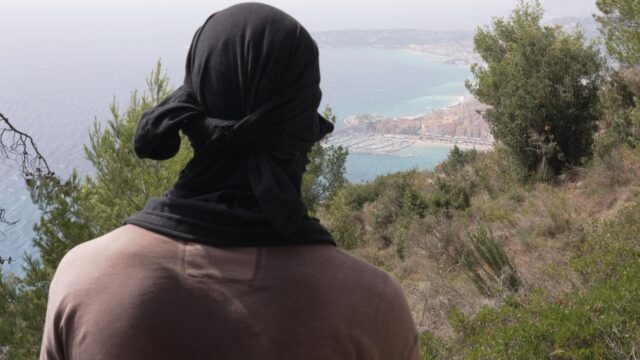
Set in the mountains near the Italian-French border at Ventimiglia, Crossing the Mountains follows Juliette, Ali and Téo, three very different protagonists, as they organise themselves to support exiles seeking to cross the border. The film, directed by Manon Ott and Grégory Cohen, presents at ParisDOC this week, where the team are searching for a French distributor and sales agent.
The synopsis describes how, ‘Juliette is a Parisian artist and activist newly arrived in Ventimiglia, Teo is an Italian anarchist activist who has lived and worked there since the border closed in 2015, and then Ali, a Sudanese exile, who passed through Ventimiglia in 2015 on his way to England, but who decided to stay and fight with the people who were fighting against the borders and for his freedom.’
The trio’s actions, the synopsis tells us, ‘focus mainly on holding an open-air border café on the side of the road used by the exiles, maintaining and signposting the mountain paths used by them, and observing police practices and violence in Ventimiglia, on the trains or in the mountains.’
The difference between the exiles’ lives and the dreamland of the sparkling tourist playground below is stark, as the directors’ notes tell us. ‘We want to show the mountains in their ambivalence, as magical and powerful, but also as places of danger and surveillance. On the other side, below, the Mediterranean Sea, which carries with it the memory of the many exiles drowned in its waves, appears more like a “sea-grave”. As for the lights of the Côte d’Azur cities shining in the distance, on the “other side” of the border, they echo the mirage that Europe can represent for those who travel.’
‘In our images, we seek to work the evocative power of the different landscapes through which our characters pass,’ Ott and Cohen add.
Producer Loiseau is confident that they’ve achieved this cinematographically, drawing on intimate first-hand experiences with the protagonists. “The film stands out for its immersive approach: Manon Ott and Grégory Cohen are not just observers, but they have lived and worked closely with activist communities at the border. This ensures an authentic perspective, free from stereotypes. Visually, the contrast between the harsh reality of the border and the beauty of the landscape is central: the film explores the frontier not only as a place of conflict but also as a space of imagination and desire for freedom. Using a language that alternates between moments of tension and resistance and spaces of lightness and creativity,” she tells BDE, adding, “Crossing the Mountains manages to be political without losing its poetic dimension.”
Indeed, this “lightness and creativity” is an integral part of the lives we observe, seemingly in contradiction with the seriousness of situation the exiles find themselves in.
As the directors note, “One of the film’s challenges is to contrast the seriousness of the situation at the border with the inventiveness and zest for life. Although they embody a serious, committed generation that sometimes seems to ‘carry the weight of the world on their shoulders,’ they also know how to keep on living. Dance and music act as outlets. It’s also a way of distancing themselves from the tragedy of the border. We’d like the film to reflect this tragedy as much as their energy, to denounce the dead, but also to focus on the living.”
As well as looking to secure French distribution and sales at ParisDOC this week, the film seeks to speak to new audiences, reaching out beyond traditional outlets. Loiseau tells us how they would like to use the film to help promote change. “Our goal is to build a support network that can amplify the film’s impact, bringing it not only to international festivals but also to alternative screening circuits (community spaces, schools, NGOs). Ideally, we want the film not only to reach a wide audience but also to become a tool for debate and mobilization, contributing to redefining the narrative around migration and solidarity in Europe.”