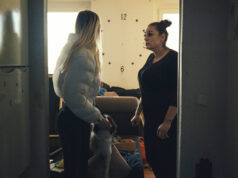
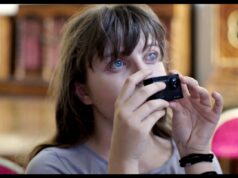
Thirty-nine-year old Amandine, who lives in Calais, northern France, with her husband and two boys, is as extraordinary as she is ordinary. She faces death by cancer and is very frightened, although she doesn’t feel any sense of rage, simply a profound regret. She even concedes how “I would rather be the one who had it, and not somebody I love.”
She is a dedicated, funny and patient mum who puts up with the new swear words that make it regularly into her son’s lexicon, and every now and then she’ll retire for a bit of peace and quiet – and a joint. Amandine has, up to the point of diagnosis, had a great life. She was always fun, boisterous and the life and soul of the party, which we see in archive of her growing up.
“It’s difficult to describe…but her energy and personality were quite extraordinary,” director Thomas Balmès tells Business Doc Europe of his heroine. “I’m not sure who picked up who, but at the end there was some kind of real connection between us, something very strong, and I think you can feel it in the film.”
“I found her character amazingly brave and how she dealt with the disease was inspiring,” he adds. “She never really complained and stayed strong until the end. Additionally, she had always dreamt of being in a one-woman show, so when she heard that there was a film being shot in the palliative care unit, she made it clear she wanted to be involved and to leave a trace for her sons to show them who their mother was and how she fought until the end against her illness.”
But Amandine isn’t the only star of the show. A beautiful chestnut horse named Peyo literally does the rounds in the unit, delivering solace and happiness to the patients, allowing itself to be stroked and sometimes standing like a beautiful and silent sentinel as conversations are had between doctors, patients and relatives. When Peyo leaves the ward, he does so in reverse, retaining eye contact and even raising a hoof in farewell.
“The film started from a photo story featuring Peyo published by The Guardian newspaper, and seeing it sparked an idea that I wanted to develop further,” says Balmès. “I saw these photographs made by Jeremy Lemkin and I immediately felt that this was a fantastic tool to speak about a difficult subject that no-one really wants to be looking at. But the presence of this horse takes the film itself to another level, more poetic, mysterious and magical.”
Such as in the extraordinary sequence when Peyo is ridden at twilight by his companion and trainer Hassan. Both horse and rider are covered in tiny lights, and the effect is mesmerising.
“Hassan was preparing Peyo one day for a show he was having in Lyon for ‘La fête des lumières.’ When I saw Peyo like this completely covered by these garlands of lights, I was hypnotized and could not stop filming. I like when shoots turn out like this, where we don’t really understand what’s really going on…a little bit like death…No-one knows what’s happening once we die. And I felt this could work well, and come back regularly in the film as a metaphor of the passage from life to death.”
The film introduces other patients as well, and we even attend some of their funerals. We are further privileged to be present at a heart-breakingly beautiful exchange between a kind and elderly gentleman named Mr Boulanger and a hospital councillor. He is ready to die. Indeed, he welcomes it. “I treasure the relationship we had,” the councillor says. “I am merely an intermezzo in your life,” he smilingly replies. “I wish you a good death,” she bids him farewell. And all the time, Peyo is standing guard.
The film is as cinematically satisfying as it is emotionally engaging. How easy or difficult was it to maintain the balance of delivering such a moving story while upholding such high aesthetic standards?
“To me, the form is crucial,” Balmès responds. “I even considered at some point to keep the film entirely silent and non-verbal. Like I did with Babies 20 years ago. But as soon as I heard some patients speaking, I realized there was no way I couldn’t include these conversations.”
“On a technical level, I shot the film with a very specific camera and very specific prime lenses. As there was no way I would bring artificial lights in the patients rooms, I used a Sony Venice camera with a Rialto (a remote captor detached from the 6k recorder) allowing me to be alone in the patient’s room [and] having all the assistants and sound recorder in the corridor so as to be as non-intrusive as possible. [I was] using very sensitive vintage lenses (Zeiss super speed Prime lenses open at 1,3 aperture) which give a very cinematically organic and non-digital look at the images.”
“I don’t think that this kind of equipment is ever used for documentaries as they require a big team and are very costly and only used usually in feature films,’ Balmès adds.
The French director expresses his gratitude both to Universal Pictures Content Group, who supported him on a project that was fundamentally different to the other audiovisual works on their roster, and to his editor Alexandre Cardon whose “amazing” work determined that Balmès would share the ‘author’ credit on the film.
“It has been from far away the most difficult film I ever did on many levels. I am very grateful to all the patients, their families and the hospital’s personnel for their trust,” Balmès insists.
“À demain sur la lune started as a documentary on the horse in the hospital, Peyo, and ended being a film about that question of what to do with your life when you know that the time you have left is short, how you are dealing with your kids, with your husband, with your family, to prepare them for your death,” he ends.
The film is selected for the European Film Promotion (EFP) and CPH:DOX EUROPE! On Demand initiative designed to boost the visibility of European documentaries in the North American market.