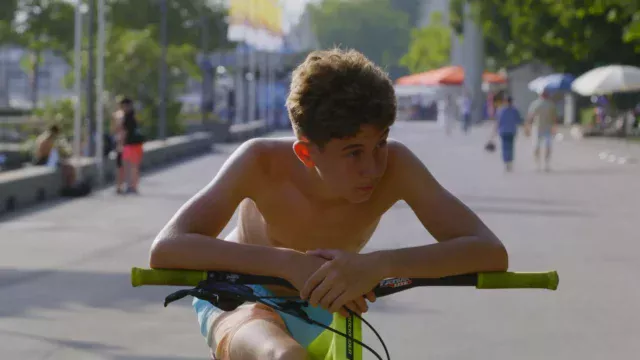
Noah is a Swiss teenager in and out of foster homes and correctional establishments. He has a more or less non-existent relationship with his dad, a loving (at times strained) one with his mum, and all the time drives his sister (11, but emotionally mature beyond her years) to distraction. But the thing about Noah – he’s just a kid, and a very lovable one too. He doesn’t want to go to school. But he does want to learn.
Another thing about Noah, his bicycle stunt riding is remarkable, even if drivers around Lausanne and its environs are forced to swerve out of the way as he wheelies towards them on the wrong side of the road.
While the film tackles adolescence, specifically that particularly vulnerable teenage boy demographic, it nevertheless offers a palpable sense of optimism. Maybe it is something to do with the lakeside setting or the perennial Swiss blue skies, but Noah is somebody you want to invest time in watching, and it is hard not to form a belief in his potential, despite his very rough start in life.
Director Matias Carlier isn’t from Switzerland (he is a Parisian) which he feels was a distinct advantage in forging the very close relationship he obviously has with his subject. Neither knew anything about each other’s respective lives and upbringing. But they liked each other from the word go.
“We shared our experiences: I explained my background and my profession as a director; he showed me how he was growing up in Lausanne, what he experienced with his friends, and, indirectly, how the system treated troubled youth, how society viewed them,” Carlier tells BDE. “This reciprocity, over the course of the different filming sessions, built a real relationship. He confided in me easily, perhaps precisely because I was an outsider to his world. I wasn’t part of his inner circle; I didn’t represent school, institutions, or his family. He had a certain freedom with me, and I believe that helped him open up.”
What’s more, for Noah, the process of being filmed was not only intrinsically interesting on a technical level – “the camera, the boom, the slightest new piece of equipment excited him” – it afforded him an outlet for expression which day-to-day existence couldn’t.
“I believe that this experience offered him a unique space: a place where he could express what he was feeling, without obligation, without immediate consequence,” says Carlier. “It wasn’t like talking to a therapist or confiding in a close friend. In front of the camera, he sometimes revealed more than during our off-camera moments. Maybe it was the emptiness of the image that invited words, that opened up a space.”
“On my side, I was simply there, listening. I didn’t judge him, I didn’t respond to his doubts, I didn’t try to correct him. Where many people around him would lecture him, I simply remained present,” Carlier adds.
The film was shot over three years, a few days every three months, and Noah undergoes physical changes throughout, growing his hair, making new friends, getting g a girlfriend and finally eyeing up a working future.
“Between these sessions, we took the time to meet outside of the camera, to share our progress, doubts, and the struggles we each faced in our lives,” Carlier explains the mutual trust and friendship that developed between them. “[But] when we came together to film, the camera set a frame. I became the director again. And I think this distance helped Noah open up: he spoke to the camera as if it were a mirror, without judgment, without expectations from me.”
“With Brice Cardinal, the editor, we began structuring the film towards the end of the second year,” the director adds. “This allowed me to take a step back and understand the direction the film was taking. When I resumed filming after that, having that distance helped me better understand what I was trying to capture. Noah had given me a pivotal period of his life — adolescence, that blurry time when one slowly transitions into adulthood. It seemed essential to me that the film end at a moment of transition.”
Does Carlier think that he may have fulfilled the role of surrogate dad to his subject, given the absence of a father figure in Noah’s life? No, he responds. “I don’t think I was a substitute father during these three years of filming. In any case, I never sought to be. At times, I may have felt like an older brother, but I prefer to say that Noah and I became friends.”
The genesis of the project was when Lionel Baier — then head of the cinema department at ECAL and the eventual producer of the — offered Carlier the opportunity to direct a documentary for television about a group of young bikers in and around Lausanne. These riders are highly skilled and fearless, and claim the public roads as their own domain.
“I was struck by the way they took ownership of public space, appropriating the city as a playground, and by the social diversity that brought them together. These first images allowed me to discover much more complex and unexpected stories than I had imagined,” says Carlier.
Noah was the youngest in the group but for him the business of biking was more than performance or play, the director stresses. It represented something altogether more “vital.”
“The bike became an outlet, a form of breathing. I felt a story emanating from him — a mix of sensitivity, contained rage, and a need for expression. This encounter changed everything: with Lionel, we decided to put aside the TV format and make a feature film. A portrait. A long-term adventure.”
A characteristic of contemporary docmaking in Switzerland is how its exponents aren’t afraid to shine a spotlight on the dark underbelly of Swiss society – to show that Switzerland isn’t all about banking, Rolexes, fondues and the Matterhorn.
“It’s true that the postcard image of Switzerland is hard to shake off,” laments Carlier. “It was also the one I had in mind before coming here to study at ECAL. And, as often happens, the confrontation with reality quickly challenged that perception… I discovered a much more nuanced Switzerland. A country that strives to maintain an image of perfection, even if it means making invisible a portion of its population living in poverty or on the margins. It is these lesser-represented, less-heard realities that immediately caught my attention.”
“And that’s what I aim to explore in my work. What draws me to cinema, and particularly to documentary, is the opportunity to discover lives, trajectories, and environments that I wouldn’t otherwise come across,” he adds. “I like to confront myself with more blurry, more distant areas. And paradoxically, it’s often in those areas that I find myself the most — in the fragilities, the uncertainties, in a way of looking at the world.”