

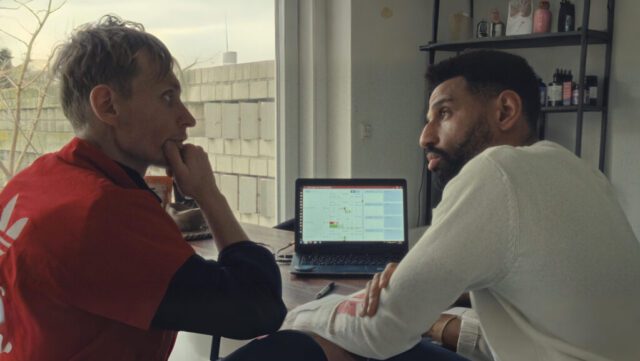
Long ago, when German filmmaker Johannes Büttner was a kid and at primary school in Frankfurt, he had a classmate called David. “We grew up in the same neighbourhood and I think we have a similar socio-economic background,” Büttner remembers.
Time passed. Büttner and David went in different directions. “We lost touch. I moved to Berlin. He stayed in Frankfurt.”
By chance, though, three or four years ago, Büttner read about David online. His old school colleague was now known as “Mister Raw.” He had become a libertarian online influencer and spiritual healer who advocated a raw food diet to his followers.
By then, Büttner was working with fellow filmmaker Julian Vogel, also from Frankfurt. They were researching potential projects about “utopian ideas from the right.” This was a post-Covid period and new protest groups were emerging across Germany.
The new film made by Büttner and Vogel, Soldiers of Light (a world premiere in VdR’s International Feature Competition) has David/Mister Raw as one of its major protagonists. He is part of a sub-culture where mistrust of government and the media has become endemic. Groups within this sphere have a strange mash-mash of beliefs. They share some of the same rebelliousness and hippy ethos as counter-culture groups of the late 1960s but they’re also often right wing and Neo-liberal in their approach to business – and many are ardent conspiracy theorists too.
Vogel and Büttner have known each other since they were teenagers. As young idealists, they identified with the radical leftist anti-fascist subculture in Frankfurt.
“Of course, in our youth, we talked a lot about the possibility to change society; to make it better and more inclusive, and to prevent the world from disaster,” Vogel remembers. He had gone on to become a filmmaker. Büttner, for his part, was both an artist and a filmmaker.
Vogel had earlier made his “EINZELTÄTER” trilogy of films about people who lost relatives in the right-wing extremist attacks in Germany in recent years. He was therefore in close touch with people who had actually suffered at the hands of extremist groups. Büttner, meanwhile, had made several art pieces exploring utopias.
“We started to talk of this idea of making a film about different kinds of movements from the spectrum of the far-right and libertarian groups – a film about their vision of the future of our society,” they say.
It seemed a happy coincidence that Büttner already had a personal connection already with David – precisely the type of subject they were looking for.
“When Johannes spent some time with David and told me about the things they talked about totally openly, in front of him, we both said, ok, we don’t have to make this film about all these different kinds of groups. Maybe let’s make a film about this group. Everything we had talked about before was incorporated [here].”
The tone of the film is disconcerting. At moments, David and his followers seem almost comic and the documentary veers close to satire. But then David’s followers might start dismissing the Holocaust or we will see abusive behaviour of some of the junior figures within the group.
“It is really easy to make fun about this scene…it can be a strategy to cope with these things, when we even look at Donald Trump as this comical figure,” Vogel reflects. “But in this maybe absurd and funny scene, people are really suffering. It is a threat to their health and balance in society.”
The film has its own fall guy in the shape of the very likeable Timo, a young working-class man with mental health issues who has come within David’s orbit. The group work him very hard but he isn’t well paid – or well looked after. The behaviour toward him is sometimes close to bullying.
Over the course of making the film, the directors’ attitudes towards David’s group gradually shifted.
“When you meet them, they are regular people; they are people from our town. You can talk to David in a very easy-going way. He has the same social and cultural language as us.”
Group members might advance the view that the earth is flat or deny that the Holocaust ever happened. This could be almost funny but, at the same time, it was sinister and unsettling too.
“We spent sometimes five to eight hours in a room with these people. We never lied to them. We never said we believed in what they are saying. But we made a pact that we would not go into discussions with them,” Vogel remembers.
The idea, instead, was to observe without intruding. Sometimes, when they left David and his followers after a long session in their company, Vogel and Büttner would find themselves bursting into laughter for “two or three minutes straight.” It was like an escape valve.
“But then we met Timo,” Vogel adds.
There was nothing funny about what happened to Timo. “We found this has a very serious side to it. The hierarchical structure that we see in right ring movements is not only absurd but is also very, very dangerous because it threatens the weakest part.”
David has positioned himself as a healer. He is approached by people whom (as Vogler puts it) “our mainstream society forgot about or lost or didn’t care about.” These can be deeply vulnerable characters. “You could almost call it like a forced labour situation…”
As artists and filmmakers, the directors acknowledge, they know what it is like to work on a project for very little material reward. “You get paid with ideology, you get paid with the idea that, at some point, you will be successful.”
What was happening to Timo (who seemed to be suffering from paranoid schizophrenia) was a distorted reflection of this. As they realised how sick Timo was becoming, the directors contemplated “trying to get him out of there.” In the event, Timo left anyway, returning to his parents who tried hard to help him. They got him into treatment but he wasn’t looked after well by the hospitals or social services.
David has seen the film and is happy it portrays him and his group accurately. Timo’s parents have also seen it. “Of course, when you make a film, there is the question of trust and there is a certain hierarchy because you are the person holding the camera but we tried to be as fair as possible as well as being transparent,” Büttner says.
On the other side, the directors worried that they were providing David and his group with a “platform” to share their offbeat and extreme views without mediation.
“In our fucked-up world, if you tell a real story about real people, you will probably have to get our lens dirty in some way,” is how Vogler sums up the moral dilemmas and compromises that come with a project like this.
Soldiers of Light was made as a co-production between Wood Water Films and Patatino Film in co-production with ZDF – Das Kleine Fernsehspiel, funded by HessenFilm & Medien. Its German premiere is set for DOK.fest München.





