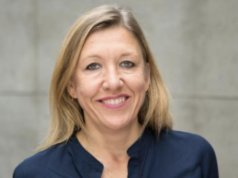
Sine Plambech isn’t just a renowned Danish filmmaker. She is an anthropologist and author as well, and has been researching migration for 20 years. Her new feature documentary, Rescue, sold by Autlook and premiering in TIFF Lightbox, came to life when she was contacted by Doctors Without Borders. They wanted to draw on her academic expertise but she had a proposal for them too. She was keen to accompany them aboard Geo Barents, the boat they operate and that saves migrants in distress.
“I knew I wanted to make a film about it if it was possible.”
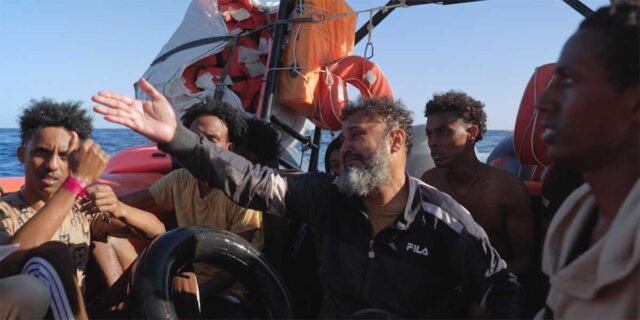
Plambech joined the boat on several voyages and there were occasions when she realised that if the Geo Barents hadn’t been there, the refugees would certainly have drowned.
“It was definitely one of the most profound experiences in my research career to be able to be on a ship and see someone be rescued right in front of my eyes,” she recalls. “A very strong moment for me was the morning after they were rescued, coming down to the deck and seeing these people having breakfast. It was just protein powder. Some of them had a quick shower and had their hair cut and suddenly they were smiling. I remember thinking that if that rescue ship hadn’t been there, they wouldn’t have been sitting there smiling.”
Plambech describes the ship as “a human island” in a sea of brutality. “I think I had imagined before I went out there that it would be all sorrow and despair – people being traumatised by what they were seeing.”
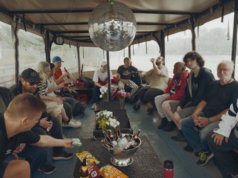
There is camaraderie and the migrants know they are in a safe place, able to eat, talk and even exercise. The other passengers include a doctor, a midwife and some nurses as well as the rescuers themselves (who are experienced at dragging dozens of people at a time, who can’t swim, out of the sea).
While it is exposing the vicious and callous behaviour of EU-supported Libyan coastguards, Rescue also has a love story at its core. A husband, Hani, is rescued at sea but, in the process, separated from his wife, Roro, and children. They are captured by the militia, locked up and abused. Their phones are taken away but Roro has hidden a spare handset in her baby’s nappy.
Plambech knows that all of the migrants would have had equally dramatic tales. “Everyone who comes on board Geo Barents had a story to tell us. I didn’t know that Hani would be [a] main character. I just knew that I had to go back and back and film again and again. I was interested in connecting the more political European story to a human story.”
When he lived in Yemen before the war, Hani had worked as a mobile phone technician. That meant he knew “quite a lot about filming.” He was very natural on camera.
It also helped that he “has this aura around him; he is a person you want to get to know.” They were filming him at “desperate moments” when he was overwhelmed with grief and anxiety, but also at times of unbelievable joy. “Making documentaries is such a crazy ride. Every day, it was like OK, what can we do, on the one hand to film it and document it, and, on the other, to help these people.”
Despite the core importance of Hani, Plambech credits editor Per K. Kirkegaard for realising that the story was really about Roro.
The plot has as many twists as any fictional movie. At one stage, we learn that Roro is pregnant. It’s not clear whether Hani is the father or one of the guards who have been sexually abusing her in captivity in Libya. Plambech and her colleagues were trying desperately to get the UN Refugee Agency to intervene on her behalf – but without success.
“We still don’t know who the father of the child is. Hani just decided he is the father of the child and she has said he is the father of the child,” the director states.
This is one of several projects on which Plambech has collaborated with fellow filmmaker Janus Metz (whose fiction films include Borg vs McEnroe and Unabomber starring Russell Crowe). Their previous project together, Heartbound, also screened in Toronto. “We do work very strongly on the narrative part of the film to make sure that the stories of our protagonists come to the fore.”
On Rescue, Plambech is directing solo for the first time. (Metz was involved in the screenplay and is also an executive producer.)
Now, the director is planning an impact campaign with Think Film. One goal is to expose the often tragic consequences of the deals the EU strikes with “countries that maybe don’t have the highest accountability in the world.” She emphasises that this is “not an activist film, an NGO film. I see it as an artistic documentation of a human rights violation – but definitely I want people to watch it and say ‘is this a good idea, to continue to outsource the border responsibilities to countries with conflicts and war and militia and weapons? Does that live up to our European values?”
Hani and his family won’t make it to Toronto for the world premiere. As asylum seekers in Germany, they’re not allowed to travel. However, it’s possible they will be able to attend the European premiere at the Zurich Film Festival. “That’s one of the issues. Where you make a film about asylum seekers, they’re not allowed to travel anywhere.”
The family are living in containers in a container park in a piece of land outside Munich with many other refugees. “They are all suffering from PTSD.” Their chances of getting asylum remain uncertain, especially as German politics swings to the right.
“Who knows what will happen to them. They are in this limbo. I visited them a week ago and they were making Yemeni food for me. They have a new baby and they named her Sine after me, which is a huge honour.”
Plambech is a senior researcher at the Danish Institute for International Studies where she advises the Danish Ministry of Foreign Affairs. She is able to combine her duties as a researcher and anthropologist with her filmmaking. “I’m allowed to do it as part of my work for which I am very grateful. It is deeply integrated in the way I think. I do my research and then think about how this story can be told to a broader audience. I feel academia know so much but they keep it in the university. I think we should use it for the greater good, and to tell everybody what is happening.”