Tomasz Wolski’s documentary The Big Chief is fascinating, becomes increasingly intriguing, and ends up frustrating – which makes it, in turn, all the more fascinating.
‘The Big Chief’ is the nickname of Jewish-Polish communist Leopold Trepper (1904-1982), who, according to his biographer Gilles Perrault, was “one of the greatest, if not the greatest” secret agent working against the Nazis. Trepper led a network the Germans dubbed Die Rote Kapelle, ‘The Red Orchestra’ – a name inspired by the code signallers which were known as ‘pianists’ – which is generally considered the most important of the Soviet intelligence networks during World War II. One of their major feats was to inform Moscow of the plans for Operation Barbarossa, Hitler’s attack on Stalingrad.
Trepper’s work resulted in some 300 thousand Nazi casualties at Stalingrad, according to one German military source that the film cites.
The intelligence network was liquidated by the Germans in 1942. Among the undisputed facts are that Trepper was the only member of The Red Orchestra who wasn’t tortured by the Gestapo and that he subsequently co-operated with them.
According to Trepper – whom we meet through a series of interviews, in colour and black and white, in French, Polish and German, cleverly edited together into a coherent, roughly chronological whole – he managed to win the Gestapo’s trust, inform Moscow and continue working as a double agent for the Soviets.
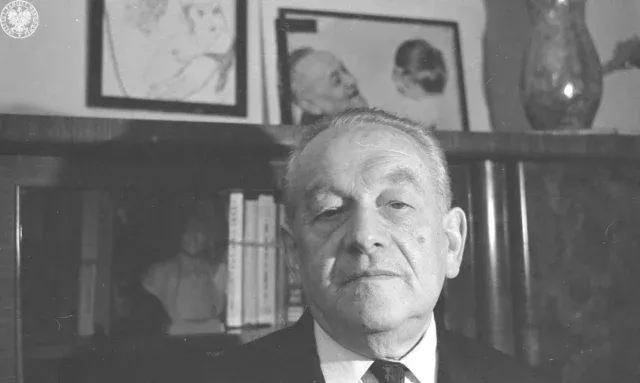
Trepper is charming, approachable and convincing. In the interviews, all of which were probably conducted sometime in the 1970s, he comes across as a friendly grandpa, his wife Luba by his side, often mentioning how they simply want to spend their remaining years quietly with their family. Living in Poland, they want to leave for Israel, where thousands of Polish Jews had fled after Polish General Secretary Gomułka began using anti-Semitic scapegoating to divert attention from social unrest.
But although the Polish government had told the “Zionists” to leave for Israel, and many thousands had been issued visas to do so, including Trepper’s children and grandchildren, it kept Trepper himself under house arrest.
First it was Hitler tearing his family apart, Trepper says in one of the interviews, then Stalin (he was imprisoned for ten years after returning to Moscow at the end of World War II, his wife believing him dead), and then Gomułka. This is part of what is so fascinating about Wolski’s spy story: how Trepper’s life connects to major developments in twentieth-century European history: Fascism and Communism, World War and Cold War, East and West, Europe and Israel.
The Polish director illustrates many of these historical events with archive footage, often with added sound (including tanks, explosions et cetera); sometimes quite playfully, as when the direct sound of an interview recording slowly fades away until the only (added) sound we hear is Trepper exhaling his cigarette. Another stylistic element is the way Wolski keeps moments immediately before and after the interviews in the film. The tapping of the microphone or the clapping of hands, to later synchronise sound and image, even becomes something of a running gag. But it also serves a more critical function, as a reminder these recordings were constructed, made by people under certain circumstances and with certain objectives.
French journalist Jean-Pierre Elkabbach, who interviewed Trepper for three and a half hours in Warsaw before his recordings were confiscated before his flight back to Paris, seems quite clearly a supporter of Trepper. A ‘believer,’ one might even say, in Trepper’s status as a war hero unfairly targeted by the Polish regime. The same goes for his biographer Perrault, another of the film’s main voices, who is fully on Trepper’s side and organises a group of activists to put international pressure on the Polish government to allow for Trepper’s migration to Israel. This French activist group ran into trouble when the head of the French counter-intelligence service DST, Jean Rochet, openly accused Trepper of collaborating with the Gestapo, but eventually triumphed in court by refuting Rochet’s sources and even getting him convicted of slander.
At this point in the documentary, as a viewer, I was squarely on Trepper’s side. Sure, the story had mentioned some complicated wartime situations, but these things happen, are always complicated and we will never know exactly what happened. All the same, Trepper had managed to survive Hitler, Stalin and Polish anti-Semitism, was now an elderly man and it seemed reasonable to just let him rejoin his family. Dramatically, the whole film felt like a thriller building towards this ending, which was finally achieved: that Trepper would be happily reunited with his family. It was a thrilling story, a “reality that surpassed fiction. Full of twists and turns that not even the most creative writer could have dreamed up”, as Elkabbach put it. The activists won, Trepper won, his family won – that’s where the film inexorably led. The End.
Fascinating, certainly intriguing, but also, after a moment’s reflection, frustrating. Trepper joined the Gestapo – yes, but as a double agent. Stalin imprisoned him when he returned after the war – yes, but he imprisoned everyone. French counter-intelligence suspected him of being a Gestapo collaborator – yes, but it was rejected in court.
Secret agents are supposed to be good at lying. At manipulating. They are supposed to be able to convince you they are on your side – especially double agents. They are supposed to appear trustworthy and likeable. So how reliable can Trepper be as a source on his own life?
Wolski adds an epilogue. Here, Trepper (who clearly had no problem taking part in this TV programme, which is intriguing in itself) is attacked on live French television by historians who doubt his story. How could he have been the only one not tortured by the Gestapo? Why did Stalin punish him as soon as he returned to the Soviet Union? How can his word be trusted at all? Especially when the “greatest” of all Soviet secret agents claims things like: “I was never a professional member of intelligence” – there may be some confusion of terminology here (whether he was on this or that payroll), but it’s certainly understandable that this claim gets scoffed at.
It’s frustrating, because the documentary leaves it at that. The whole film is, more or less, Trepper’s story, and then there is this fierce attack on Trepper – and thus on the story of the documentary itself – at the very end, and that’s it. At the same time, it’s this frustration that makes The Big Chief so fascinating again on another level. Wolski leads us down this increasingly intriguing path through twentieth-century history, and then pulls the rug out from under us.
After having checked with some external sources that historians are indeed still debating Trepper’s role during his time with the Gestapo (which is information that would have been helpful for the documentary to have included, even if only during the end credits), I feel Wolski’s approach to Trepper’s fascinating, intriguing and frustrating story is justified – but I’m not sure everyone will agree. Which is itself part of the frustration – and fascination.
Poland/The Netherlands/France, 2025, 86 minutes
Director Tomasz Wolski
Production Kijora Film
Producers Anna Gawlita
International sales Anna Gawlita (Kijora Film)
Script Tomasz Wolski
Editing Tomasz Wolski
Sound Aleksandra Landsmann, Igor Kazmirchuk
With Leopold Trepper, Luba Trepper, Jean-Pierre Elkabbach