

If there is one country that is punching well above its weight in doc terms, it is Norway, which has seen success after success over recent years with the likes of 2024 Sundance winners Benjamin Ree (Ibelin), Silje Evensmo Jacobsen (A New Kind of Wilderness) through to this year’s Oscar win for No Other Land, co-produced with Norwegian Antipode Films.
Add to these, Vibeke Løkkeberg’s Berlin 2025 hit The Long Road to the Director’s Chair and CPH:DOX head-turners Facing War (Tom Gulliksen) and Flophouse America (Monica Strømdahl), not to mention Victor Kossakovsky’s upcoming Trillion, produced by Sant & Usant and described as the second part in his ‘empathy’ trilogy, and you get the idea.
“A door is opened I think. We had some really incredibly strong documentaries over the past few years. And I think this has definitely paved the way for other Norwegian talents that can follow up with their stories,” says NFI’s Elisabeth Aalmo.
Willingness to take a risk is a factor, Aalmo cites her former colleague Klara Nilsson Gunning, ex-Documentary Film Commissioner, who told BDE in 2024: “When nobody else wants to go in and support a project, we can do it. We don’t need approval from anybody else. We are a system where you have a single commissioner taking in an application and making a sole decision on the artistic quality of that production, which means that you don’t have to discuss with other people in order to make that decision. The effect of that is that you can be much more personal with what you choose.”
“One of the biggest talents of Norway and the Norwegian film industry is that we’re fast… because it’s a small country [population 5.5 million],” Nilsson Gunning added.
All of which means that the shackles are off for Norwegian filmmakers who can be as courageous as they like when telling their stories, Aalmo tells BDE in Nyon. “But still, I think what is really great about this success is that people are really cheering for each other. It’s a really strong community so people are willing to share both their experiences and their knowledge. It’s very inspiring when you see some of your colleagues succeeding and then sharing in their success.”
On April 8, five new Norwegian works-in-progress will be presented to the professional audience in tow in Nyon.
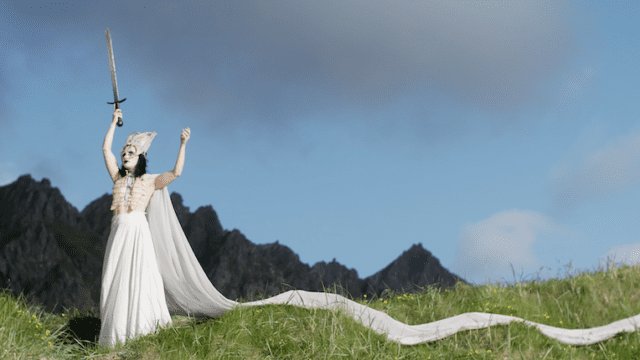
Debutant Maja Holand’s Hex is set in the heart of Norway’s ‘black metal’ scene, and a new force is emerging, the synopsis reads. Three young women – Nikoline, Victoria, and Johanna – have entered into a three-year pact where they will devote their entire lives to awaken the world, each other and themselves as witches. And start screaming… The project, produced by Mari Nilsen Neira of Herstory and budgeted at € 532,300 with 79% already in place, has a mooted release date of January 2026. “It’s really a strong and courageous project and is a bit provocative,” Aalmo describes the film. “It is very timely and deals with female strength and challenges.” Hex evolved out of the NEO project development programme at NFI.
Maria Galliani Dyrvik’s Nigeria-located Hope Is A Word, produced by Anita Vedå of Smau media, details how oil extraction keeps ravaging the Niger Delta. But Nnimmo Bassey, a poet activist, refuses to lose hope and raises a new generation of voices to fight the oil industry. “It will be a very poetic film,” comments Aalmo. “And it give audiences a different aspect of activism with a strong focus on hope. The director Maria and Nnimmo are friends and she’s been following him and his work in Nigeria.” The production team is looking to close the film’s €501,920 budget ahead of its April 2026 release.
In the project Strangers & Stayers, co-directors Julia Dahr, Julie Lunde Lillesæter and Hannah Jayanti explore the US Tangier Island, a resilient Chesapeake Bay community of 400 people facing rapid land loss due to sea level rise and erosion. The synopsis reads how, although many of the conservative islanders don’t believe in man-made climate change, the filmmakers try to foster honest conversations that bridge the divides with those holding opposing views. Produced by Natalya Sarch of Differ Media, the filmmakers hope to deliver by January 2026 after reaching their budget of €770,000 (80% already in place). “It’s a really relevant project about climate changes and polarization within a small local community, and the need for dialogue in these times,” Aalmo comments of the project. Co-director Julia Dahr world-premiered her climate-themed With Gracein IDFA Competition for Youth Documentary in 2024.
Anette Ostrø’s The Golden Swan tells the tragic story of the director’s brother Hans Christian who was murdered and beheaded by a terrorist group in the Himalayas. Hidden on his body are poems and letters from his time in captivity. These testimonies form the backbone of a brutal yet healing story, now shared by his Anette Ostrø. “Even though this was in the 1990s and maybe one of the first cases that we heard of, at least in Norway, it’s still so relevant today with everything that’s going on around in the world,” says Aalmo of the project produced by Siri Natvik and Beathe Hofseth of Fri Film. The €782,924 budget is nearly complete and the film has a proposed release date of August 2025.
The fifth work-in-progress is The Universe Is My Selfie by debutant Amir Ajdinovic, with a completion date of May 2025. The synopsis is intriguing. Blending fragmented conversations with urban cityscapes, travelogues, old photographs and voiceovers, the film is a poetic and defiant meditation on identity, war, and the elusive medium of film. “He is a real talent that I’m very excited about and he is studying philosophy, so he is combining his interest in philosophy with his family background. His family escaped from war in Bosnia, so it is really a personal essayistic film about identity and growing up in a multicultural society,” says Aalmo. What’s more, Ajdinovic is something of a multi-hyphenate, taking on directing, editing and music score duties. The producer of the fully-financed project is Elin Sander of Aldeles.
Another Norwegian project up for grabs in Nyon (VdR–Work in Progress) is Guro Saniola Bjerk’s In Cod We Trust, described as a portrait of a town, and a meditation on home and belonging. “To a fishing village, at the very top of the world, in the far north of Norway, people from all over the world have come in search of a better life. It creates an exciting symbiosis of people, and a society completely out of the ordinary,” producer Benedikte Bredesen told Business Doc Europe at Finnish Film Affair in September 2024.
With an expected release date of September 2025, Bredesen is looking to complete the film’s €421,105 budget at VdR-Industry.
“It’s a mosaic film of people who are as unpredictable as the weather and the sea surrounding them, knit together by fish and nature. With an observational camera we dive into the village, and you will feel like you are there. It reveals that in the most remote and coldest places on earth, you find the warmest people with the most outstanding humour,” director Saniola Bjerk signs off.





