

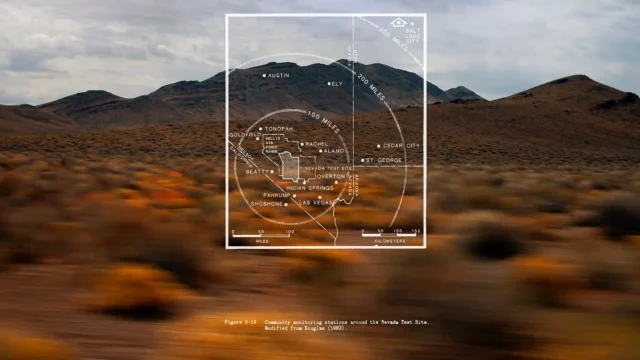
When the US Nuclear Waste Policy Act was passed in 1982, the US Department of Energy (DOE), seemingly almost at random, came up with six potential sites where 70,000 metric tonnes of the highest-level nuclear waste could be buried. This was material that was going to be toxic for thousands of years – so not the stuff any American actually wanted in their backyard.
Casey Carter’s To Use A Mountain (a world premiere in VdR’s International Feature Competition) tells the story of what newscasters called “a competition no-one wants to win” – the one to become the permanent home of the country’s radioactive nuclear waste.
“I learned about this issue when I was in graduate school for architecture actually…I was looking into this issue of nuclear waste and I was learning about Yucca Mountain [in Nevada], which is the final site of the film. If people know about this issue at all, they know about Yucca Mountain but they don’t know about these other places which were also contenders for this facility,” Carter explains.
Carter is a polymath who holds degrees in physics and photography as well as a masters in architecture. He first imagined this project as “a body of photographs because I was making photographs long before I was making films” but soon decided a feature doc was a better choice.
During his research, the director had found the DOE reports on the candidate sites. These had details of the “tiny little towns” where the US government proposed to dump the waste. Carter was “very struck” by the bureaucratic language in the official documents. “They were just completely devoid of any humanity,” he says. “They were just entirely driven by a sense of utility – seeing these places as a means to a solution rather than places with people and history.”
The chilling, soulless documents feature prominently in the film. Carter will show snippets of the text on screen but will then reveal the stories of the people who actually live in the places threatened with having to store the waste.
“I knew the documents were also always going to be the voice of the government, the Department of Energy,” Carter explains.
Like the DOE officials, Carter considers in depth all six candidate sites for the waste dump; from Valerie Dome in Louisiana to the Yucca Mountain in Nevada; from Richton Dome, Mississippi to Davis Canyon, Utah, and from Deaf Smith County, Texas to Hanford, Washington. The difference is that, unlike the government officials, he listens to the locals. “I wanted to draw a contrast between these two different ways of understanding a place, one which is this cold and technocratic way and another which is more humanistic and emotional – and rooted in our sense of identity and history.”
In the film, we hear from people like Tom Bailie, a farmer who grew up outside the Hanford Site. This was established in the early 1940s to produce plutonium as part of the Manhattan Project and has been described as “America’s most contaminated nuclear waste site.” When the farmer was a kid, he remembers he and his classmates were tested all the time by the medical authorities. “We didn’t think nothing of it,” he says. In hindsight, though, it’s obvious the kids were being looked at for symptoms of illnesses caused by the radioactivity.
“That was very shocking for me, to hear him describe the banality and commonplace occurrences associated with these actions on site,” Carter observes.
Then there is the testimony from Ian Zabarte, a political activist and member of the Shoshone Nation of Indians. He highlights how the US government has completely reneged on the original treaty it struck with the Shoshone over the Yucca Mountain and the land in Nevada. In Mississippi, we hear from women who have already suffered issues associated with chemical contamination from a wood processing plant. In Louisiana, a once thriving community is all but destroyed by sulphur and lead poisoning caused by a battery reprocessing plant – and then, to add to their angst, they discover the government is contemplating storing nuclear waste there. (Carter points out that there wasn’t enough space in the documentary to tell this story in full).
“It’s just this [feeling of adding] insult to injury that so many of these rural communities have faced, specifically these that were considered for the terrifying prospect of the nuclear waste disposal,” Carter says of the extraordinarily callous way the US government has treated its own citizens.
The director regards his documentary as both hopeful and desperate. “We have to face the despair of the circumstances that we have created to understand them, It [the film] is a bit of a despairing condemnation of the way in which the United States went about this process in their initial search for this facility [to store the waste].”
Carter adds, though, that he is also very “inspired by the individuals and the landscapes that populate the film.”
What can be done about the nuclear waste? As the New York Times recently reported, the US government still doesn’t have a permanent site to dispose of used nuclear fuel and is now contemplating turning to Finland, “the first country that does.”
Whatever happens to the waste, activists are hoping at the very least for what Carter calls “consent-based dialogue” about its disposal – not simply to have politicians deciding from on high how the problem should be dealt with.
“People feel alienated from their government and the way that their government engages them in the civic process,” Carter sums up one problem of communication that needs to be overcome.
To Use A Mountain has taken Carter several years to complete. He made “the initial trip” to four of the sites featured in the film in the summer of 2018.
“Luckily, from the very beginning, I felt very strongly, after that trip, that there was a very potent film here to create but that it needed time and it needed the effort,” the director explains why the project has taken over six years. “I wanted to build relationships and to return to these places year after year.”
The documentary was produced by Colleen Cassingham and Jonna McKone. It has passed through such events as Hot Docs Dealmaker, IDFA Rough Cut Forum, Sheffield Meetmarket and Visions Du Reel Pitch. Its supporters include The Rogovy Foundation and The Redford Center.





