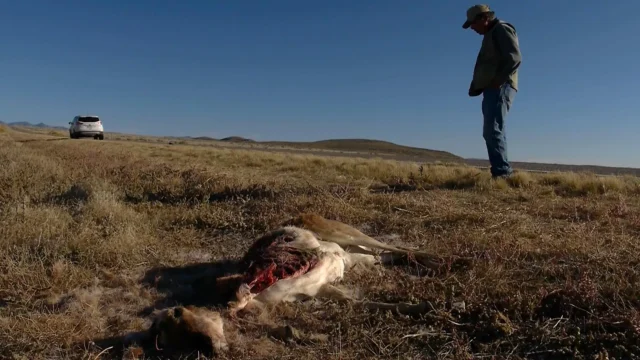
Al Moon is a Vietnam veteran living on Yurok nation tribal land in northern California. He’s a wise and philosophical man but one who has experienced a difficult and violent past with more than its share of guilt, shame and trauma. The salmon the tribe depends on are no longer returning in the same numbers they once did. “The river is sick, the ocean is sick, the fish are sick, the people are sick,” he sums up the problem.
French filmmakers Vivianne Perelmuter and Isabelle Ingold met Al by chance while travelling across the US and he eventually became the subject of their film, New Beginnings (original title Les Recommencements, a world premiere in VdR’s Burning Lights section).
“We had very few clothes and so we had to go to the laundromat. That’s the place where we met Al in a very peculiar way. We didn’t plan anything. He was the one who came to us because someone had told him he would meet people from far away and it would be important for him,” Ingold remembers.
Moon approached the filmmakers, guessing they were European because of their shoes, and he asked them to translate a Spanish song, Take Me Home, Oh Condor. They ended up having dinner. The day after, he brought the directors back to his reservation in the mountains.
For years, Al had been contemplating attending one of the annual reunions of the soldiers he served alongside in Vietnam. He had kept on putting it off. When he finally decided to go, the filmmakers accompanied him, documenting his journey.
There is a very disturbing and intimate revelation late on in the documentary. The fact that Al is prepared to share it with the directors shows the extraordinary level of trust he built up with the French directors during their time on the road.
Perelmuter and Ingold embarked on the film at very short notice. There was no time to pitch it or raise money. Al was about to set off and they were going to go with him. They shared some of the driving. Perelmuter was doing most of the camera work while Ingold did the sound.
“Sometimes we switched when we were tired,” Ingold recalls. “We were doing everything. We did the cooking, the filming. We were downloading the SD cards and we were also talking.”
The directors first met when they were at La Fémis, the prestigious French national film school. As they have shown in their previous work together, for example Elsewhere, Everywhere (2020, about a young Iranian man claiming asylum in England), they have a fluid approach to storytelling. They don’t set up formal interviews but prefer simply to talk. They’ll share their own experiences and encourage dialogue. In this case, they were with Al all the time, sometimes even staying in the same motel room.
Perelmuter speaks of the “closeness and the distance” that making the film gave them to their subject.
“Our first impression when we met him at the laundromat, he was so vivid, so talkative. It was later on, the day after, that we felt there is a little scar in this man…he would like to overcome his anger but sometimes he bursts.”
Al had come back “broken” from Vietnam. His relationship with “white guys” was still sometimes fraught. He was extremely sensitive to insults or to being patronised. He would wear a cap showing that he was a Vietnam veteran. “He told us it’s a way to tell people, hey, I am a small Native American but I have been somewhere. You have to pay respect to me.”
Perelmuter and Ingold treated Al with warmth, sensitivity and tact. He responded by opening up to them in a way that took even himself by surprise.
“We don’t ask questions. When we came back to the US to record the voice-over of the film and we talked again about the long relationship we had had over the years it took to do the film, he told us he had changed,” Ingold observes.
Much of the footage was shot at night. Perelmuter explains this was intended partly as a stylistic choice.
“The movement of the film is very much to go toward the light. We have to start with the darkness…the night is a way to be close to someone, to a place or to people but to manage the mystery – not to invade too much. We try to trigger the imagination.”
The directors describe themselves as “very different.” Perelmuter says that Ingold is “very precise on historical details” while she is more “feeling things and philosophical.” When they edit, Ingold is “very quick” whereas Perelmuter is very slow. “We are very different [but] we need each other,” they conclude.
When they were en route to the reunion of the Vietnam veterans, the filmmakers still weren’t sure that Al really wanted to attend.
“He wanted it but he feared it as well…the journey way deeper than the destination somehow,” Perelmuter notes. “We said to him ‘what will happen will happen. We are with you and we are OK if you don’t go.’ What was important for us, and what touched us, was that it was not a nostalgic thing for Al to meet again the men from his battalion. It was a way to turn the page…we felt that Al was very scared when he entered the hotel.”
There had been racism against Native Americans in Vietnam and Al wasn’t at all sure what response he’d get from his old comrades. By chance, the first person he met in the lobby was a Japanese-American who had been one of his closest friends. Another friend, an African-American, also joined the group. That put him more at his ease as they tried to make sense about some of the terrible events they had witnessed.
The documentary took several years to complete. Eventually, producers Stéphane Jourdain, Hanne Phlypo and Julie Frères came aboard the project. It was made through Clin D’Oeil Films and La Huit Production in co-production with Tempo Films, Shelter Prod, RTBF and CBA.
“It was a long adventure and so our producers Hanne and Stéphane were very important,” the directors acknowledge the “passion” of their collaborators.