

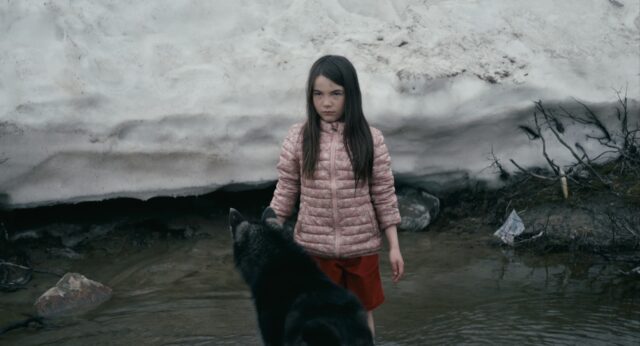
‘Can you swallow a truck? It’s the question kids often ask folks visiting the remote northern village of Kangiqsualujjuaq, situated on Inuit reserved land in Nunavik, Canada, over 900 miles from Montreal.
The question gives them a clue as to how to pronounce the very long name of the village correctly. German filmmaker Marie Zrenner came here to make her film, Spring in Kangiqsualujjuaq, a world premiere in DOK.fest Munich and also the director’s graduation movie from film school).
Zrenner was lured to Kangiqsualujjuaq after winning a scholarship to study in Montreal. While in Canada, she had met Kathy Snowball, a singer from the community. Kathy, who was then studying and performing in Montreal, featured in Brenner’s earlier short doc, Kathy and Theresa, which competed in the German Competition Documentary Film at DOK Leipzig in 2023.
Kathy and Zrenner stayed in touch. When Kathy returned to Kangiqsualujjuaq, she invited the director to join her there. They travelled on a tiny plane seating around ten passengers. “We [the director and her DOP] were going for hours over the tundra. You just see white. We arrived at the beginning of spring. It was still very white and wintry.”
The temperature was still sub-zero but the German filmmakers received a warm reception. The community welcomed them as if they were family members. “The good thing was that we actually arrived together with Kathy. We were a very small team. It was just me and the cameraman, Youssef Nassar.”
The village was remote in the extreme. It could only be reached by air. There were few roads. Bears lurked nearby. Zrenner and Nassar stayed for two months. “The place is really stunning. The nature is incredible. I have never been in a place like that in my life…I was very intrigued by the landscape,” Zrenner recalls.
In the new film, Kathy is again one of the main protagonists. She now faces an important choice in her life, whether she should stay in the village or look for opportunities elsewhere.
Other storylines also soon emerged. “In my work, I am always a bit drifty, following what happens in the shooting,” the director explains why the documentary also focuses on Annah-Sky, a young girl being brought up by a single dad. “He is from Montreal and met the mother of the girl. They decided to move there. She got pregnant. But things happened. They split…” A third protagonist is Ellasie, a slightly older woman.
The community has had to fight for its identity, language and culture in the face of over a century of colonial oppression.
When she arrived in Kangiqsualujjuaq, Zrenner was startled to meet so many children. They are always outdoors, playing with their bikes. Homes are crowded and there is an acute housing shortage – so kids are often found out in the streets even after the sun goes down. They feature prominently in the film – and Zrenner set up workshops to get them involved.
One sequence shows the children racing up and down inside the church. “I found the presence of church and religion very strong there.”
A younger generation is now beginning to question the ardent Christian beliefs of their parents and grandparents. The elders remain devout, even if Christianity was imposed on them as their own traditional beliefs were brutally suppressed. Historically, the community practised shamanism, but the old spiritual practices are largely forgotten.
“Ellasie grew up going to church every Sunday. She told me that for her it’s through spirituality and hunting and fishing that they re-connect [with the past]. She doesn’t know anybody who practises shamanism.”
Zrenner herself came to filmmaking having originally studied sculpture, working with clay and ceramics, and she sees clear parallels between the two arts.
“In sculpture, I was always interested in materials and combining things. But then came this idea that I wanted something moving, and also I am interested in narration,” she explains her move from one form to another. “For me, the whole process of editing is very close to sculpting…I really loved the editing process on this film.” (Her editor, Ulrike Tortora also worked on Kathy and Theresa.)
Spring in Kangiqsualujjuaq was made quickly. When Kathy announced she was going back to her home village, Zrenner decided immediately to accompany her. She found early support from producer Nicole Leykauf’s Leykauf Film. There was also a little money from her film school – University of Television and Film Munich – as well as from FFF Bayern and the airline Canadian North.
“Most of the money went into travel costs, going up there. There were just two of us, the DOP and me, but still the flights are extremely expensive,” the director notes.
Zrenner has recently become a mother herself but when she was in the Inuit village, she was startled that some of the kids asked her if she was a grandma. Parents there have children at an early age – so it isn’t that unusual to find grandparents still in their 40s. “[But] I was 31 at this moment!”
As an outsider, Zrenner didn’t feel it was her position to make grand statements about the social and political situation of the Inuit people. “In Canada, most of the people know about it. Maybe in Europe, it is less [well known]. There is a lot of prejudice. On an emotional level, those things are present in the film.”
The levels of social deprivation are obvious. “In Canada, it is very well known that the depression and suicide rate in those communities is very, very high but, for me, it is always important to keep respect for the person [the subject] and leave them their space and privacy. The film focuses on how the protagonists want to show themselves and not on how [other] people think communities like that look like,” Zrenner says of the respect she was determined to show her hosts.





