

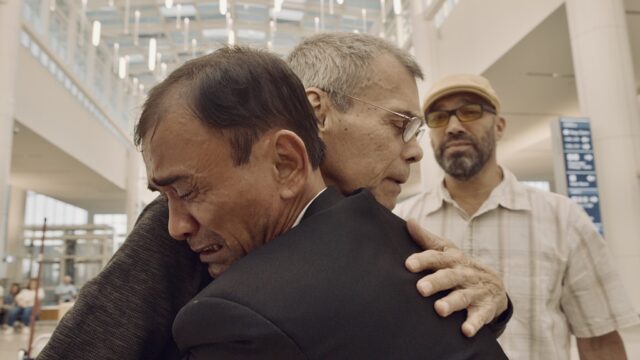
It’s 50 years now since the end of the Vietnam war. A still largely unchronicled aspect of the conflict is the plight of the “Amerasian” children born to Vietnamese mothers but abandoned by their American GI fathers. Sang, the subject of Weronika Mliczewska’s new doc Child of Dust (sold by Rise and Shine and in competition at Krakow FF) is one of these lost souls. The film world-premiered at Thessaloniki Doc Fest.
This is Mliczewska’s feature-length documentary debut as a director and a producer, and took eight years to complete. It came about partly because she had been in Vietnam making a short film about Esports, working with Vietnamese producer Chi-Minh De Leo of Clubhouse Films. (He was also part of Child of Dust from the start.)
Through Brian Hjort, director of the NGO Father Founded, and his friend Hung Phan, the Polish filmmaker had also found out about DNA testing of Amerasians searching for their fathers. She told them that when they had a new DNA match, she would be very keen to hear and potentially to follow the story. “The Amerasians I had met, their emotions were so raw. Their tears showed me that this was not a topic of the past. It’s not about an old war, as some people say. It’s a topic of the present,” she declares.
Many months later, Mliczewska learned about Sang. At that stage, she had no idea where the case might lead. “It is very rare that the [American] father accepts, and it is very rare that the father is alive,” she points out her subject was an unusual case.
The director quickly realised that Sang really was desperate to find his father.
“I felt that this was a very universal topic. Fatherhood in Vietnam is your social status. When something wrong happens to you, your father is your insurance for life…not having a father means that you don’t have social relevance. That’s why, for Sang and for the Amerasians, it is such a big painful issue – they long to be accepted, to be acknowledged as human beings.” (Sometimes, she adds, they feel as if they are treated like animals).
Mliczewska has an intriguing background. She studied at Goldsmith’s, University of London, and at the University of Warsaw, taking courses in anthropology as well as in film.
“I think anthropology allowed me to tell this story from Sang’s perspective…I am not imposing my own cultural discourse [on the subject]. The film is very emotional because I try to look at the world through his eyes, not through my eyes and my cultural background.”
This was a very long gestating project. The director says she and her crew built up their relationship with Sang over a period of several years. He gradually came to trust them fully and the documentary includes some very emotional and intimate moments – filmed in up close and personal fashion.
“At the end of this journey, he didn’t even look at the camera. He didn’t even see the presence of the camera. He just trusted.”
The filmmakers would only shoot scenes that Sang was comfortable with. “We made sure we were not crossing borders but, at the same time, we were like family. When he arrived in the US and saw me, we greeted each other as if we were part of the family. We got really, really close.”
Sang has a very expressive face. You need only to look at him to realise that he has endured more than his share of suffering.
“I have to tell you there was so much sadness in his childhood and this caused so much childhood trauma for him…we decided not to feed off that but to show how strong and courageous he is as a person to face his situation.”
One reason that the director felt such a strong connection with her subject was that she herself has experienced ill treatment from her peers. As a teenager she was badly bullied.
“I was a nerd. I always was the best student. I loved reading books. I was bullied for that and I felt I don’t belong,” she remembers. “The bullying was so strong I was even thinking of suicide but the turning point for me was [realising] it was not them defining me but I can define the life around me because I am strong.” She recognised Sang’s resilience as similar to her own.
The filmmakers weren’t only close to Sang. They established a strong rapport with his American family. “I thought it was incredible that the [American] father took accountability for a son he didn’t know of all his life. For me, this is a great and courageous thing.”
The father and his family were trying to set an example for others. Not that this was straightforward for them. “It’s never perfect and, yes, Sang ended up with not a perfect family. But they are dealing with their own troubles.”
The cultural differences quickly became obvious. “They are very visible and sometimes shocking, but my intention was not to judge anyone because I know how difficult it is for them.”
There is a familiar assumption that immigrants coming to America are in search of a better life. In the case of Sang, though, this was never the case. His motivation was far more with finding his father than with improving his circumstances.
Child Of Dust has backing from The Polish Film Institute. It was produced by Ya Man Studio with ClubHouse Films, Ginestra Film and Lonely Production as co-producers. TVP and Al Jazeera are also aboard.
Mliczewska had her “hands full” on the project. Not only was she the director. She also wrote, produced, did some of the camera work – and she was pregnant during shooting.
Vietnamese-American filmmaker Bao Nguyen, whose own feature The Stringer premiered to acclaim in Sundance in January, was another of the producers. He has been entrusted with bringing the film to Vietnamese-American audiences and the aim is to have Sang’s father present at the North American premiere.
“He will be our best advocate for that because his parents immigrated to the US as well, Mliczewska says of Nguyen. “He is very in synch with this story and knows so many people who started like Sang in the US.”





