

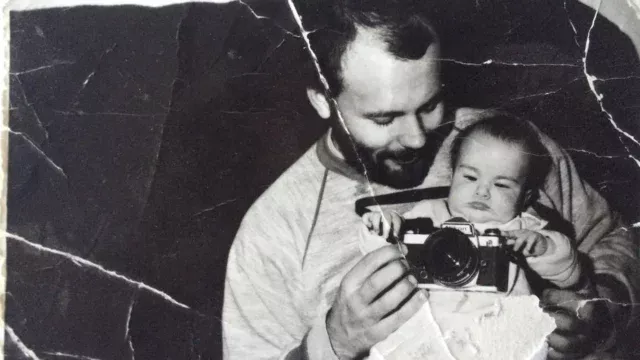
Croatian Dalija Dozet’s father Danko filmed everything, and drove everybody to distraction in the process. He filled over 300 tapes that he never subsequently watched. But his untimely death just after his 55th birthday created a void in his family which could not be filled.
“Though he would turn any family gathering into a chaotic mise-en-scène in front of the camera and endlessly tested our nerves, now that he and his camera [were] gone, we [were] not able to communicate at all,” says Dalija of the loss she felt.
That was until she decided to assess all the footage he shot, tape by tape, hour after hour, day after day. “I wanted to know him more. I wanted to discover him and see who he was. So I just started to watch it,” Dalija tells Business Doc Europe.
The undertaking was a genuine labour of love. The tapes were chaotic, unedited and unlabelled, with a multitude of differing technical aspects, but Dalija nevertheless began to plough through them all. She admits that she may have begun the process too early after his death, just after she herself graduated, but it was nonetheless necessary. “I would sit there and cry or laugh or just like be amused by all of this. So for me, it was cathartic. But then later, I began to put it all into a narrative,” she tells Business Doc Europe. “He left a mosaic that I wish to arrange,” she underlines in the film.
“Since his death I’ve watched thousands of hours of his video archive documenting the daily life of a family [and] not sensing its dissolution,” she further summarises. “These materials go back over 30 years and their content portrays not only the closest family, city, growing up and the current times, but also my own coming of age. Now I see on the footage that he too was coming of life. At 55 he already looked tired and much older than he actually was. But I didn’t see it then.”
That said, the Danko we mostly see on screen is a playful mischief-maker who relentlessly pokes his camera everywhere, annoying everybody. “Dad, stop filming,” is the oft-repeated refrain of his kids. His own father gets even more frustrated with him. “I’m about to lose it,” he tells Dragica, Danko’s mother, at one point. What’s more, it doesn’t matter how mundane the subject, Danko will shoot it. He would even film condensation on a wall.
Dalija likens her dad to “all these influencers” who “shoot everyday life and show you what they ate for breakfast and how their bedroom looks…and we see it on Instagram every 15 seconds all the time!” But the difference is that Danko didn’t want to share it with anybody. “He didn’t have an actual concept, you know, it was just like the filming was enough.”
What was particularly poignant for Dalija during the rediscovery process is that she got to know her dad beforehe was her dad. On screen she watches him wooing her mum, Mirela, the only person who seems able to retain her poise in the frame. And she sees him working his camera when he was a young man, experimenting with the form.
Dalija’s development through childhood is also there to see, as is her coming of age when she receives her first movie camera as a birthday present. And yes, Danko wanted to always demonstrate how it should be used – “hey, let me show you,” we hear him say. But their mutual love is also in evidence, and Danko’s present of a camera marked the start of her own journey along the same road taken by him nearly four decades before.
Danko explained to Dalija aspects of filmmaking, about the “language of film,” she tells BDE, but not his fascination with it. At no point was his camera anything other than “an extension of his hands, tirelessly documenting the world around him… I discovered that it actually was his tool, but also his urge…like a third eye. But he never spoke about it as an artist or somebody who wants to share this passion. It was more like just being present in the space with his camera.”
Throughout the realisation of My Dad’s Lessons, Dalija worked on other short fiction and commercial projects, both for “financial reasons and emotional reasons.” She would take a break of a few months from time to time, “just to rethink it, because I was very attached to it and I couldn’t, you know, see it clearly.”
But the process “matured” her, she says, both as a filmmaker and a person. “I definitely got another chance to rediscover him and to realise that we are all much more layered than we remember each other.”
“I also discovered that the process of making films has to be long as it can be, so you can find, yourself, new perspectives and learn through it. I was actually studying fiction film, not documentary, but I was always very much into hybrid forms and experimental films. So this was also a process of how to put something on a timeline and try to see how it works in the longer minutes.”
She also began to understand better his approach to life and the business of observation. “At some points I was also filming a lot with my phone trying to just, you know, catch up the reality around me, not to share it with anybody. So to be in this frame that helps you to discover the world, I can totally understand this.”
When he was alive, Dalija would get angry with the father she loved, like daughters have done throughout eternity, but the archive she unearthed made her see her him with greater clarity. “I couldn’t understand that it was his obsession. I just thought he’s just like trying to make us all mad. So in a way, seeing the footage…gave new time and new space to make our relationship different – and maybe to [allow] closure with him.”





