

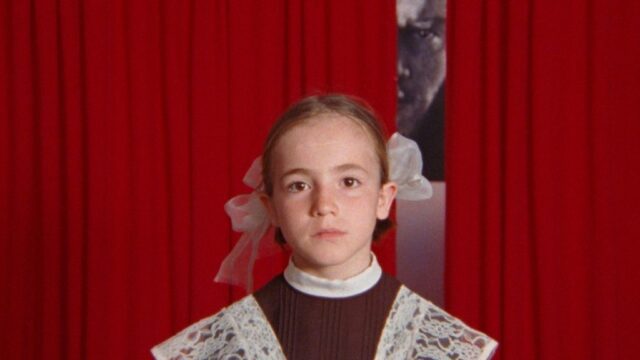
The events of Vladlena Sandu’s past that she depicts in her hybrid documentary Memory (sold by Loco Films and which opened the 22nd edition of the Giornate degli autori in Venice) are frequently horrific and harrowing in the extreme. As a child, after the divorce of her parents, the Crimea-born filmmaker moved to live in Grozny with her mother in the exact period when the Russian Federation was waging war against the Chechen Republic.
President Yeltsin had sent the Russian army to Chechnya in the 1990s, starting off a spiral of bloodshed. The death toll was huge.
Sandu, who has lived in Amsterdam for the past three and a half years, tells Business Doc Europe that one reason she delayed learning to speak English was that, when she was a child, her original English teacher was killed right in front of her.
“I was 14 years old. Every time I tried to learn English afterwards, I had a trigger, going [back] to these bad memories,” she says. “My English is still broken. But it is enough to understand.”
Memory was originally intended to be a found footage, archive-based project, but it now includes poetic evocations of the filmmaker’s early childhood featuring young actors. There are also highly stylised reconstructions of some of the violence Sandu witnessed. For example, we see dolls decapitated, or with their limbs lopped off, or with axes in their heads. We hear her deadpan voice-over describing the most extreme events in a completely matter of fact way.
This is not the first time Sandu has dealt with family trauma. Her 2016 short documentary Holy God also looked back on a period when Grozny was being destroyed, reflecting on the experiences of the filmmaker, her mother and grandmother.
As if living through an apocalyptic war as a child wasn’t enough, Sandu was a victim of sex trafficking during her teenage years. She plans to deal with this grim episode in another film, provisionally titled The Rainbow Cinema and still at an early stage.
“The bad memories, I have a chance to look at them – and I feel myself more calm,” she explains how it helps her to confront the demons from her childhood in her art. Her hope with her filmmaking is to try to break “the circle of violence” that has for so long surrounded her. In particular, she wants to start discussions about children’s rights.
Sandu ends Memory with a montage of images of kids with weapons and kids who’ve life-changing injures because of war.
“If you look at toyshops, you’re going to find a lot of weapons there,” she notes how children can become accustomed at a very early age to playing with guns and thereby normalise violence.
“During my childhood, I didn’t have a real Barbie because I was from a very poor family. I had an artificial doll, a very cheap one, without good hair. I created for this doll a lot of dresses [made] from old stuff,” Sandu reminisces, but she points out that her period of childhood innocence lasted for only a very brief time, before war intervened and surviving became all that mattered.
Sandu met her producer Yanna Buryak, founder of the then Moscow-based production company, Mimesis, at the Kinotavr Festival in 2015, where Sandu’s debut short fiction film Kira, about a runaway girl, received the Jury Prize.
“I thought it was really well-made for a student film, very profound, and I was able to empathise with the character a lot,” producer Buryak remembers. “I felt there was something very special about it. It felt very mature in comparison to other short films in the programmer. We started talking, we clicked, and very soon after, she told me about this dream project she was hoping to make.”
Even with the involvement of Mimesis, Memory remained extremely tough to finance. “It wasn’t easy in Russia to find the money for this kind of film…topics about the Chechen war in Russia are taboo,” the director observes. “The whole world believed that there was liberty and democracy in Russia in the 90s, but it was fake.”
The true history of what went on in Grozny in the 90s isn’t often told – but she was there, and saw the death and bloodshed unleashed by Yeltsin at first hand.
Director and producer “agreed with each other we would make this project happen no matter what!” says Buryak.
After the Russian full-scale invasion of Ukraine, the producer has left Russia “indefinitely.” She has moved to France and was involved in the setting up there of Limitless, the company which became the French co-producer on Memory.
When other avenues closed, early development on the project was financed by Buryak’s father, a Kyiv businessman. “He felt very strongly about holding the Russian government to account for what they were doing. He also wanted to support me and my career,” the producer says.
The filmmakers began to take Memory to different labs, financing and coproduction events. Eventually, the IDFA Bertha Fund provided support. “That motivated other funds to start supporting us but it took many years to reach that moment.” Raymond van der Kaaij’s Revolver Amsterdam soon jumped on board as the Dutch co-producer.
Sandu shot the project in Chechnya and Ukraine in 2021 before the full-scale invasion. Other funding came from Aide Aux Cinémas Du Monde – CNC – Institut Français, Région Île-de-France, Netherlands Film Fund, and Doha Film Institute.
Memory is part of a series of films that Sandu has made about her own and her country’s past. Holy God and another short, No Nation Without Culture (2022), about totalitarianism in Russia and Chechnya under Putin and Kadyrov, mine similar seams.
One recurring motif in Memory is a giant gorilla. The director herself is seen in the gorilla’s costume. “In King Kong, people from America go to this island near Indonesia and try to colonise this territory…for me, this image is about how I felt myself. I was a kid and other people from Russia, they just wanted to colonise my home. And after that, these criminal guys from the Caucasus part, they sold me to Moscow – that’s something quite bad! For me, King Kong is the image of colonialism.”
Following its well-received premiere on the Venice Lido, Memory has already received invitations to several other major festivals.
“Hopefully, the great reviews we received in Venice will be convincing enough to distributors around Europe to support the film,” Buryak says of a documentary which now looks set to become an awards contender too.





