

When Olga Lucovnicova started to develop her documentary feature debut Last Letters From My Grandma, produced by Frederik Nicolai of Belgian outfit While We’re Here, the world seemed to be an altogether less fractured place. Hers was going to be a journey to “another planet.” At least that’s what she thought of Russia when growing up as a small girl in faraway Moldova. It was where her father, Slava, was brought up, and the place she imagined she would one day visit as a cosmonaut.
Russia was also where her grandmother Antonina lived, in the small industrial city of Asha. She was a beautiful woman who could sing like an angel, made beautiful clothes and worked “like a good Soviet” in a metallurgy plant, like everybody else in the city. But she was also a tortured individual who committed suicide (or “ended her life by her free will,” as Lucovnicova prefers to phrase it) at the age of 51, just before the collapse of the Soviet Union and not long before her future grand-daughter (Olga) was born.
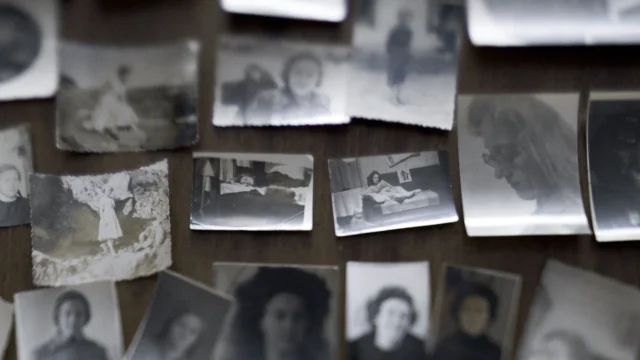
One day, Lucovnicova was given a gift by her father. It was a box of mementoes which included photographs of her grandma, as well as all the letters sent to Slava after he left Russia for Moldova, having completed his military service in 1983. (After serving Mother Russia as a soldier, he wanted to escape to the furthest extremes of the USSR.) The letters from Antonina are loving and lyrical, but they also document her spiralling descent towards despair.
That said, Slava’s recollection of his mother is not at all pleasant. She was very strict with him, and even more so with his younger brother Andrey who remained after Slava’s departure. “My intention was to help him and me and us [the family] together to get rid of this post-Soviet trauma and to start a new page in our life,” Olga says.
So she persuades her dad to return with her to Asha, as she embarks on a quest to understand her grandmother, and in the process unite the disparate elements within her family.
But the more she digs into her family’s past, the more she discovers other such tragedies as befell her grandmother. Her great-grandfather threw himself under a train after returning from the First World War. Her 16-year-old second cousin overdosed on pills a few years back. We also hear that Antonina’s sister Anoushka tried to poison herself with vinegar to escape a violent husband. Is Olga’s a damaged DNA, therefore? Or was it life in Russia that drove her family members towards such desperate acts? “Is it genetic or is it the impact of the bigger history, especially the history of the Soviet Union and Russia in general?” she muses to BDE.
All cosy thoughts of planets and cosmonauts were banished when Russia invaded Ukraine in February 2022. “I knew that the family ties were broken a long time, some years before I was born, and I hoped that with this film, I would reunite the family and then it will be a happy ending,” Olga tells BDE. “But everything changed when the war in Ukraine started. I was completely shocked and devastated. And I didn’t have the happy ending I wanted.”
She even discovers that there is a schism in the Ukrainian branch of the family. Her step-grandfather Nikolay left Ukraine many years before to marry grandma Antonina, and to live with her in Asha. The family he left behind are now divided over where their loyalties lie. Nephew Zhenya is fighting for the Russians, while his sister is an ardent Ukraine nationalist. Zhenya would prefer not to meet his sister’s son on the battlefield, he says, but nevertheless tells Nikolay via video call that, “once every century a Russian man must stand up and make his mark.”
The scene, observed by a pained Slava, was not staged for effect, Olga underlines to BDE. “I had no idea that there was a soldier [in the family] fighting on the side of Russia. The idea of the call was only that Nikolay could finally reunite with his family in Ukraine, with whom he lost connection since 2014.”
For Olga, visiting the industrial city of Asha was “striking” as she was immediately reminded of Fritz Lang’s Metropolis, which she had seen as a student in the Academy of Arts in Moldova. “This metallurgic plant is in the city centre, and the city is built around this metallurgical plant. And in this place worked several generations from my family, including my grandmother, including my step-grandfather, including my great-grandmother and my father, of course. And now, there works my uncle and my cousin.”
Three times a day the siren still sounds across the city. “I was telling my father that it’s crazy, because it’s controlling you, it’s like a giant clock in the city. This metallurgical plant has controlled the rhythm of life of all the people since they were born,” Olga tells BDE.
Her father sees it differently, however, illustrating a generational shift in outlook. “He says, no, it’s actually the sound of life. Because if you hear this sound, this means people have work. This means that the city is alive.”
Then again, her father has a predisposition towards contrariness, Olga points out. “It’s probably the last personal film I’m ever going to make. Because this process was extremely difficult, especially because I was working with my father,” she says. “He is my best friend in general, but at the same time, he’s very aware of the filmmaking process. And every time I was asking him a question, he was perceiving it as, ‘you asked me because you want me to answer this, but I will not answer what you want to hear.’”
For Olga, this was a journey she had to undertake. “I needed to go there to find out all the family secrets, to better understand myself and this part of my roots and my family history,” she says. “And now I can say that I needed this journey and it helped me to get over certain fears from deep inside me.”
What’s more, she feels an even closer kinship to the grandmother she never met. “She was really like a ghost all the time following me, and also visually because we resemble one another,” Olga observes. “But now after I did the film, I understood how different were the circumstances in which we lived. I think I got free from her life story, but also it helped me to understand why she was as she was, and [why she felt] imprisoned.”
As well as working as a filmmaker, Olga is studying for a PHD in Leuven, working on a paper titled ‘Filming Memory/Filming My Family. Intergenerational; trauma and prosthetic memory of WWII in post-Soviet society.’
“In this research, I’m trying to investigate how cinema and media influenced and created certain memories in post-Soviet territories, especially in relation to the Second World War, and I’m trying to challenge these memories through this film,” she tells BDE. “My idea is that in the Soviet Union, cinema was censored and controlled by the state, but now we have the possibilities of making first-person cinema, author-driven films in which we can challenge these state-generated historical narratives through personal stories.”
“Hopefully after doing this film, which was a kind of therapy for me, I got rid of this transgenerational trauma, so my daughter (who is just 6 months) can live without them and not inherit them from me.”
And what about Slava, her dad? How does he respond to the film? “Well, he’s a very not standard person. He’s not usual,” she returns to the paternal theme. “What you expect him to do and think, it’s, it’s all the time the opposite. I was really afraid of showing him the film and he was afraid of watching it himself. But I showed him the first rough cut and was all the time very, very gentle watching the film. But in the end, he said, ‘No, I think there is not enough drama. It’s too light.”
After telling a heart-rending story of family trauma and conflict, it was not the response she was expecting. “So I didn’t show him yet the final version,” she resolves. “We’ll watch it together soon on the big screen at its [future] world premiere.”





